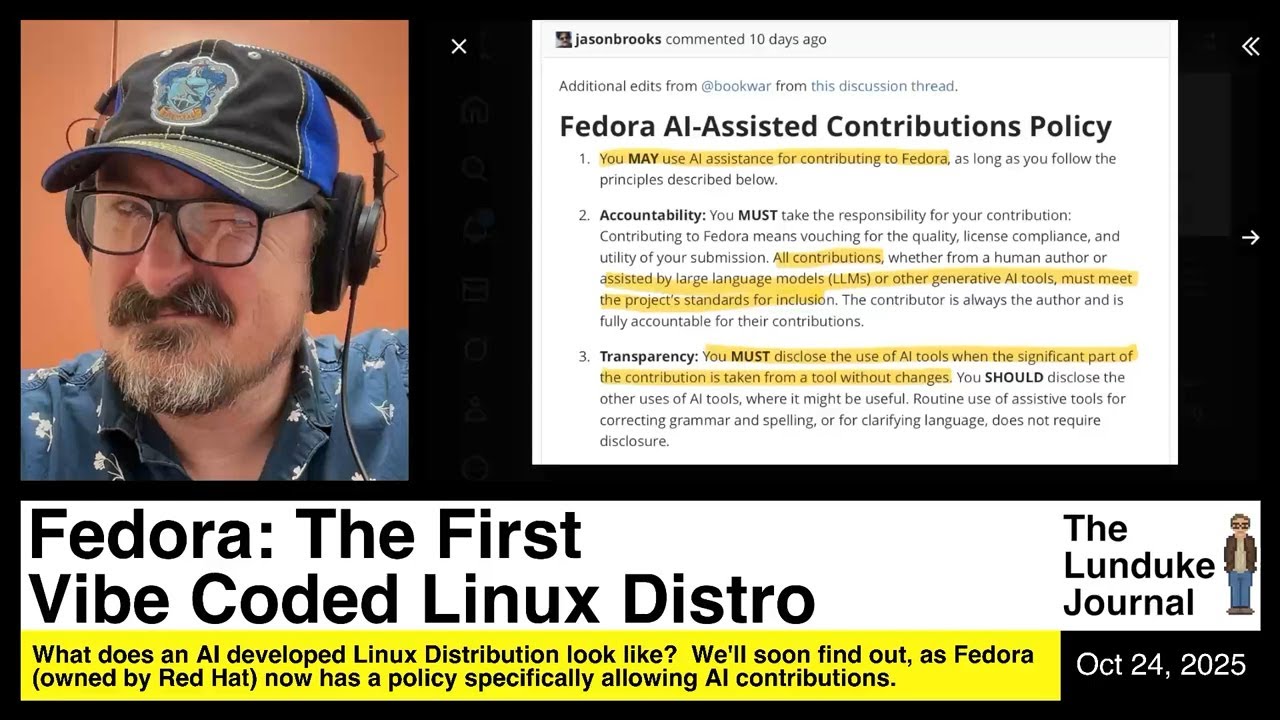
The Fedora Linux project has officially approved a new AI-assisted contributions policy, allowing developers, contributors, testers, and others to use AI tools for contributing to Fedora Linux and related projects. This policy explicitly permits AI-generated content such as code patches, bug reports, documentation, and artwork, provided that the submitter takes personal responsibility and is transparent about the AI assistance used. This move essentially makes Fedora the first Linux distribution to openly embrace what the video terms “AI vibe coding,” signaling a significant shift in how open-source contributions might be handled going forward.
Fedora is closely tied to Red Hat, which is owned by IBM, and the leadership of the Fedora project is composed mainly of Red Hat employees. This corporate connection is important because Red Hat has recently mandated that its employees not only use AI in their daily work but also promote it actively. Their bonuses and pay incentives are directly linked to how well they implement and evangelize AI technologies. Consequently, Red Hat employees working on Fedora are financially motivated to ensure that AI-generated contributions are accepted and integrated into Fedora Linux, making this policy change somewhat inevitable.
Red Hat’s commitment to AI is part of a broader corporate strategy, as highlighted by statements from Red Hat’s CEO and leadership. For example, after acquiring the AI company Neural Magic, Red Hat emphasized that “AI needs to be scalable, trainable, and everywhere,” underscoring their vision of AI integration across all platforms. Fedora’s project leader has also outlined goals to make Fedora a dominant player in the AI field, focusing on server-side AI capabilities and embedding AI features deeply into the Fedora ecosystem. This strategic direction aligns Fedora closely with IBM’s AI systems and ambitions.
The adoption of AI-assisted contributions by Fedora raises questions about how other major open-source projects, such as the Linux kernel and GNOME, will respond. Many of these projects have strong ties to Red Hat, with key contributors often being Red Hat employees. There is already discussion about making projects like GNOME more AI-friendly, suggesting that similar AI acceptance policies could spread across the broader open-source community. This could lead to a significant transformation in how open-source software is developed, reviewed, and maintained, with AI playing a central role.
In summary, Fedora’s new AI-assisted contributions policy marks a pioneering step in integrating AI into open-source development. Driven by Red Hat’s corporate strategy and financial incentives, Fedora is positioning itself as a leader in AI-enabled Linux distributions. This change is likely to influence other projects within the open-source ecosystem, especially those with strong Red Hat involvement. As Fedora embraces AI-generated contributions, the community and industry will be watching closely to see how this “vibe coded” Linux distribution evolves in the coming releases.