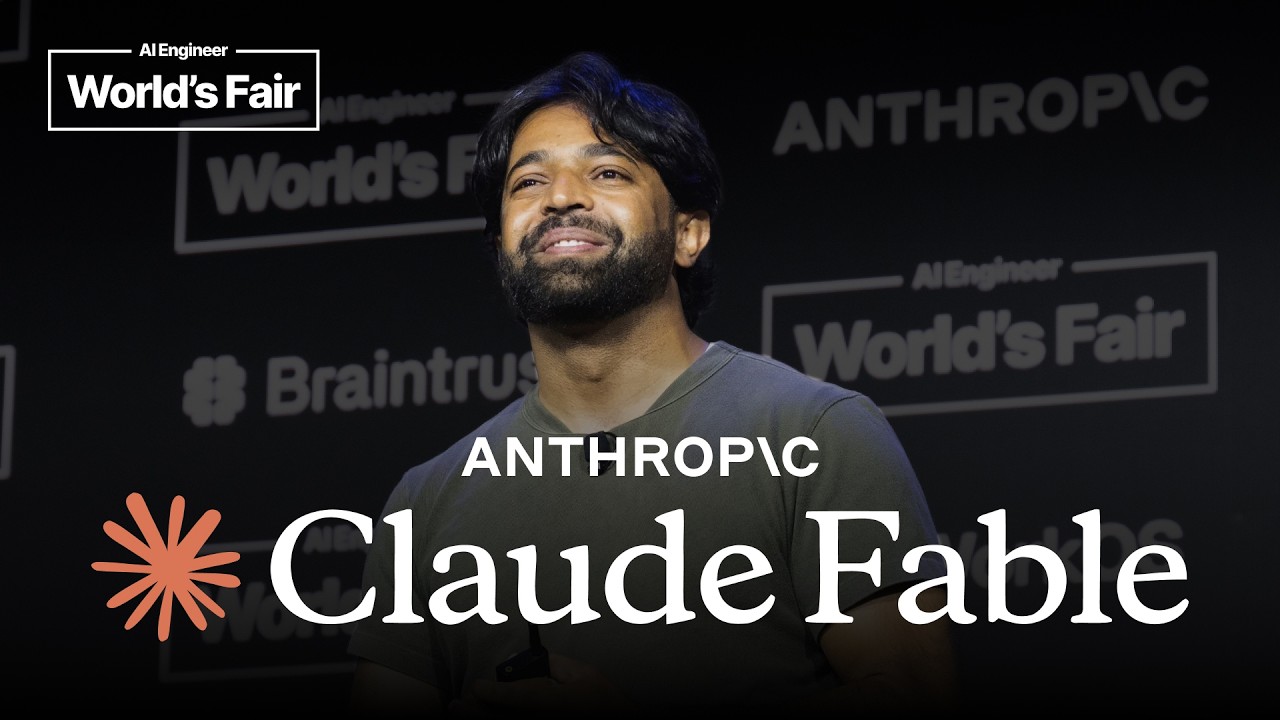
In his talk, Thariq Shihipar from Anthropic introduces Fable, a new and exciting model in the Anthropic lineup, likening its release to entering an open-world RPG after completing the tutorial. He emphasizes that Fable represents a significant step forward, offering vast new capabilities but also presenting challenges due to its complexity and the breadth of what it can do. Thariq outlines his approach to working with Fable through four key themes: unhobbling Claude (the underlying model), identifying unknowns, managing difficulties, and embracing an unreasonable mindset to unlock the model’s full potential.
Thariq explains that models like Claude are “grown, not designed,” meaning their capabilities evolve organically through data, feedback, and compute rather than being explicitly engineered for specific benchmarks. He highlights the concept of “capability overhang,” where the model can perform smarter, more complex tasks when given the right tools, such as code execution, rather than relying solely on memorized knowledge. For example, Claude Code can dynamically generate scripts to answer questions that simpler chat models cannot, demonstrating how the model’s intelligence can spike with the right prompts and tools.
A significant part of working effectively with Fable involves understanding and managing unknowns—the gaps between the “map” (the user’s plan or prompt) and the “territory” (the real-world context and constraints). Thariq categorizes unknowns into known knowns, known unknowns, unknown knowns, and unknown unknowns, and shares practical strategies for uncovering these through blind spot analysis, brainstorming, interviews, references, and implementation notes. These techniques help users stay in the loop with Fable’s reasoning and ensure alignment between human intent and model output.
Thariq also reflects on the emotional and practical impact of using advanced AI models like Fable. While the model dramatically accelerates tasks that once took weeks, enabling rapid prototyping and iteration, it also evokes a sense of loss for the traditional, hands-on coding experience. Despite this, he encourages embracing the change and learning to collaborate with AI, viewing it as a new frontier that requires patience and adaptation but promises substantial productivity gains and creative possibilities.
Finally, Thariq advocates for a mindset shift towards being “unreasonable” in the best sense—rejecting traditional tradeoffs and limitations in favor of ambitious, all-in approaches to problem-solving. He stresses that AI’s promise lies not just in making building easier but in generating real value, which requires experimentation and persistence. His closing message is a call to action for AI engineers to explore boldly, prove AI’s transformative potential, and balance productivity with meaningful human connection.