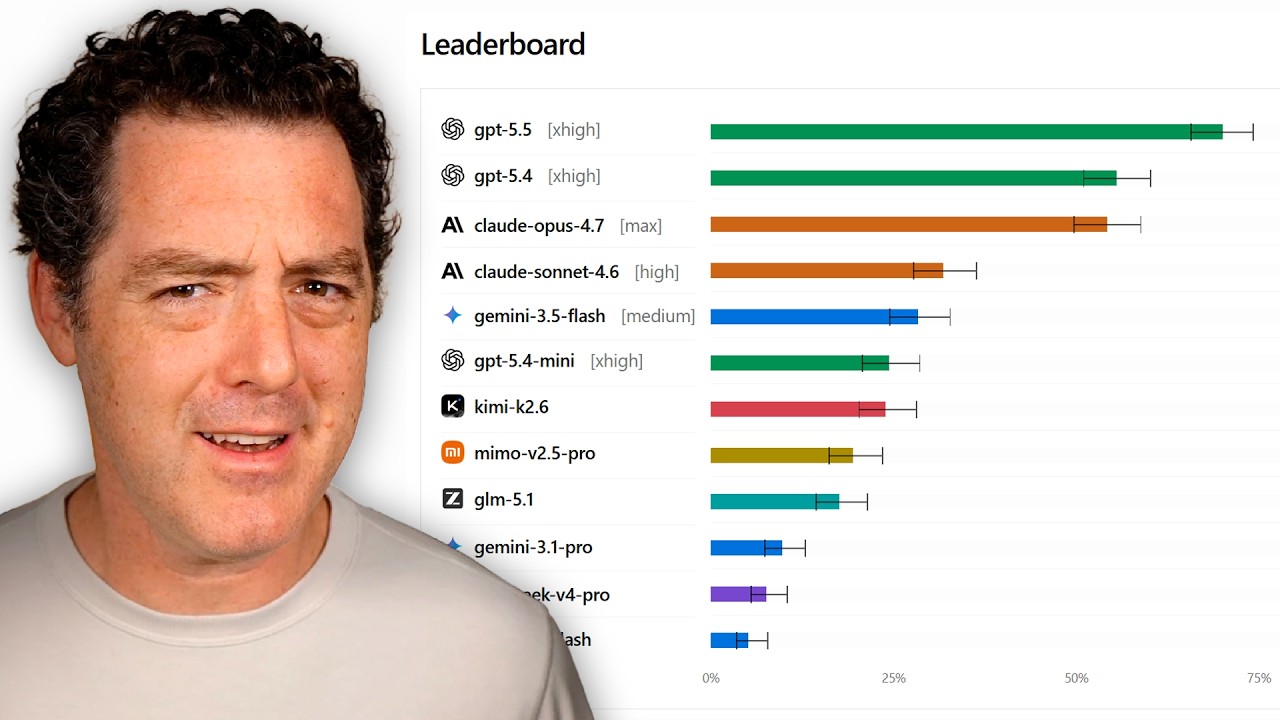
The video discusses DeepSWE, a new software engineering benchmark developed by data curve.ai, which aims to provide a more accurate and realistic measure of AI coding model performance compared to existing benchmarks. Unlike many current benchmarks that often reuse public GitHub commits or issues—potentially contaminating results by models having seen the solutions during training—DeepSWE uses contamination-free tasks written from scratch. It covers a broad range of 91 repositories across five programming languages, including TypeScript, Go, Python, JavaScript, and Rust, ensuring high diversity and real-world complexity. The prompts are shorter than those in previous benchmarks, but the required solutions are significantly more complex, better reflecting how developers actually interact with coding agents.
One of DeepSWE’s key innovations is its reliable verification system, which drastically reduces false positives and false negatives compared to benchmarks like SWEbench Pro. SWEbench Pro’s verifier misgrades outputs at rates of 8.5% false positives and 24% false negatives, whereas DeepSWE achieves just 0.3% and 1.1%, respectively. This means DeepSWE’s evaluation more accurately reflects whether a model’s solution truly works, regardless of the specific implementation approach. The benchmark also aligns prompts with natural developer communication, focusing on behavior rather than overly prescriptive instructions, requiring models to explore and discover solutions end-to-end, which mirrors real-world usage.
The leaderboard results from DeepSWE show a clear performance gap between models, with GPT 5.5 Extra High leading by a substantial margin over Opus 4.7 and other competitors. This contrasts with other benchmarks where scores tend to cluster closely together. GPT 5.5 not only achieves the highest pass rates but also does so with fewer output tokens and lower cost per trial, making it both more efficient and effective. In contrast, Opus 4.7 is more expensive, slower, and requires more tokens to solve problems, despite being a strong model in its own right. Other models like Gemini 3.5 Flash and Claude variants lag behind in both performance and cost-efficiency.
Behavioral insights from DeepSWE reveal differences in how models handle multi-part prompts and repository states. Claude models tend to forget parts of multi-behavior prompts and sometimes fail to mirror changes across branches, while Opus 4.7 shows strong attentiveness to repository context by exploring git history to recover solutions. GPT 5.5 stands out for its precision in following prompt instructions and producing patches that honor all stated behaviors. Additionally, stronger models tend to self-verify their work by writing their own tests unless explicitly discouraged, a behavior that DeepSWE encourages but SWEbench Pro does not.
Overall, DeepSWE is praised for its realistic and rigorous approach to benchmarking AI coding models, aligning well with the experiences shared by developers on coding-focused social media. It provides a clearer differentiation between models and better reflects real-world coding challenges. While the video host notes that personal experiences with models may vary, the consensus in the AI community supports GPT 5.5 as the current leader. The video also briefly mentions a missing model, Composer 2.5, which reportedly offers excellent price-to-performance but is not included in DeepSWE’s current evaluations.