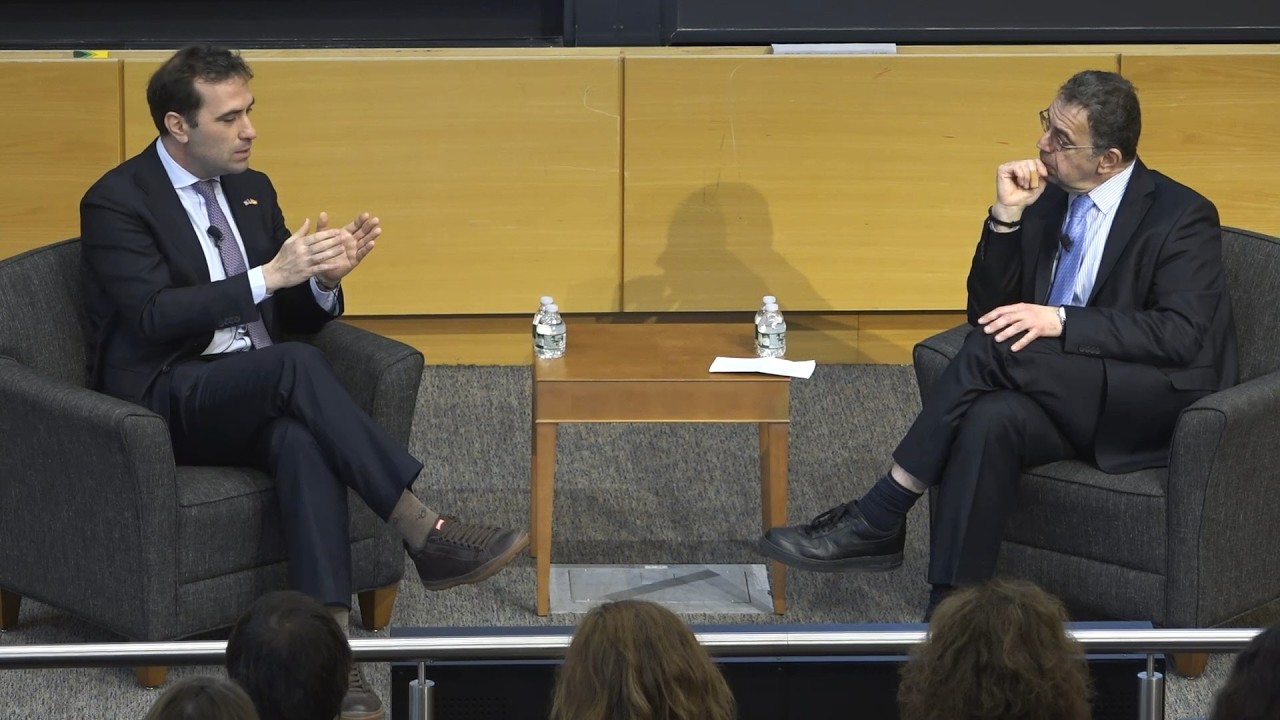
The fireside chat at MIT featured Spain’s Deputy Prime Minister Carlos Cuerpo in conversation with Professor Daron Acemoglu, focusing on Spain’s economic resilience amid global challenges such as the wars in the Middle East and Ukraine. Cuerpo highlighted Spain’s robust economic growth, noting it as the fastest-growing major advanced economy in 2024 and 2025, with strong job creation and improved fiscal health, including a primary surplus and reduced debt levels. He emphasized Spain’s strategic investment in renewable energy, which has significantly reduced dependence on gas for electricity pricing, enhancing economic resilience against energy shocks.
Unemployment remains a concern, with Spain’s rate at 9.9%, which, while high by some standards, reflects structural improvements compared to past periods marked by imbalances like housing bubbles and current account deficits. Cuerpo pointed to labor market reforms and investments that have driven job creation in higher-value sectors, contributing to sustainable growth. The discussion then shifted to Europe’s broader policy challenges, including the need for deeper capital markets, increased investment in strategic sectors, and improved governance mechanisms to overcome fragmentation among member states.
A key issue raised was the absence of a truly safe European asset akin to U.S. Treasury bonds, which limits Europe’s financial integration and efficiency. Cuerpo advocated for expanding joint European debt issuance to create a deeper, more liquid market that could lower financing costs for countries and firms alike. Both speakers agreed on the importance of strengthening European institutions and enhancing local governance to balance democratic participation with effective policy coordination, especially in areas like defense, energy, and digital transformation.
The conversation also addressed Europe’s lag in technological innovation, particularly in AI, compared to the U.S. and China. Cuerpo stressed the importance of building European data infrastructure, such as data centers and cloud sovereignty, to support AI development while maintaining economic security. He highlighted Spain’s openness to AI-related investments and the potential for AI to complement human intelligence, boosting productivity. Both agreed that Europe must avoid relying solely on regulation as a competitive strategy and instead foster innovation ecosystems that leverage existing industrial strengths.
In the Q&A session, Cuerpo discussed concerns about external shocks, the need to sustain structural reforms to maintain growth, and the importance of addressing inequality and demographic challenges through integration and opportunity creation. On political leadership, he emphasized public service as a key motivator for technically skilled individuals to enter politics. He also described a new $200 million Spain-Massachusetts biotech venture capital fund aimed at strengthening transatlantic collaboration. Finally, on economic security, Cuerpo acknowledged Europe’s need to reduce dependency on American tech firms while maintaining open partnerships, aiming to build competitive European industries in technology, finance, and energy.