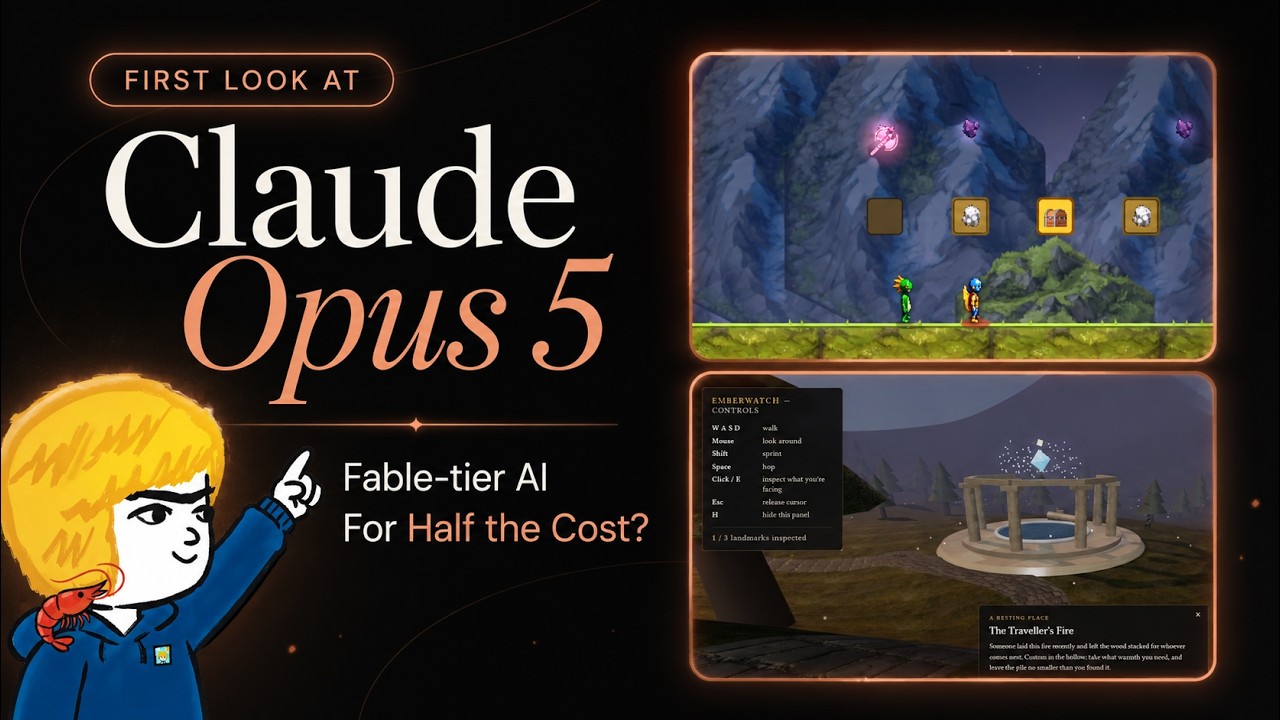
Anthropic recently released Claude Opus 5, completing their Opus model lineup alongside Sonnet and Fable 5. Opus 5 is positioned as being as capable as Fable 5 in most tasks but with fewer guardrails, addressing a common frustration with Fable’s restrictive safety measures, especially during coding tasks. Importantly, Opus 5 is offered at roughly half the price of Fable 5, making it a more cost-effective option without compromising much on performance. The video creator tested Opus 5 by giving it the same game development task previously assigned to Fable 5, where it successfully transformed old game assets into a polished side-scrolling game, demonstrating impressive creativity and execution.
Benchmark comparisons show that Opus 5 performs very well, often slightly outperforming Fable 5 and significantly beating earlier models like Opus 4.8. It excels particularly in coding benchmarks, debugging, and root cause analysis, with a strong emphasis on self-verification and iterative improvement. Anthropic highlights Opus 5’s thoughtful and proactive nature, including its ability to build and use tools creatively, which enhances its problem-solving capabilities. The model also supports mid-conversation tool changes without invalidating prompt caches, contributing to cost and latency efficiencies during extended agent runs.
One notable improvement in Opus 5 is its reduced guardrails, with about 85% fewer interventions than Fable 5, allowing for more flexibility while maintaining strong alignment with Anthropic’s constitutional principles. Although it remains cautious in sensitive areas like vulnerability exploitation, Opus 5 strikes a balance between safety and usability. The pricing model aligns with Opus 4.8’s standard input-output rates, making it a more affordable alternative to Fable 5 while delivering comparable or better performance, which has been positively received by the AI community.
Further testing involved auditing a custom benchmark called Tobi Bench, where Opus 5 identified several critical and medium-level bugs and flaws, demonstrating strong debugging capabilities. When its audit was reviewed by another model, GBT 5.6 Sol, most of Opus 5’s findings were validated, confirming its reliability in code analysis and error detection. This interaction also highlighted Opus 5’s tendency to use assertive language, though its technical assessments were largely accurate, reinforcing its utility for complex coding and benchmarking tasks.
Finally, Opus 5 was tested on a 3D world creation task using three.js, where it produced a richly detailed and immersive fantasy environment that surpassed previous attempts by other models, including Opus 4.8 and Kim K3. The model demonstrated advanced capabilities in generating natural landscapes, lighting effects, and interactive elements, showcasing its versatility beyond coding into creative and graphical domains. Overall, the video concludes that Claude Opus 5 is a highly capable, cost-effective, and more user-friendly AI model, likely to become a preferred choice for many users who found Fable’s guardrails too restrictive.