The video showcases DeepSeek V4.1 Flash, an open-weights, multimodal AI model with innovative architecture that reduces memory and serving costs while delivering competitive performance in agent tasks like 3D game creation and interactive web design. Although it lags behind top closed-source models in expert benchmarks, its cost-efficiency and creative capabilities make it a promising tool for developers and the AI community.
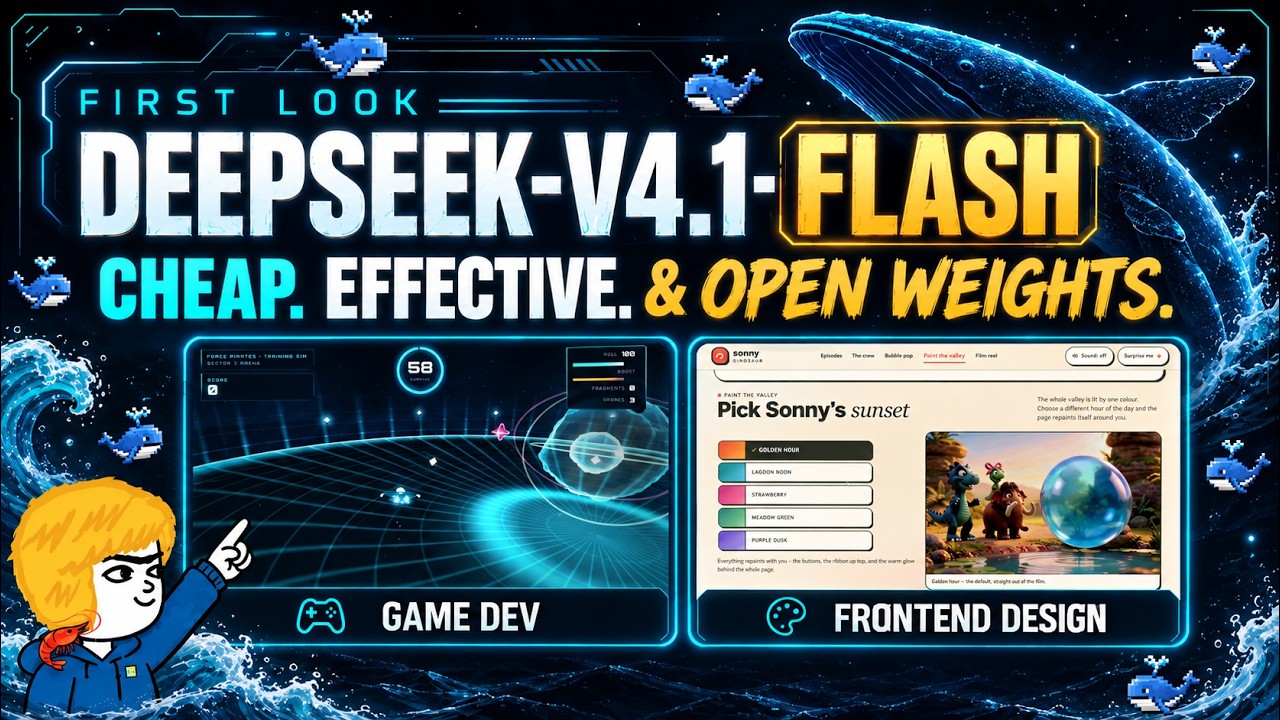
The video presents a first look at the newly released DeepSeek V4.1 Flash model, an open-weights, multimodal AI model with 5.5 billion parameters designed for agent tasks. The creator demonstrates the model’s capabilities by having it generate a 3D mini-game featuring a firefighter jet collecting energy fragments while avoiding drones. Compared to previous models, DeepSeek V4.1 Flash produces a more visually appealing and genuinely 3D experience. The model is notable for its innovative architecture focused on shrinking the KV cache, which reduces memory and bandwidth costs, making it cheaper and more efficient to serve.
DeepSeek V4.1 Flash employs a novel causal encoder-decoder design that activates fewer parameters during prefill and decode stages, significantly lowering resource consumption. The model boasts a 1 million token context window and achieves a much smaller global KV cache size compared to earlier versions, which translates to reduced serving costs. Benchmark tests show that while DeepSeek V4.1 Flash outperforms previous DeepSeek versions and rivals some frontier models in many tasks, it still lags behind leading closed-source models like GPT-5.6 and Opus 5 in expert reasoning and coding benchmarks.
The video creator runs several comparative tests using familiar prompts previously given to models like Astra, Fable, and Opus 5. In a Sonic-style game creation task, DeepSeek V4.1 Flash reused many original game assets effectively, producing a playable but somewhat less polished game compared to Astra and Fable. In a 3.js cinematic recreation of the first paragraph of Lord of the Rings, the model generated a colorful and populated scene, though it was slower and less refined than Opus 5 but an improvement over earlier DeepSeek versions. The total cost for these tasks was impressively low, around $2.15.
Another test involved creating a playful, interactive landing page for a dinosaur video series using multimodal inputs like images and videos. DeepSeek V4.1 Flash successfully incorporated multiple interactive elements and a video scrolling effect, outperforming Astra but not quite matching Fable’s polish and creativity. Although some features like video playback on scroll did not function perfectly, the model followed instructions better than Astra and demonstrated solid multimodal understanding and creative design capabilities.
Overall, DeepSeek V4.1 Flash is a promising open-weights model that balances cost-efficiency with competitive performance in many agent-related tasks. While it is slower and less capable on expert-level benchmarks compared to top closed models, its innovative architecture and reduced serving costs make it an attractive option for developers. The creator expresses interest in exploring the model’s architecture further and invites viewers to share their experiences, highlighting the model’s potential for future improvements and broader adoption in the AI community.
Useful Links