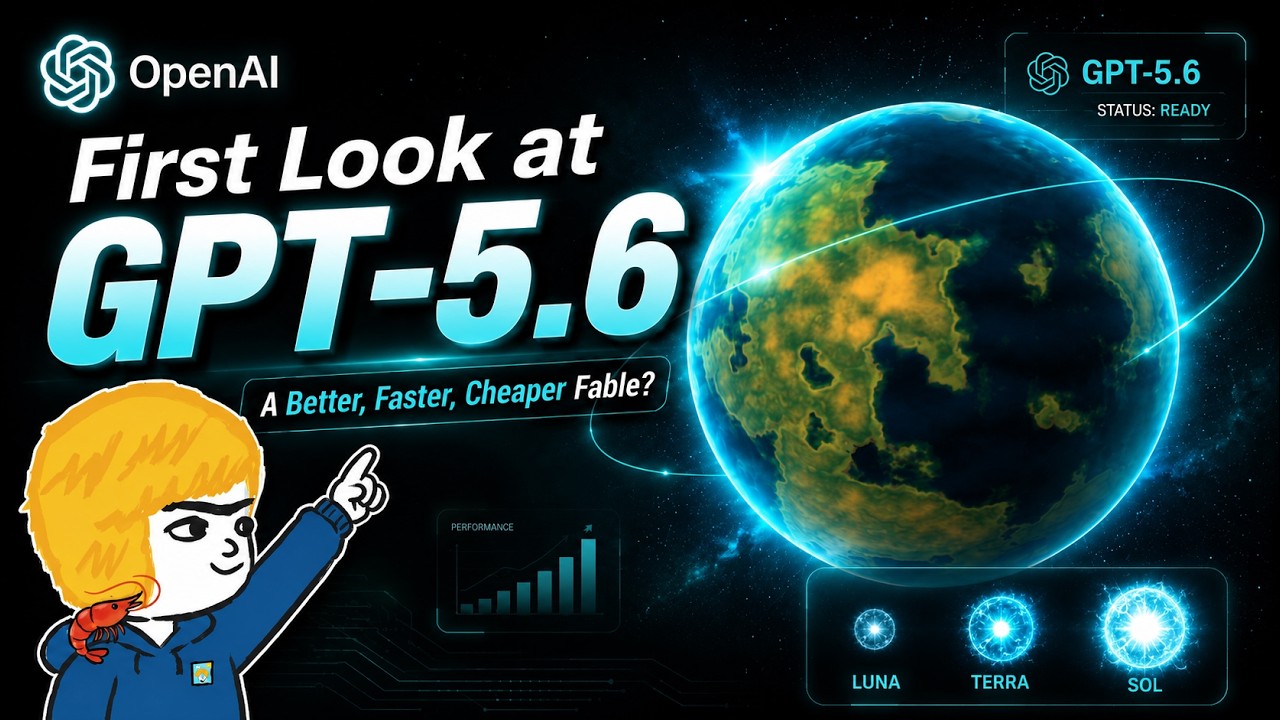
OpenAI recently announced GPT-5.6, the latest iteration of their GPT models, which has been in preview with select partners and is now more widely accessible. GPT-5.6 is offered in three variants: Sol, the flagship model; Terra, a balanced model for everyday tasks; and Luna, a cost-efficient option. The flagship Sol model is the primary focus due to its advanced capabilities. The model is designed to be smarter and more efficient, delivering more useful work per token, dollar, and minute. It also introduces new workflows such as Max and Ultra modes, which allow for longer reasoning chains and parallel task coordination, respectively.
One of the standout features of GPT-5.6 is its improved programmatic tool calling, enabling it to write and run lightweight programs in memory to manage tools, filter results, and track progress. This reduces the need for multiple model interactions and prompt tokens, especially in tool-heavy tasks. The model also excels in generating stronger interfaces and presentations, as demonstrated by the creator’s use of GPT-5.6 to produce a visually appealing slideshow. Benchmark results show GPT-5.6 performs competitively with other leading models like Fable, particularly in coding and cybersecurity tasks, while being faster and more cost-effective.
In practical testing, GPT-5.6 was tasked with creating a complex HTML game interface involving 3D graphics and animations. The output was visually impressive, with unique stylistic elements and smooth functionality, outperforming or matching previous models like Fable, Grock, and Opus in style and detail. The only minor issue was a slight imperfection in the staggered headline animation, but overall, the model showed a significant improvement in front-end coding and presentation quality. The increased context window in Hermes Agent also enhanced its ability to handle long-horizon coding tasks.
Further testing involved auditing a complex AI supply chain project’s codebase for bugs using GPT-5.6’s Ultra mode. The model identified multiple high-severity bugs and provided a concise, clear report. When these findings were cross-verified by Fable, it confirmed most of the issues, including some critical bugs that Fable had missed or even introduced in its own code. This demonstrated GPT-5.6’s strong auditing capabilities and highlighted the importance of using multiple models for code review to catch errors that might otherwise go unnoticed.
Overall, GPT-5.6 represents a significant advancement in AI model capabilities, particularly for agent-driven workflows, coding, and cybersecurity. Its efficiency, speed, and improved reasoning make it a promising tool for developers and researchers. The creator plans to adopt GPT-5.6 as the main driver in their Hermes Agent projects and looks forward to exploring its potential further. The video concludes with an invitation for viewers to share their experiences with GPT-5.6 and stay tuned for more updates.