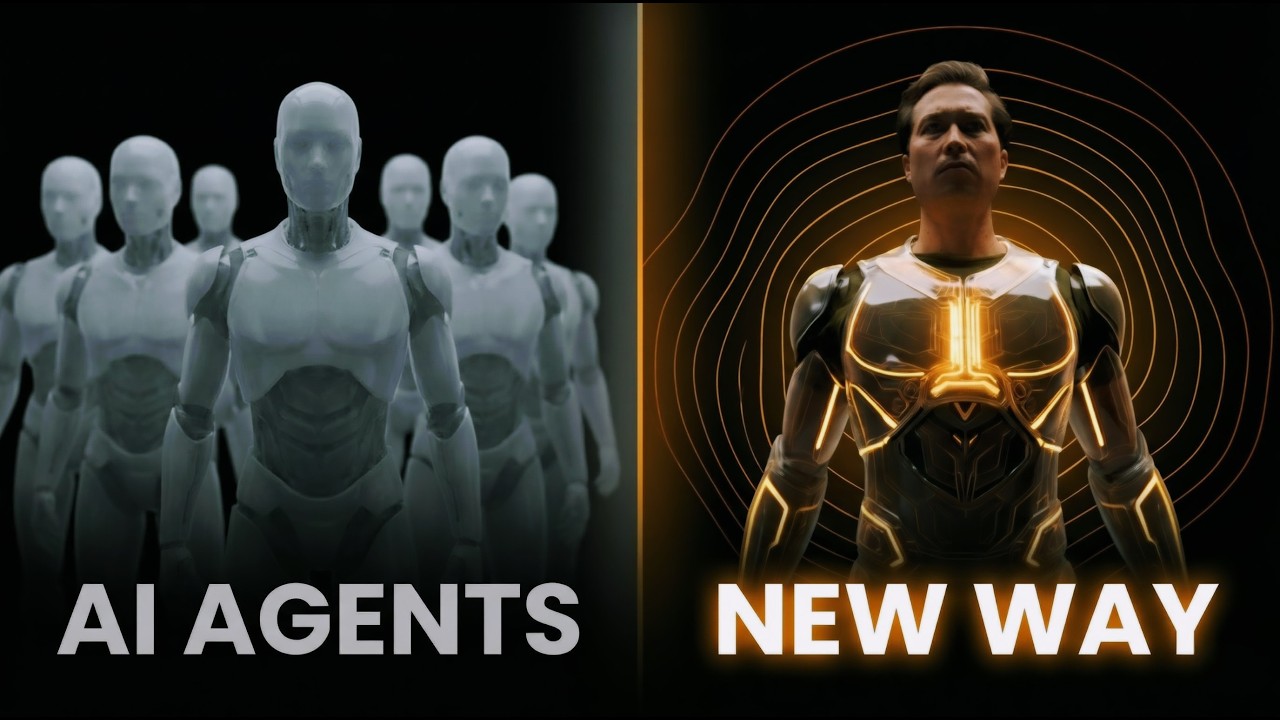
In early 2023, after six years and teaching 6,000 students, the speaker stopped teaching the course “Building a Second Brain,” feeling a deep personal and professional shift. This pause led to a profound question: what does it truly mean to extend the human mind with technology now that AI can perform most knowledge work? The speaker identifies two contrasting visions of AI’s role: one where AI acts as a replacement, autonomously doing work for humans, and another where AI serves as a cognitive exoskeleton, amplifying human capabilities without replacing the person.
The speaker argues that the current hype around autonomous AI agents is misplaced. Despite significant investment and enthusiasm, these agents are difficult to build, unreliable, and require constant maintenance. Instead, the speaker advocates for the exoskeleton metaphor, where AI enhances human effort rather than substituting it. This approach aligns with the speaker’s long-term vision of AI as a tool that protects memory and boosts creativity, making users more powerful and capable rather than obsolete.
A key insight from recent research at Harvard Business School supports this exoskeleton view. The study showed that individuals working with AI outperformed two-person teams without AI, not only in productivity and quality but also in emotional experience. Those using AI reported higher excitement, energy, and enthusiasm, along with lower anxiety and frustration. This suggests that AI amplification leads to better work and greater enjoyment, challenging the notion that AI simply offloads tasks.
The speaker also emphasizes the enduring value of personal knowledge management (PKM) and note-taking. Despite AI’s ability to generate content on demand, having a well-organized personal knowledge base remains crucial. PKM acts as a foundation that allows AI to produce unique, personalized insights rather than generic responses. This preparation is likened to making deposits in a knowledge bank, enabling compound growth in understanding and creativity.
Finally, the speaker challenges the prevailing sense of urgency around AI adoption, arguing that there is still ample time to learn and integrate AI thoughtfully. With a large portion of the global population yet to adopt generative AI, rushing out of fear risks poor decisions and stunted learning. To support this measured approach, the speaker announces the launch of the AI Second Brain cohort, a three-week live program designed to help participants build a personalized AI-powered system that truly extends their mind, marking a genuine shift rather than a fleeting trend.