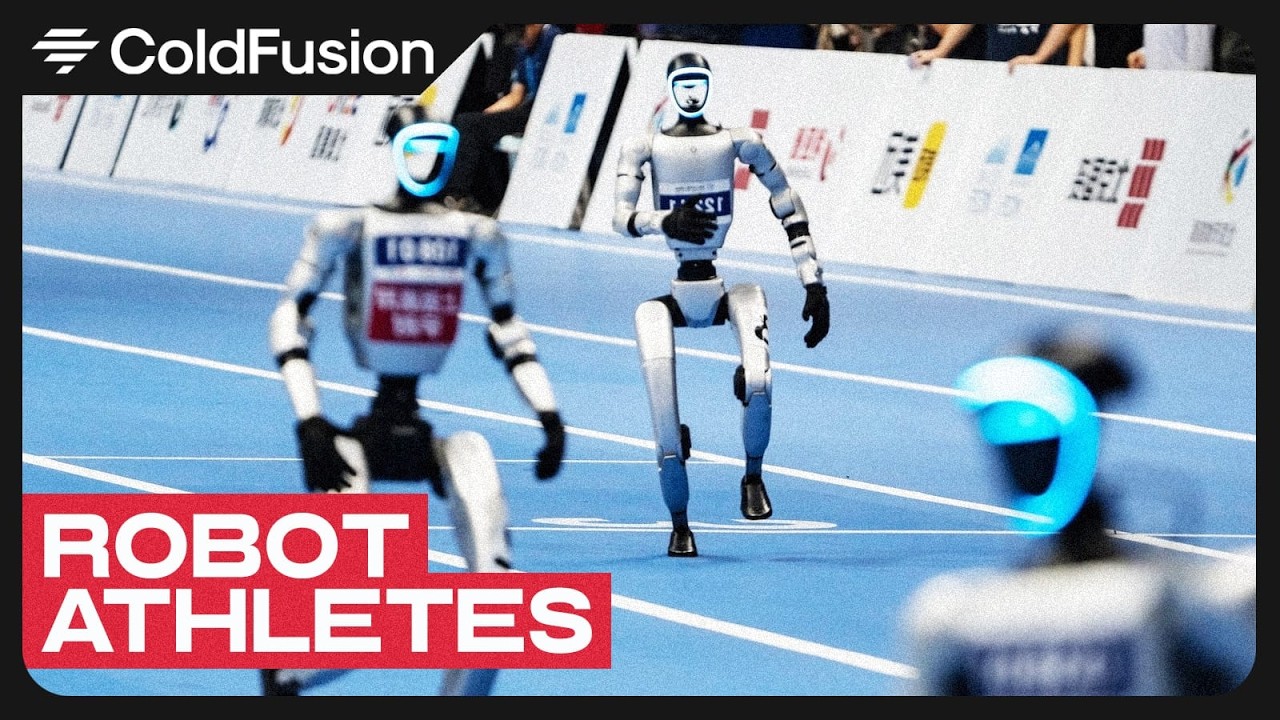
The video explores the rapid advancements in humanoid robotics over the past few years, highlighting a silent revolution in the field that has largely gone unnoticed amid the AI hype. It begins by showcasing the world’s first humanoid robot Olympics held in Beijing, featuring robots from over 16 countries competing in events like soccer, track and field, and martial arts. This event exemplifies the growing proliferation and capabilities of humanoid robots, which are increasingly being designed not just for entertainment but also for practical tasks such as sorting packages, folding clothes, and working in factories. The video emphasizes the unique challenge humanoid robots face in adapting to dynamic environments in real time, unlike traditional industrial robots that perform repetitive tasks.
The video then delves into the state-of-the-art humanoid robots from the United States, focusing on companies like Figure and Tesla. Figure’s O2 robot, powered by an in-house AI system called Helix, demonstrates impressive dexterity and natural language understanding, enabling it to perform household chores autonomously. Tesla’s Optimus robot, trained using neural networks similar to those in Tesla’s self-driving cars, is designed for home use and can perform tasks such as taking out the trash, sweeping, and opening cabinets. Tesla employs simulation-based training and fleet learning, allowing the robots to continuously improve. Boston Dynamics’ Atlas robot is also featured, showcasing advanced agility and a new generalist AI model that controls both walking and manipulation, marking a significant step toward versatile, adaptive robots.
The video discusses the advantages and challenges of humanoid robots compared to specialized machines. Humanoids are more socially acceptable and can operate in environments built for humans without requiring modifications, making them suitable for elder care and household tasks. However, they are less efficient than wheeled robots on flat surfaces or specialized robotic arms in factories. The video highlights the importance of AI in enabling these robots to perceive and understand their surroundings through multimodal systems that combine vision, language, and motor control. This integration, powered by advances in large language models and transformer neural networks, has been crucial in making humanoid robots more capable and reliable.
Turning to China, the video explains how the country leverages its manufacturing prowess and state-backed funding to mass-produce humanoid robots at lower costs. Chinese companies like Unitry, Agibbot, and Engine AI are producing robots that, while sometimes less advanced than their American counterparts, are widely available and used for entertainment, research, and some industrial applications. China’s government has heavily subsidized robotics development, with multi-billion-dollar funds supporting the industry and ambitious goals to increase global market share. This approach contrasts with the U.S., where private sector innovation leads to higher quality but slower production and market entry.
In conclusion, the video highlights the contrasting strategies of the U.S. and China in humanoid robotics: America leads in AI sophistication and robot intelligence, while China excels in scale, cost efficiency, and rapid production. The integration of advanced AI models like Google DeepMind’s Gemini into robotics is pushing the field forward, enabling robots to understand and act in the physical world with increasing competence. The video ends by posing a question to viewers about the potential impact of affordable, functional humanoid robots becoming widely accessible, suggesting that such a future may arrive sooner than expected.