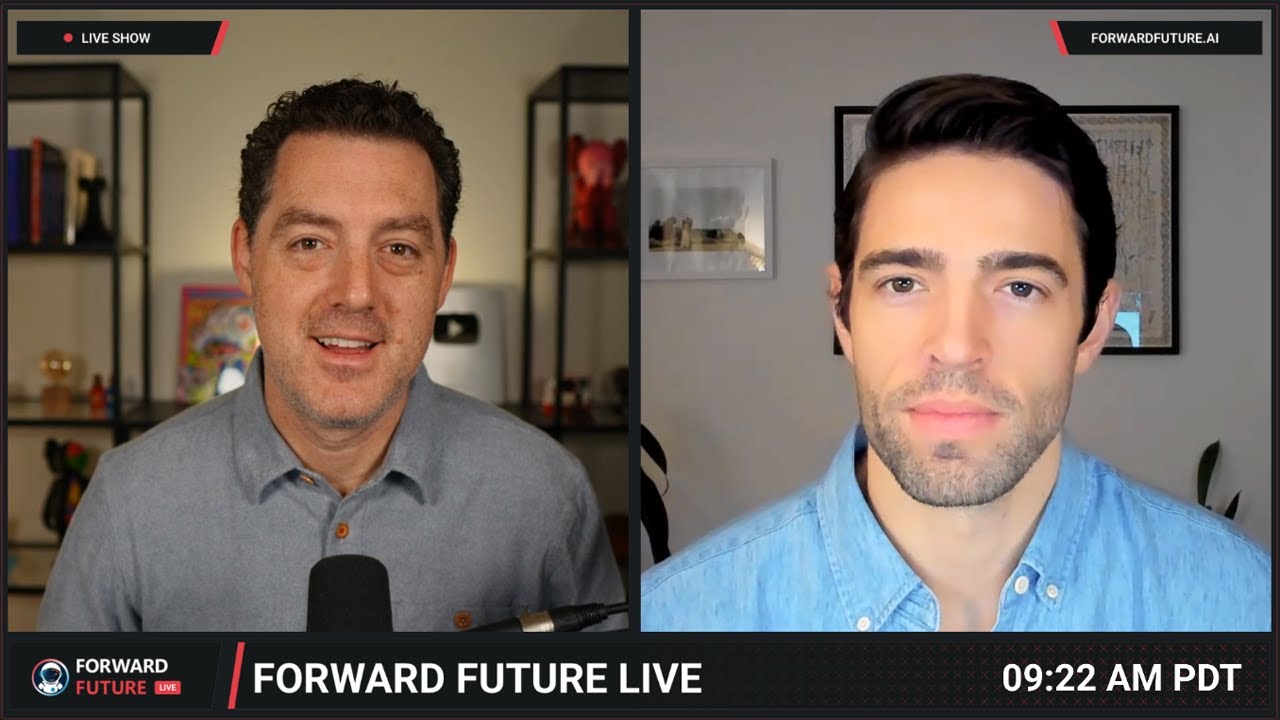
On the February 6th, 2026 episode of Forward Future Live, hosts Matt Berman and Nick Wentz welcomed three prominent guests to discuss the latest developments in AI infrastructure, the SaaS market, and breakthroughs in AI-driven mathematics. The show opened with a rundown of recent AI model releases, notably Anthropic’s Opus 4.6 and OpenAI’s GPT-5.3 Codex. The hosts highlighted Opus 4.6’s advancements in agentic tool use and its million-token context window, making it the first non-Google model to reach this milestone. They compared its performance to OpenAI’s Codex, noting differences in coding workflow transparency and speed, and discussed the growing competition between Anthropic and OpenAI, including their pricing strategies and user experience philosophies.
The first guest, Tim Davis, president and co-founder of Modular, explained his company’s mission to eliminate hardware lock-in for AI workloads. Modular is building a software abstraction layer—likened to a “hypervisor for compute”—that allows AI models to run seamlessly across different types of silicon, from Nvidia GPUs to Google TPUs and beyond. Davis emphasized the importance of freeing developers from being tied to specific hardware, enabling more scalable and cost-effective AI deployments, especially as inference workloads grow with user bases. He also discussed the trend toward edge computing, predicting that as models become smaller and more efficient, more AI tasks will be performed locally on devices rather than in the cloud.
Next, Joe Floyd, general partner at Emergence Capital, joined to analyze the so-called “SaaS-pocalypse”—the recent sharp decline in SaaS company stock prices. Floyd attributed the drop primarily to multiple compression rather than fundamental business weakness, noting that while revenue growth has slowed, the market’s reaction has been outsized. He discussed how AI-native companies are attracting investor attention and capital, while traditional SaaS firms lag in AI adoption. Floyd also critiqued OpenAI’s vision of collapsing the application layer into agents atop databases, suggesting that while this future is plausible, it will take years to materialize and that existing systems of record will likely adapt and survive.
The third guest, Karina Hong, founder and CEO of Axiom, shared how her four-month-old AI startup achieved a breakthrough by solving previously unsolved math problems and acing the notoriously difficult Putnam exam. Hong described Axiom’s approach of combining mathematical proof generation and verification using formal languages like Lean, enabling AI to reason and self-improve in math and code. She discussed the implications for mission-critical applications where verified code is essential, and outlined Axiom’s vision for commercializing AI-driven verification in industries such as chip design, enterprise software, and cryptography.
Throughout the episode, the hosts and guests reflected on the accelerating pace of AI innovation, the shifting competitive landscape, and the broader societal implications. They discussed the proliferation of local AI models, the potential for self-improving AI systems, and the evolving role of agents in both consumer and enterprise contexts. The show concluded with commentary on Anthropic’s clever Super Bowl ad campaign positioning itself as the “anti-ad” AI platform, and a look ahead to a year likely to be defined by rapid advancements and increased competition in artificial intelligence.