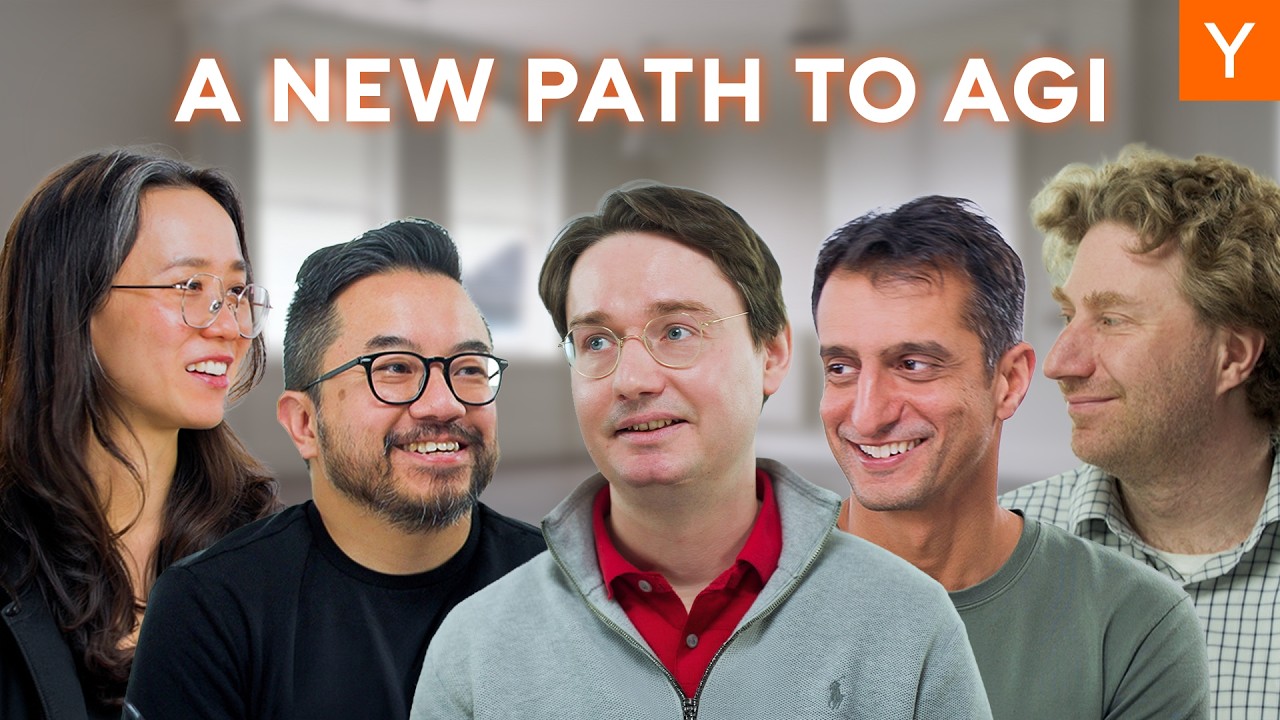
In this insightful discussion, François Chollet, founder of the ARC AGI benchmark and the NDIA research lab, shares his vision for the future of artificial intelligence and the pursuit of artificial general intelligence (AGI). Chollet emphasizes that while current AI progress, particularly with large language models (LLMs) and coding agents, is impressive and accelerating, it is not the ultimate path to optimal AI. His lab, NDIA, is exploring a fundamentally different approach based on symbolic program synthesis, aiming to replace parametric deep learning models with concise symbolic models that can generalize better, require less data, and run more efficiently. This approach seeks to build a new machine learning substrate that is closer to optimality and more aligned with the principles of scientific discovery.
Chollet explains the evolution of the ARC benchmark series, designed to measure AI’s reasoning and generalization capabilities. ARC V1 focused on static pattern recognition, while V2 introduced more complex reasoning tasks that recent AI models, especially those leveraging coding agents and verifiable reward signals, have begun to solve effectively. The newly released ARC V3 shifts focus to agentic intelligence, requiring AI systems to actively explore and learn in interactive environments without prior knowledge or instructions, mimicking human-like exploration and problem-solving efficiency. This makes ARC V3 a more robust test of fluid intelligence and adaptability, challenging current AI paradigms.
The conversation highlights the significance of verifiable reward signals in domains like code and mathematics, which have enabled breakthroughs in automation and reasoning through reinforcement learning and trial-and-error training. Chollet notes that while LLMs excel in domains with clear verification, progress in more ambiguous areas like natural language understanding and creative tasks remains slower due to the lack of formal verification. He also discusses the importance of removing humans from the AI improvement loop to achieve scalable, recursive self-improvement, a principle that underpins both deep learning’s success and the goals of NDIA’s symbolic learning approach.
Chollet shares his perspective on the future trajectory of AI, predicting that AGI capable of human-level skill acquisition efficiency across diverse tasks may emerge around 2030, coinciding with future iterations of the ARC benchmark. He encourages exploration of alternative AI approaches beyond deep learning, such as genetic algorithms and state-space models, emphasizing the need for scalable methods that minimize human intervention. Reflecting on his experience with Keras, he advises open-source project maintainers to prioritize usability, community building, and educational documentation to foster adoption and growth.
Finally, Chollet offers a hopeful message for individuals navigating the rapidly evolving AI landscape. He urges people to embrace AI progress as an empowering tool rather than a threat, advocating for continuous learning and adaptation to leverage AI advancements effectively. By understanding both AI technologies and the domains they wish to impact, individuals can ride the wave of AI innovation to enhance their skills and opportunities in an increasingly automated world.