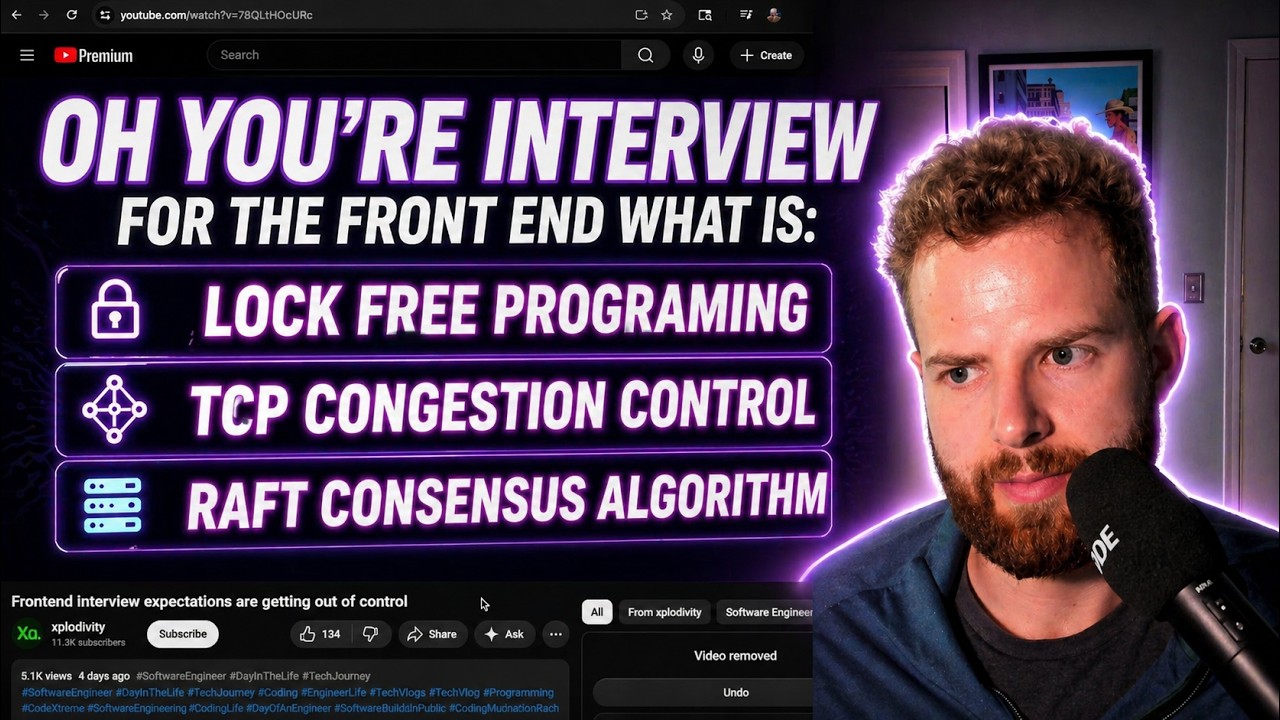
The video discusses the increasing difficulty and expanding scope of front-end engineering interviews. Many engineers feel overwhelmed because these interviews now demand knowledge beyond just frameworks like React or Vue, requiring a deep understanding of foundational JavaScript concepts such as closures, promises, and the event loop. The speaker emphasizes that even if developers don’t consciously realize it, they are using complex JavaScript features like closures regularly, especially in frameworks like React. This foundational knowledge is crucial, yet many candidates struggle because they have learned frameworks first without grasping the underlying JavaScript mechanics.
The interview process has evolved from simple UI and CSS questions to encompassing full-stack topics, including system design, API rate limiting, database architecture, and even AI integration. The speaker highlights the absurdity of expecting front-end engineers to have backend skills such as writing SQL queries or designing scalable databases during front-end interviews. This shift means that front-end interviews often feel more like full-stack or core engineering interviews, which can be confusing and frustrating for candidates who applied specifically for front-end roles.
Beyond coding and system design, front-end interviews now test candidates on performance optimization techniques like debouncing, throttling, caching, and handling API failures. Candidates are also expected to understand bundlers, code splitting, tree shaking, and lazy loading—topics that many front-end developers might not have deeply explored. The speaker downplays the importance of CSS styling questions in interviews, arguing that these are easy to learn and less indicative of a candidate’s true front-end engineering skills compared to JavaScript fundamentals and system integration knowledge.
The speaker shares personal experiences of interviews where most rounds focused on backend or system design topics, with only one round dedicated to React, which was still challenging due to interruptions. Despite the difficulty, the speaker encourages candidates to focus on building components incrementally during interviews to demonstrate their understanding of front-end concepts like state management and asynchronous operations. They also stress the importance of mastering basic coding problems and JavaScript fundamentals, as these are often used as qualifiers in interviews.
In conclusion, the video argues that front-end engineering roles today require a broad and deep skill set that goes far beyond simple UI development. Candidates must be prepared to handle questions spanning JavaScript internals, system design, backend concepts, and even AI features. The speaker agrees with the notion that without a solid grasp of JavaScript fundamentals and broader engineering knowledge, front-end developers may struggle to advance in their careers or secure higher-paying roles. The video ends by inviting viewers to share their thoughts on the fairness and scope of current front-end interviews.