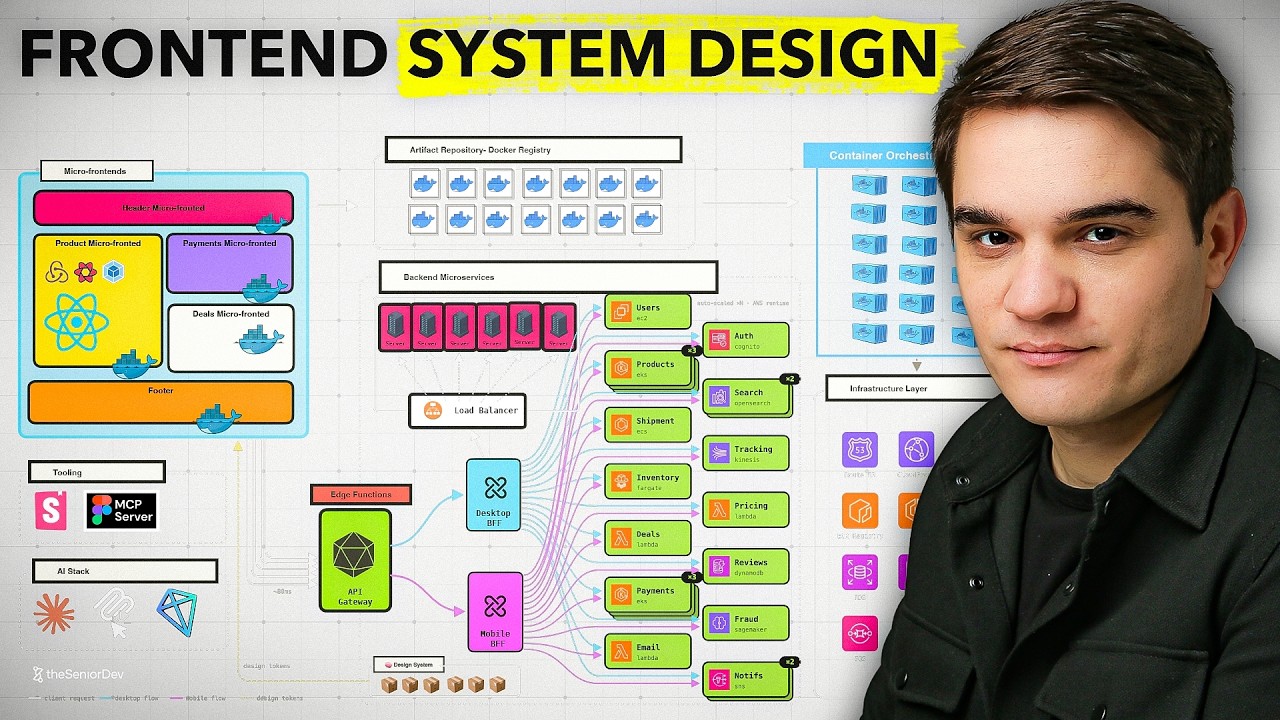
The video emphasizes the importance for front-end engineers to enhance their system design and architecture skills to stay competitive, especially as AI advances in coding capabilities. It begins by explaining micro-frontends, which involve splitting a traditional front-end monolith into independent applications managed by smaller, feature-focused teams. This approach parallels microservices in the back-end, enabling teams to work independently, reduce communication overhead, and accelerate development. The speaker highlights the evolving team dynamics influenced by AI, where smaller teams equipped with coding agents can deliver faster while focusing on minimizing verification time and architectural drift.
Next, the video covers essential architectural patterns such as API gateways and backend-for-frontend (BFF). An API gateway centralizes common functionalities like authentication, caching, and rate limiting, simplifying communication between clients and multiple microservices. The BFF pattern allows front-end teams to own a dedicated backend layer tailored to their specific client needs, enabling faster feature development without depending heavily on back-end teams. This pattern also supports different APIs for various clients, such as mobile and desktop, optimizing data fetching and reducing over-fetching or under-fetching issues.
The discussion then moves to deployment and infrastructure strategies, including containerization with Docker and orchestration with Kubernetes or alternatives like AWS ECS. Containers package applications with their dependencies, ensuring consistent deployment across environments. While front-end engineers don’t need deep DevOps expertise, understanding these tools at a high level is crucial. The video also explains the role of CDNs in improving web performance by caching static assets closer to users worldwide, reducing latency and enhancing load times through optimized caching and compression.
Further, the video delves into front-end specific concepts such as design systems, monorepos, and rendering strategies. Design systems ensure visual consistency and code reuse across micro-frontends by defining shared design tokens and reusable components, which also improve AI-generated code quality. Monorepos consolidate multiple projects into a single repository, facilitating standardization and enabling AI tools to work efficiently across service boundaries. Rendering strategies like client-side rendering, server-side rendering, and incremental static regeneration are explained with their trade-offs, emphasizing the importance of choosing the right approach based on performance and SEO needs.
Finally, the video touches on performance optimization and real-time data fetching techniques. Core Web Vitals—Largest Contentful Paint, Interaction to Next Paint, and Cumulative Layout Shift—are key metrics for measuring website performance. Code splitting and lazy loading help reduce initial load times by delivering only necessary JavaScript per page. For real-time communication, server-sent events are highlighted as an efficient method for one-way streaming of data from server to client, commonly used in AI chat applications, contrasting with polling and WebSockets. The speaker encourages front-end engineers to broaden their full-stack knowledge and leverage AI tools effectively to build scalable, maintainable, and high-performance front-end systems.