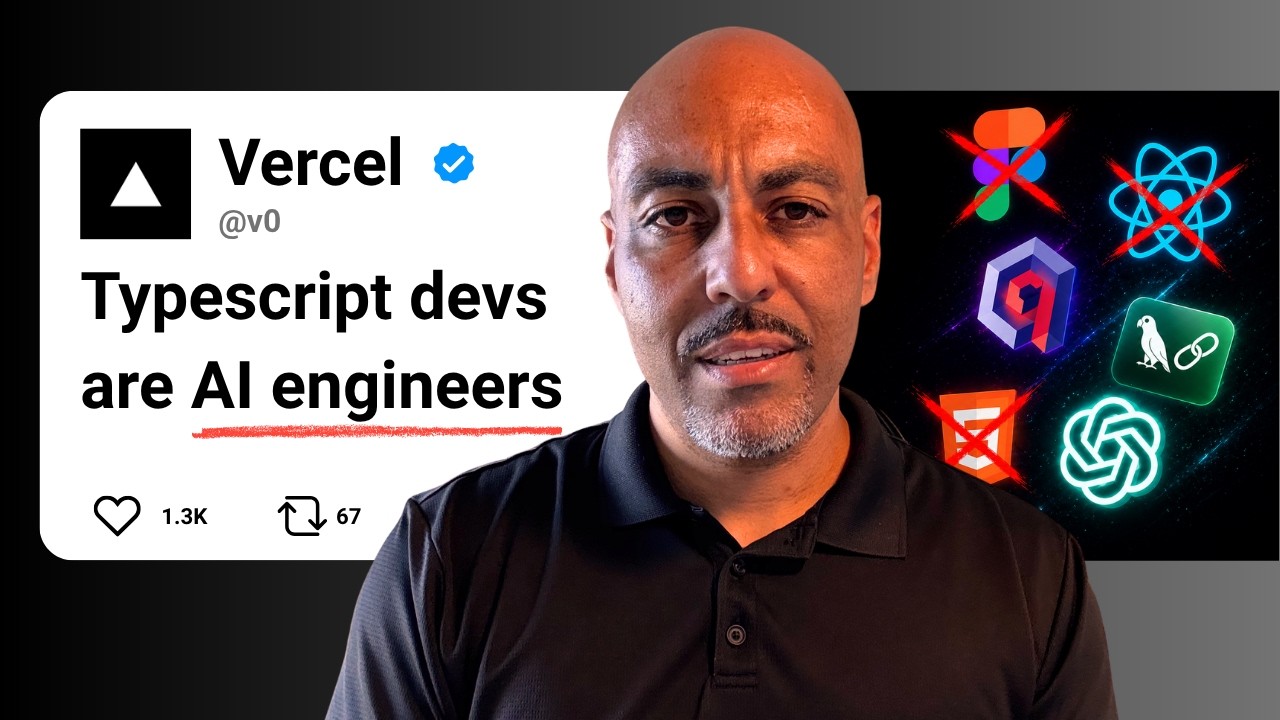
The speaker argues that front-end developers are well-positioned to transition into AI engineering by leveraging their existing skills in API integration, user interface design, and applied AI tools without needing deep mathematical expertise or a complete shift to traditional machine learning paths. They emphasize practical experience with AI APIs, frameworks like Next.js, and techniques such as retrieval augmented generation as key to successfully building user-facing AI applications and advancing in the AI field.
The speaker recounts an experience at a conference where a Verscell executive boldly claimed that “The AI engineer of the future is a TypeScript engineer,” a statement that initially sparked skepticism and backlash. However, over time, the speaker realized the accuracy of this claim, especially for front-end developers who often feel disconnected from the AI field. The transition from front-end or full-stack development to AI engineering—particularly applied AI involving APIs like OpenAI or Anthropic—is more accessible than many believe. The speaker encourages front-end developers to reconsider the notion that they need extensive math degrees or to switch entirely to Python or machine learning boot camps to enter AI roles.
The speaker highlights that front-end developers are uniquely positioned for AI engineering because they are already familiar with the core workflow of calling APIs, handling JSON data, and presenting it to users. Most AI products today are user-facing, often centered around chat interfaces, where user experience and interface design are crucial. Examples like Juicebox and popular chatbots such as Claude and ChatGPT illustrate the importance of front-end skills in building effective AI-driven applications. Despite some UI challenges like flickering in chat interfaces, front-end engineering remains vital and relevant in the AI era.
To make the leap into AI engineering, the speaker shares their personal journey, which involved initially studying complex topics like linear algebra and LLM fundamentals but only truly understanding them through hands-on projects involving retrieval augmented generation (RAG) systems. They emphasize that while deep mathematical knowledge is essential for building AI models, it is not necessary for applied AI roles focused on integrating and optimizing AI services. Understanding concepts like embeddings, vector databases, and how to manage and retrieve data effectively is key to success in these roles.
The speaker also offers practical advice on tools and libraries, recommending front-end developers use frameworks like Next.js and Vercel’s AI SDK to build advanced AI applications. These tools enable developers to create dynamic user interfaces that can stream not just text but React components, enhancing user interaction beyond simple chat responses. The speaker stresses the importance of building applications that do more than just display information, such as incorporating human-in-the-loop workflows and actionable UI elements, which add significant value to AI products.
In conclusion, the speaker argues that front-end developers are closer to becoming AI engineers than they might think and should seize the growing opportunities in this space. They caution against limiting oneself to just learning Python or traditional machine learning paths and instead advocate for leveraging existing front-end skills combined with AI API integration and RAG techniques. The speaker’s own career transformation and the success of others they have taught serve as evidence of this practical path. They encourage viewers to explore provided resources and projects to gain hands-on experience and accelerate their transition into AI engineering roles.