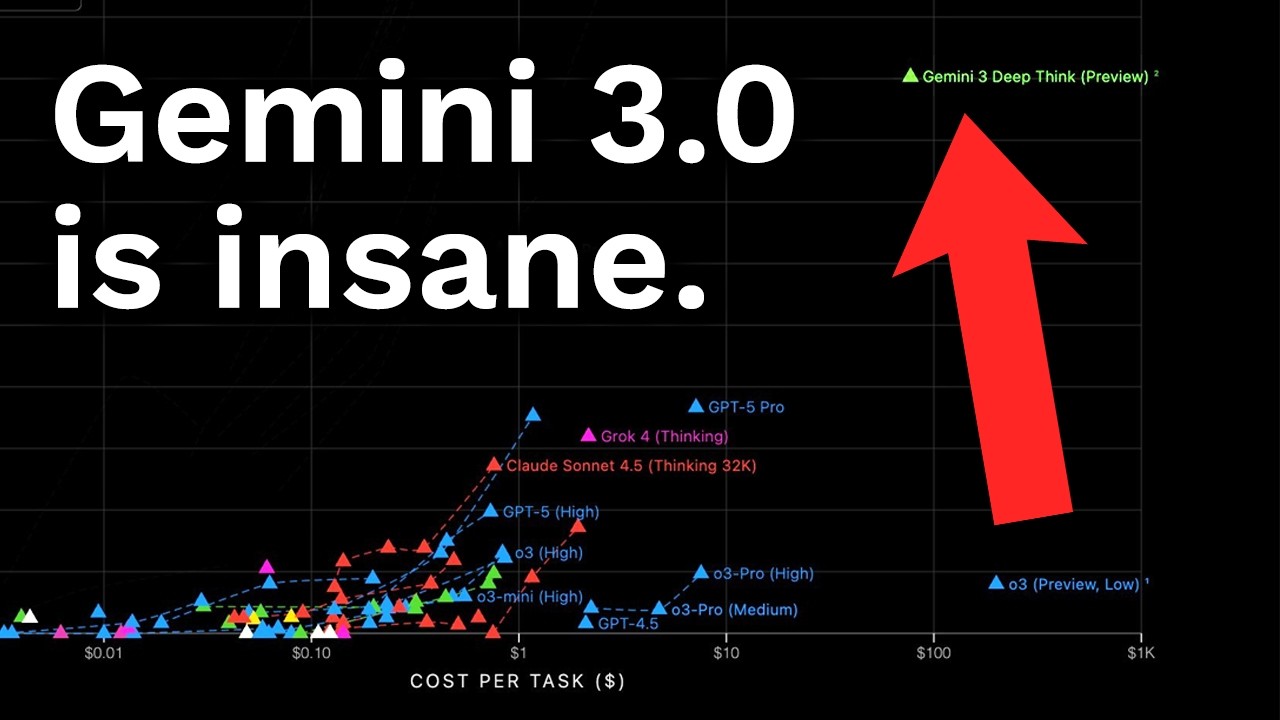
Google has just released Gemini 3.0, a groundbreaking AI model that outperforms all existing models, including ChatGPT and Claude, across numerous benchmarks. One of its most impressive features is its ability to “one-shot” complex tasks, such as creating a fully functional 3D Lego editor web app from a single prompt, a feat that previously required multiple iterations and debugging. Gemini 3.0’s performance on the ARC AGI 2 visual reasoning benchmark is unparalleled, signaling a significant step closer to artificial general intelligence (AGI). The model boasts a massive one million token context window and impressive speed, processing 87 tokens per second despite being a multi-trillion parameter model.
Gemini 3.0 excels particularly in front-end development, leveraging Google’s vast data resources from search, YouTube, Docs, and more to create powerful multimodal AI capabilities. Google has integrated Gemini 3 into various products, including an interactive assistant that can generate animated visualizations to explain complex concepts like DOS attacks. Alongside Gemini 3, Google also launched Anti-Gravity, a full integrated development environment (IDE) powered by Gemini 3, featuring a built-in browser and screen recording tool that allows real-time debugging and development. This suite of tools highlights Google’s commitment to pushing AI technology forward.
The video demonstrates Gemini 3’s ability to build complex applications, such as a CapCut clone video editing software, using natural language prompts and reference images. Although some minor errors occurred during the build process, the AI was able to debug and fix issues autonomously, showcasing its advanced reasoning and problem-solving skills. Gemini 3’s performance on the Design Arena benchmark further cements its dominance, outperforming competitors by a significant margin in categories like website development, game development, 3D design, and UI components. This release is considered one of the most significant AI advancements since GPT-4.
Google’s competitive edge is further strengthened by its proprietary Tensor Processing Units (TPUs), which enable efficient and cost-effective model inference, freeing the company from reliance on Nvidia GPUs. This hardware advantage, combined with Google’s extensive data and engineering resources, positions Gemini 3 as a formidable leader in the AI space. The video also highlights Google’s AI Ultra subscription, which offers extensive features and integrations across Google’s ecosystem, providing exceptional value compared to other AI service providers.
In conclusion, Gemini 3 represents a major leap forward in AI capabilities, signaling Google’s remarkable comeback in the AI race. Its unmatched performance, multimodal abilities, and integration into powerful development tools make it a game-changer for developers and users alike. The video emphasizes that Gemini 3 could become the dominant AI platform in the near future, surpassing current leaders like ChatGPT. For those interested in staying at the forefront of AI technology, adopting Gemini 3 and Google’s AI ecosystem is highly recommended.