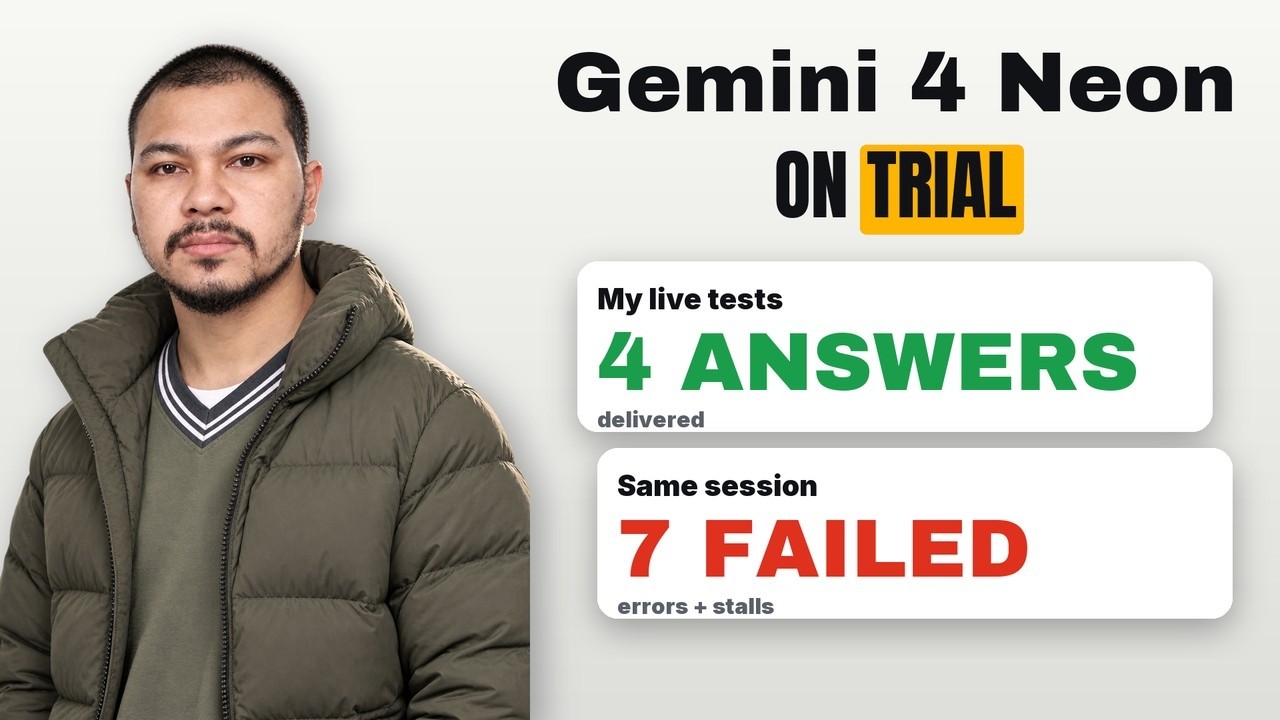
The video investigates the discrepancy between Google’s impressive benchmark claims for Gemini 4 Neon and the real-world performance experienced by the creator in Google AI Studio. Google reports Gemini 4 Neon scoring 95.2% on a long context test, outperforming competitors Claude Opus 5.5 and GPT 6.2 Sol on most benchmarks. However, when the creator first tried to use Neon, it immediately returned an error stating the model was unavailable. This raised questions about whether the benchmarked model and the accessible version are the same. The video approaches this as a trial, weighing evidence from Google’s official pages, news coverage, and hands-on tests, assigning verdicts of admitted, partial, unverified, or rejected to each claim.
The news and official documentation confirm several key points: Gemini 4 Neon is positioned as a middle-tier model between Hydrogen (fast, everyday use) and Carbon (for complex, heavy tasks). Pricing matches Google’s published rates at $3 per million input tokens and $15 per million output tokens, with no free tier available for Neon. The model supports a massive context window of up to one million tokens shared between input, thinking, and output, and accepts multimodal inputs (text, images, video, audio, PDFs) but outputs text only. Google also removed older sampling controls and recommends using four thinking levels, with “high” as default.
Google’s benchmark table shows Neon leading in 16 out of 19 categories, especially excelling in long context tasks, but losing in a few coding benchmarks. These results come directly from Google’s model card and have not been independently reproduced. The creator’s own tests in AI Studio involved four tasks: a JavaScript traffic jam simulation, a classic bat and ball puzzle, a Python bug fix, and an honesty trap involving a fictitious paper. While Neon provided mostly correct and concise answers, it frequently failed with internal errors, stalls, or unavailability messages, especially at higher thinking levels or when using grounded search.
The grounded search feature, which should enhance responses with real-time information, failed to return any answers even after extended waiting. The creator notes that Google’s documentation recommends long timeouts (up to 15 minutes) or background execution for complex tasks, which may explain some stalls given the model’s recent launch and possible high demand. The video concludes that while Neon largely fulfills its advertised capabilities on paper, its current practical usability is hindered by instability and frequent errors, requiring users to implement retries, long timeouts, and experiment with thinking levels.
In summary, Gemini 4 Neon is a promising model that leads benchmarks and offers advanced features, but its early release state shows significant reliability issues in real-world use. The creator advises caution and patience, recommending that developers prepare for errors and delays when using Neon today. The video invites viewers to subscribe and suggest further tests, with the hope that future updates will improve Neon’s stability and grounded search functionality, allowing a full realization of Google’s ambitious claims.
Useful Links