The video discusses the evolution of search systems capable of handling multiple data types—text, images, audio, video, and documents—within a single pipeline. Traditionally, building such systems required multiple embedding models and vector stores, making the architecture complex and difficult to maintain. Each modality (text, image, audio, etc.) needed its own model and index, and integrating them required additional layers for reranking and fusion, resulting in slow and expensive solutions. The speaker references previous advances, such as the Quen model, which allowed for joint text and image embeddings, but highlights that these solutions were still limited in scope.
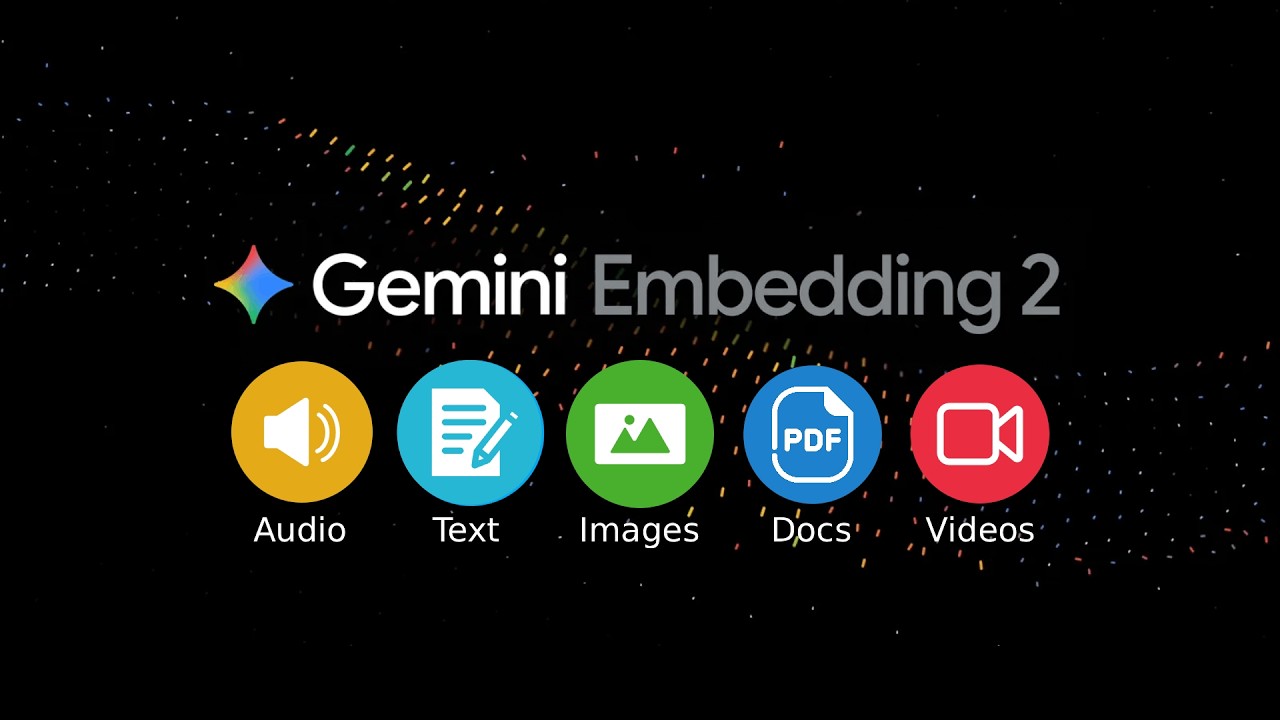
The main focus is on the newly released Gemini Embedding 2 model from Google, which represents a significant leap forward in multimodal embeddings. Unlike previous models, Gemini Embedding 2 can natively process and embed text, images, audio, video (up to two minutes), and documents like PDFs without the need for format conversion or transcription. This means that all these different types of content can be mapped into a shared high-dimensional vector space using a single model and index, greatly simplifying the search and retrieval process. The model enables users to query with any modality and retrieve semantically similar results across all supported types.
The video explains how embeddings work: the model converts any piece of content into a vector of numbers in a high-dimensional space (over 3,000 dimensions), capturing the semantic meaning of the content. Items that are semantically similar—such as a text about a cat, an image of a cat, and an audio recording mentioning a cat—will be located near each other in this space. This unified approach allows for powerful cross-modal search capabilities, such as finding relevant images or videos using a spoken query or combining text and image inputs to refine search results.
Practical demonstrations show how the Gemini Embedding 2 model can be used to embed and compare different modalities. The speaker walks through examples using Google’s GenAI SDK, embedding text, images, audio, video, and PDFs, and then performing similarity searches across these types. The model supports chunking for large inputs (e.g., splitting long videos or documents into smaller segments for more precise search), and it allows for both individual and aggregated embeddings when combining multiple pieces of content, such as a social media post with both text and images.
Finally, the video notes that Gemini Embedding 2 outperforms previous models on standard benchmarks for text-to-text, image-to-text, and text-to-image similarity, and it is already integrated with popular frameworks like LangChain, LlamaIndex, and vector stores such as ChromaDB. The model also supports variable embedding sizes for performance optimization. The speaker encourages viewers to experiment with the model and consider new use cases enabled by this unified multimodal embedding approach, emphasizing its potential to simplify and enhance AI-powered search and retrieval applications.