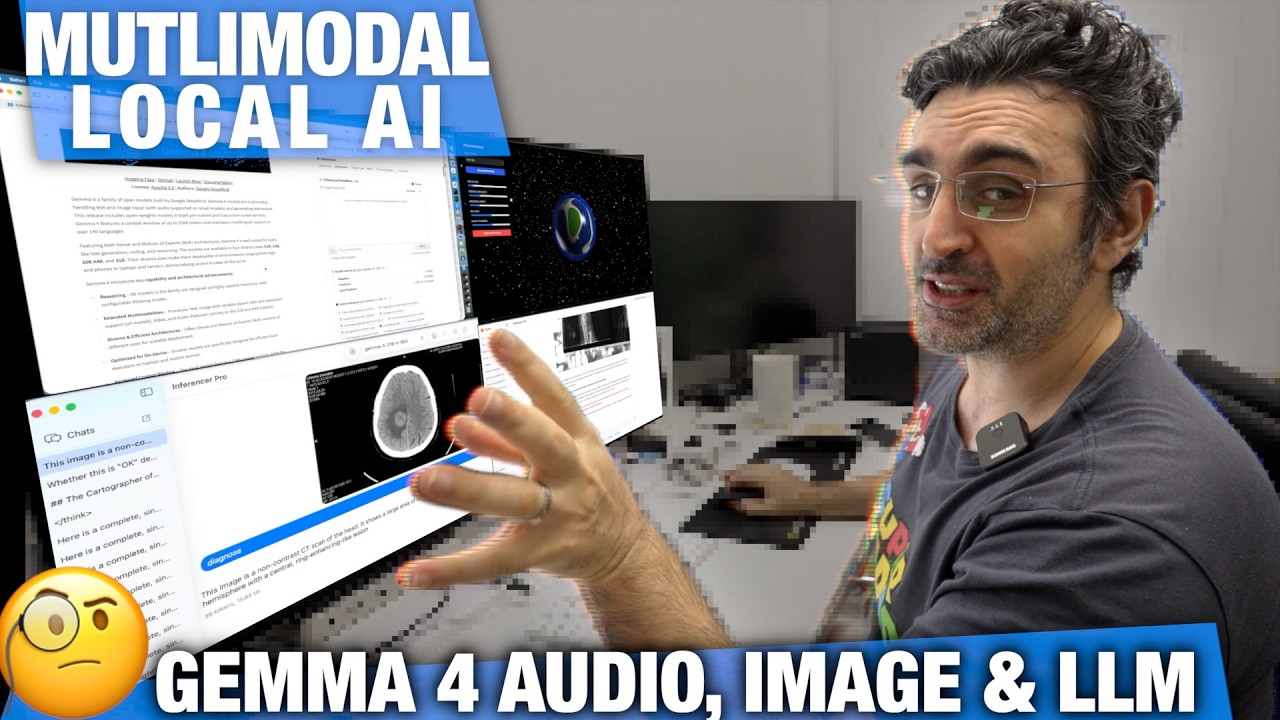
The video explores Google’s Gemma 4, an open-weight multimodal AI model that builds upon the success of its predecessor, Gemma 3. Despite the models being relatively small, they boast impressive capabilities including image, video, and audio recognition, as well as enhanced reasoning, coding, and multilingual support across 35 languages. The presenter highlights the model’s efficiency, speed, and increased context window, noting that even the smaller versions outperform Gemma 3 in various benchmarks. Quantizations at 9-bit have been achieved to maintain near-lossless quality, and the presenter offers to provide specialized versions upon request.
A significant portion of the video is dedicated to testing Gemma 4’s multimodal abilities. The model successfully analyzes complex images such as CT scans, identifying medical conditions like brain tumors with appropriate disclaimers about not being a medical professional. Even the smaller models demonstrate a surprising level of medical image comprehension. Additionally, the AI performs well in audio analysis, accurately identifying voice gender and transcribing speech with high confidence. The presenter also experiments with voice commands, showing that the model can follow spoken instructions, although some limitations exist in rendering specific formats like LaTeX.
The presenter then challenges Gemma 4 to recreate a software application from a screenshot, focusing on Swift code generation. The AI produces a detailed Swift UI layout and API integration code, though not fully error-free, demonstrating the potential for AI-assisted app development. The smaller, faster models generate HTML versions suitable for web browsers, showcasing the model’s versatility in code generation. The recreated UI includes functional elements like sidebars and chat views, impressively mimicking the original app’s structure and design, which the presenter finds both exciting and somewhat unsettling regarding the future of software development.
Further tests assess Gemma 4’s natural language processing and reasoning skills. The model generates coherent and stylistically consistent stories, though with some overuse of punctuation like em dashes. Logical reasoning challenges, including classic riddles, are handled accurately by the larger models, while smaller ones show diminished performance. The AI also demonstrates effective tool use, such as making web requests to retrieve information from Wikipedia, with the more advanced models succeeding where smaller ones fail. These results underscore the trade-offs between model size, speed, and intelligence.
Finally, the video showcases Gemma 4’s coding prowess through interactive web page creation and game-like simulations. The AI generates complex, high-fidelity code for a solar system simulation with interactive elements like launching asteroids and controlling a spaceship in third-person perspective. While the larger model initially encounters some runtime errors, it later self-corrects, highlighting its evolving capabilities. The presenter expresses enthusiasm for Google’s renewed commitment to open-weight models and multimodal AI, anticipating future releases with even larger models and expanded features, and invites viewers to share their thoughts and coding challenges for further exploration.