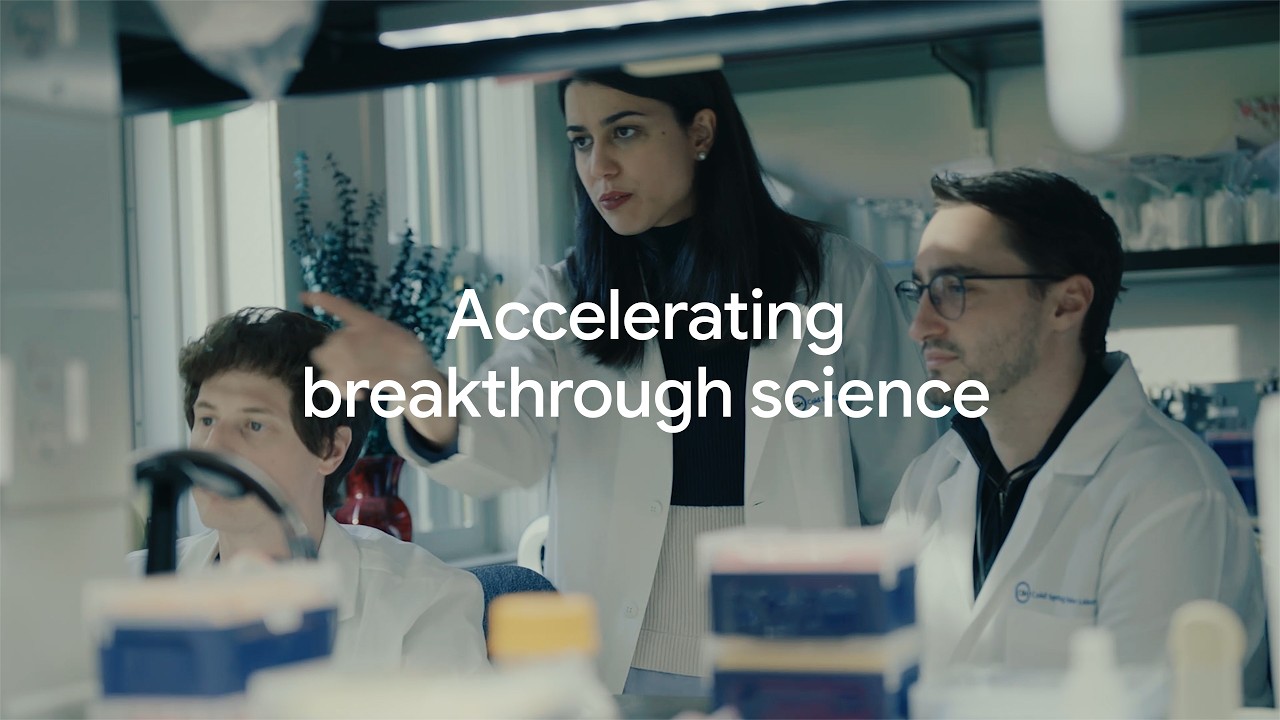
The video presents Co-Scientist, an AI-driven multi-agent system that accelerates scientific discovery by mimicking a research team to generate, evaluate, and evolve novel hypotheses from vast scientific literature, thereby overcoming challenges posed by rapidly expanding knowledge. Demonstrated through impactful examples like liver fibrosis research, Co-Scientist empowers scientists to drastically reduce research time, fostering a collaborative future where AI and humans together drive unprecedented innovation and breakthroughs in science and medicine.
The video highlights the profound significance of the scientific method as a cornerstone of human progress, driven by an innate spirit of exploration and the desire to understand the world. Scientists are motivated by the pursuit of new knowledge, often facing the challenge of an overwhelming and rapidly expanding body of scientific literature. With knowledge doubling every two months, staying current is nearly impossible, making it difficult to ensure no critical information is missed. This challenge is especially acute in fields like rare diseases, where treatments exist for only a small fraction, and the slow pace of biological research can be frustrating for both scientists and patients.
To address these challenges, the video introduces Co-Scientist, an AI-driven multi-agent system designed to accelerate scientific discovery. Unlike a simple language model, Co-Scientist mimics a real research team by assigning specialized roles to different AI agents. These agents collaboratively scour literature, generate and evolve hypotheses, extract new information, and rank ideas, enabling a rigorous and structured approach to scientific inquiry. This system leverages the vast expanse of global scientific knowledge to propose innovative solutions to complex scientific problems, effectively acting as an engine for discovery.
Co-Scientist’s ability to integrate and connect facts from disparate fields allows it to generate creative and novel hypotheses that might otherwise remain undiscovered. The video shares an example where Co-Scientist was tasked with exploring epigenomic aspects of liver fibrosis and potential drug treatments. The AI produced hypotheses so compelling and rigorous that they inspired immediate experimental follow-up, demonstrating the system’s potential to drastically reduce the time required for research from months or years to mere days. This capability empowers scientists by effectively deploying a virtual team of experts to accelerate the pace of discovery.
The impact of Co-Scientist extends beyond individual labs, fostering a broader scientific community empowered to make major advances across diverse fields. The system has already contributed to new findings that have been published and promises many more breakthroughs in the pipeline. The excitement among researchers is palpable, as the AI tool not only enhances productivity but also opens up possibilities for discoveries that were previously unimaginable. This marks a significant shift from traditional research methods to a future where AI and human scientists collaborate seamlessly.
Ultimately, the video envisions a transformative future where the best scientists, equipped with AI tools like Co-Scientist, can achieve unprecedented levels of productivity and innovation. By accelerating the scientific process and enabling the exploration of entirely new ideas, this technology has the potential to revolutionize science and medicine. The transition from concept to clinical impact is underway, promising to benefit society by delivering faster, more effective solutions to pressing scientific and medical challenges.