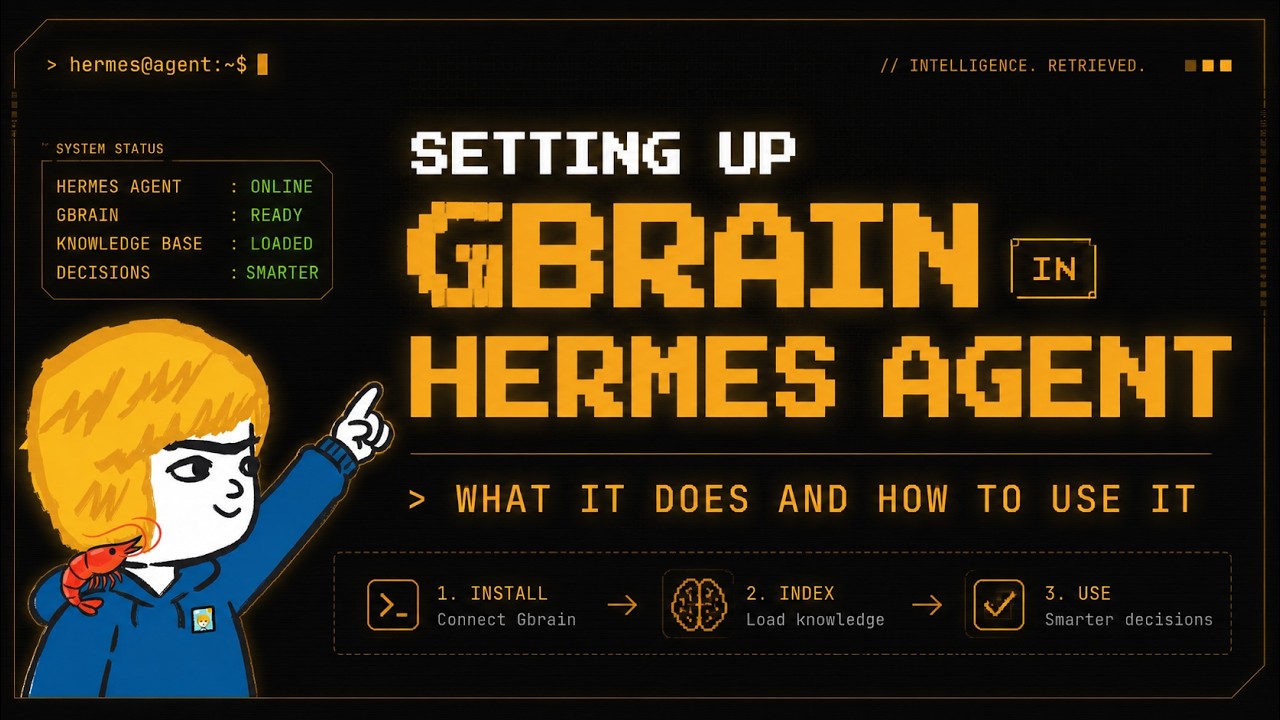
The video introduces Gbrain, an open-source tool developed by Garry Tan, president of Y Combinator, which is widely used as a “second brain” alongside AI agents like Hermes Agent. Unlike Hermes memory, which only recalls information discussed within the agent’s conversations, Gbrain serves as an external knowledge base that stores information in markdown files within a Git repository. This allows it to ingest and manage data from outside the chat environment, such as meeting notes and documents, making it a more comprehensive repository of knowledge about the user’s world.
The presenter explains the differences between Hermes memory, LM wikis, and Gbrain. Hermes memory is designed to remember interactions and decisions made during conversations with the agent, while LM wikis are curated domain-specific knowledge bases. Gbrain, on the other hand, acts as a broader knowledge graph that organizes typed pages about people, companies, meetings, and decisions, integrating information that the agent has never directly encountered in chat. This makes Gbrain particularly useful for managing complex, real-world information at scale.
The architecture of Gbrain is straightforward: it syncs markdown files to a local Postgres (PG) Lite database and exposes over 30 tools via the MCP protocol, which Hermes Agent can interact with as subprocesses. This setup avoids the need for servers or tokens, making it lightweight and easy to integrate. The video walks through the installation process, highlighting the need for an embedding API key for vector search functionality, and demonstrates how to seed Gbrain with data and query it effectively, showing its ability to cite sources and perform graph queries to reveal relationships between entities.
A key advantage of Gbrain is its MCP server, which allows Hermes Agent to communicate with Gbrain efficiently without repeatedly launching command-line processes. This results in faster, smoother interactions and better integration. The video also emphasizes best practices for using Gbrain, such as searching it first for factual information, writing decisions back into it for durability, and treating it as the authoritative source for world knowledge, while Hermes memory continues to handle conversational context and session history.
In conclusion, the presenter sees Gbrain as a valuable tool for solo entrepreneurs or small teams who need to manage diverse and interconnected information about people, projects, and companies. It complements Hermes memory rather than replacing it, providing a structured, cited, and scalable knowledge base that enhances the capabilities of AI agents. The video ends with an invitation for viewers to share their experiences and tips with Gbrain, and a promise to provide follow-up insights after using it more extensively in daily workflows.