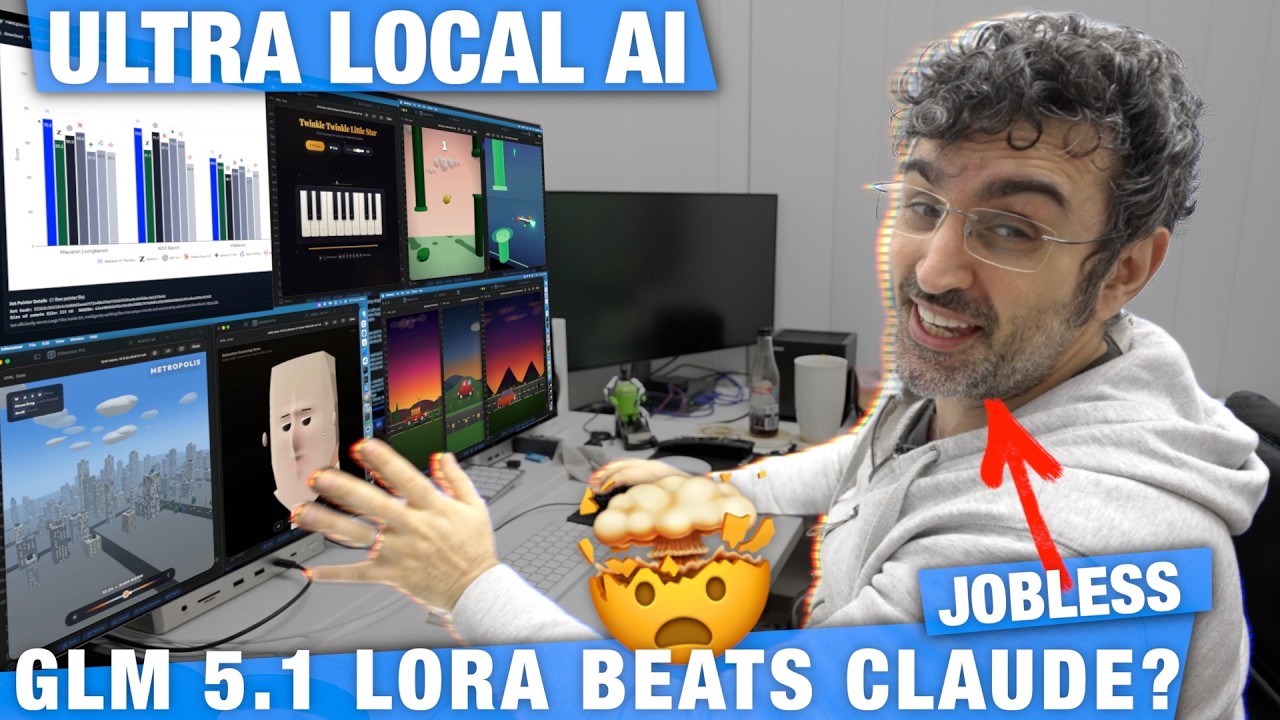
The video provides an in-depth review of Macaron V1, a fine-tuned version of GLM 5.1 enhanced with five specialized LoRA (Low-Rank Adaptation) modules designed for different tasks such as chat, coding, and clue-style workflows. The presenter highlights impressive benchmark results where Macaron V1 outperforms the base GLM 5.1 and other models like Opus, especially in software engineering tasks. The LoRAs are lightweight, adding only about 2GB for the coding module, and use a rank of 16, which balances training speed and performance effectively. The model employs a routing system that directs prompts to the appropriate LoRA, optimizing task-specific outputs.
The review includes extensive testing of the base GLM 5.1, the merged version with all LoRAs combined, and the specialized coding variant. Various creative and technical tasks were evaluated, including generating piano music in HTML, creating 3D Flappy Bird and plane games, photorealistic human face renders, and procedural planet generators. The coding variant often produced the best results, especially in music tempo and visual effects like falling piano keys and asteroid impacts. The merged version sometimes suffered from conflicts between LoRAs but still delivered solid outputs, while the base GLM 5.1 showed strong performance but occasionally encountered runtime errors.
The presenter also compared these models against Claude, an AI available in the cloud, noting that Macaron V1’s local open-source performance was superior in many respects, especially in creative generation tasks. Logic and factual recall tests showed all versions performing similarly, but in mathematics, the base GLM 5.1 slightly outperformed the others, with the coding variant sometimes getting stuck in response loops. The video emphasizes that while the merged LoRA version offers convenience, it may suffer from overlapping adaptations, making the specialized coding LoRA and base GLM 5.1 preferable for certain tasks.
Application development tests, such as generating an MS Word clone and a 3D city, revealed that the merged version could sometimes produce better-rendered pages, but the coding variant was faster and more stable. The presenter also explored safety and common-sense reasoning, where all models generally performed well, though the merged version occasionally exhibited unexpected behavior when prompted with potentially unsafe tasks. Overall, the coding variant and base GLM 5.1 were highlighted as the most reliable and effective, with the merged version being a trade-off between performance and convenience.
In conclusion, the video praises Macaron V1 for its impressive capabilities and efficient use of LoRAs, which enable specialized task handling without significantly increasing model size or complexity. The presenter plans to release an INF (infinite precision) edition that further improves quality, demonstrated by enhanced piano visualizations and more realistic human face renders. The review suggests that Macaron V1’s coding LoRA variant currently leads in performance, even surpassing cloud-based models like Claude in some creative benchmarks, making it a promising tool for local AI applications.