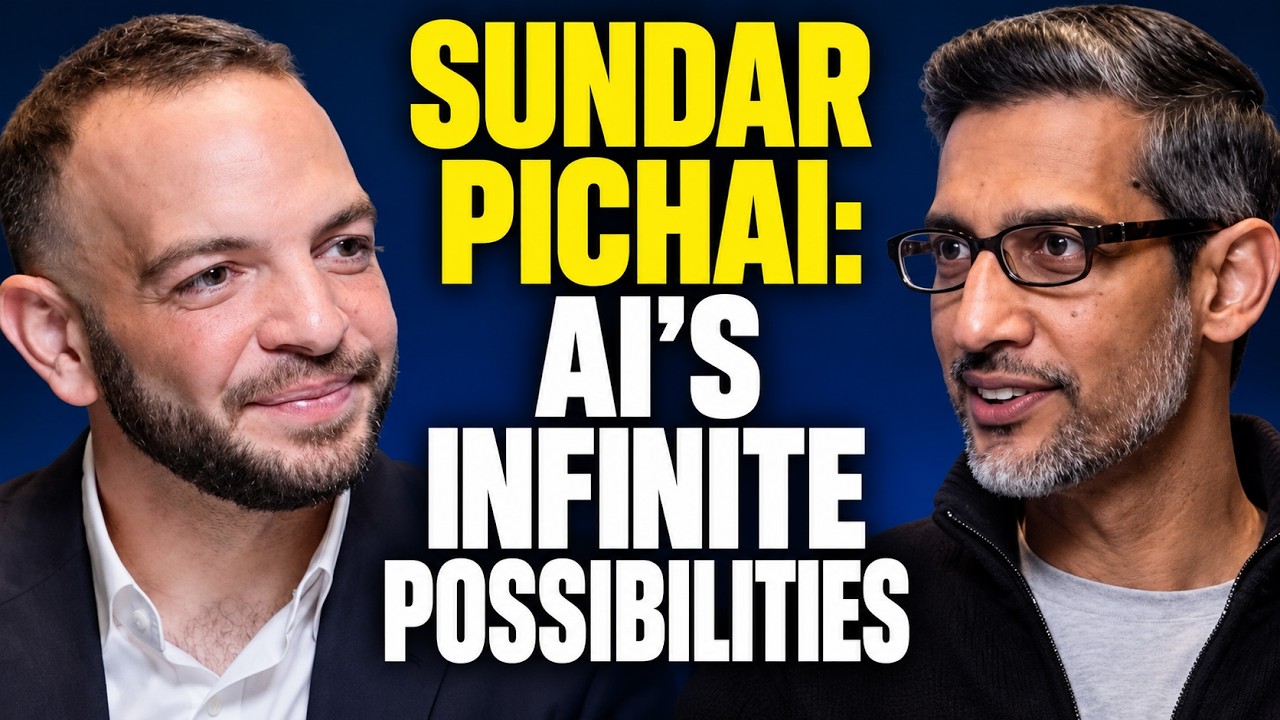
In this insightful discussion, Google CEO Sundar Pichai emphasizes that AI represents one of the most consequential technologies ever, with vast and evolving possibilities. He highlights Google’s commitment to staying at the AI frontier, exemplified by their latest Gemini 4 Argon model, which outperforms competitors in coding, math, science, and knowledge work. Pichai stresses that while standard AI models can power many products effectively, frontier models are crucial for pushing the boundaries of AI capabilities, enabling innovation, and addressing complex tasks that simpler models cannot handle.
Pichai addresses concerns about recursive self-improvement (RSI) in AI, clarifying that while AI models assist researchers in improving themselves, the technology is still far from fully autonomous self-improvement. He underscores the importance of safety, alignment, and real-time monitoring to mitigate risks associated with AI behavior. Pichai advocates for industry-wide standards and independent evaluation to ensure responsible AI deployment, acknowledging the need for ongoing vigilance and regulation as the technology advances.
Google’s dual focus on language models and world models reflects their holistic approach to AI development. Pichai explains that world models, which simulate and understand the physical environment, are essential for applications like robotics and embodied reasoning. This multi-faceted research strategy aims to converge various AI architectures to build more advanced and general intelligence systems, positioning Google to lead in diverse AI domains.
On the business side, Pichai discusses the challenge of allocating compute resources between Google’s cloud services and AI research. He reveals that Google prioritizes compute for frontier AI development, even at the expense of short-term cloud revenue, to maintain leadership in AI innovation. He also touches on the broader industry’s compute shortages and the long-term planning required to meet future demands, including ambitious projects like data centers in space to harness abundant solar energy for massive computational needs.
Looking ahead, Pichai envisions AI interfaces becoming seamless and natural, adapting to human behavior rather than requiring humans to adapt to technology. He foresees AI agents working persistently across platforms like Gmail, Search, and the Gemini app, providing proactive assistance. Monetization will follow the delivery of clear consumer value, with AI-powered tools already enhancing productivity in areas like software development. Despite challenges, Pichai remains deeply optimistic about AI’s potential to improve lives while emphasizing the need for responsible development and societal benefit.
Useful Links