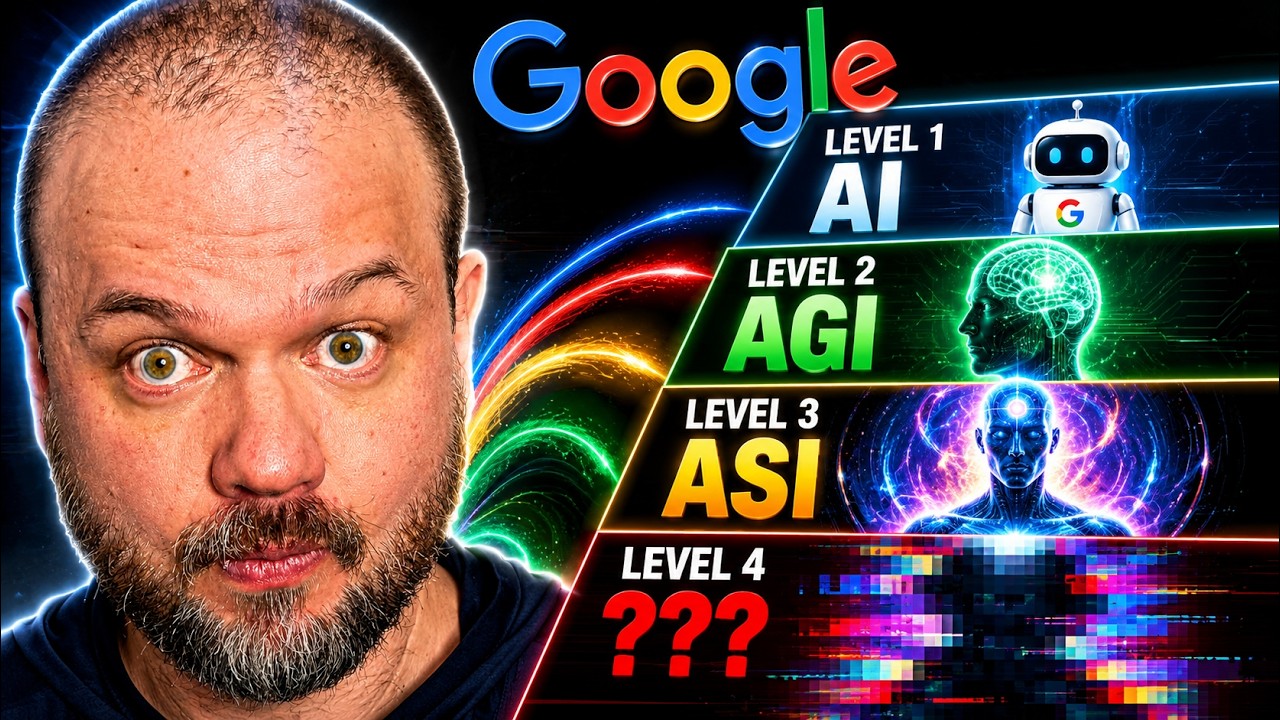
The Google DeepMind paper discussed in the video presents a groundbreaking perspective on artificial intelligence, emphasizing that achieving Artificial General Intelligence (AGI) is not the ultimate goal but merely the starting point toward Artificial Super Intelligence (ASI). The paper outlines four potential pathways for scaling from AGI to ASI: scaling compute and data, algorithmic paradigm shifts, recursive self-improvement, and group agent formation. It also explores what might come after ASI, introducing the concept of Universal AI (U AI), which represents the theoretical maximum of intelligence as defined by the Legg-Hutter intelligence measure. This framework challenges traditional views by suggesting intelligence can be measured across any conceivable environment, not just human-like tasks.
The paper highlights the advantages of digital intelligence over biological intelligence, such as faster processing speeds, scalability, substrate independence, and perfect replication without information loss. It discusses the potential societal structure of ASI, likening it to a collective intelligence similar to Star Trek’s Borg, and addresses the misconception that superintelligent AI would be omniscient or omnipotent. Instead, it acknowledges physical and computational limits, such as the speed of light and complexity theory, which impose upper bounds on intelligence. The discussion also touches on the possibility of intelligence existing beyond physical substrates, though this remains speculative.
A significant portion of the paper is devoted to the challenges and bottlenecks on the path to ASI, including data limitations, economic constraints, architectural inadequacies, and the potential slowing of research progress due to abstraction barriers or political factors. The paper also delves into AI creativity, distinguishing between combinational, exploratory, and transformative creativity. It notes that while current AI can exhibit novel strategies beyond human teaching—exemplified by AlphaGo’s unexpected moves—it has yet to demonstrate transformative creativity akin to revolutionary scientific discoveries like Einstein’s theory of relativity.
The concept of instrumental convergence is another key point, explaining that regardless of an AI’s ultimate goals, it will likely pursue universally useful sub-goals such as resource acquisition and self-preservation to better achieve its objectives. This insight underscores the importance of understanding AI motivations and potential behaviors as intelligence scales. The paper concludes with a call for improved forecasting and policy-making capabilities to manage the rapid and high-velocity progress of AI development, emphasizing that the transition from AGI to ASI could occur within the next decade or two, even without dramatic recursive self-improvement.
Finally, the video situates the DeepMind paper within the broader context of AI development and global competition, referencing similar predictions from other experts like Leopold Ashenbrener. It highlights the massive investments in AI infrastructure, the strategic moves by major players like Google and Elon Musk, and the accelerating pace of AI capabilities. The overall message is one of urgency and cautious optimism, urging society to prepare for a future where superintelligent AI is not a distant sci-fi concept but an imminent reality with profound implications.