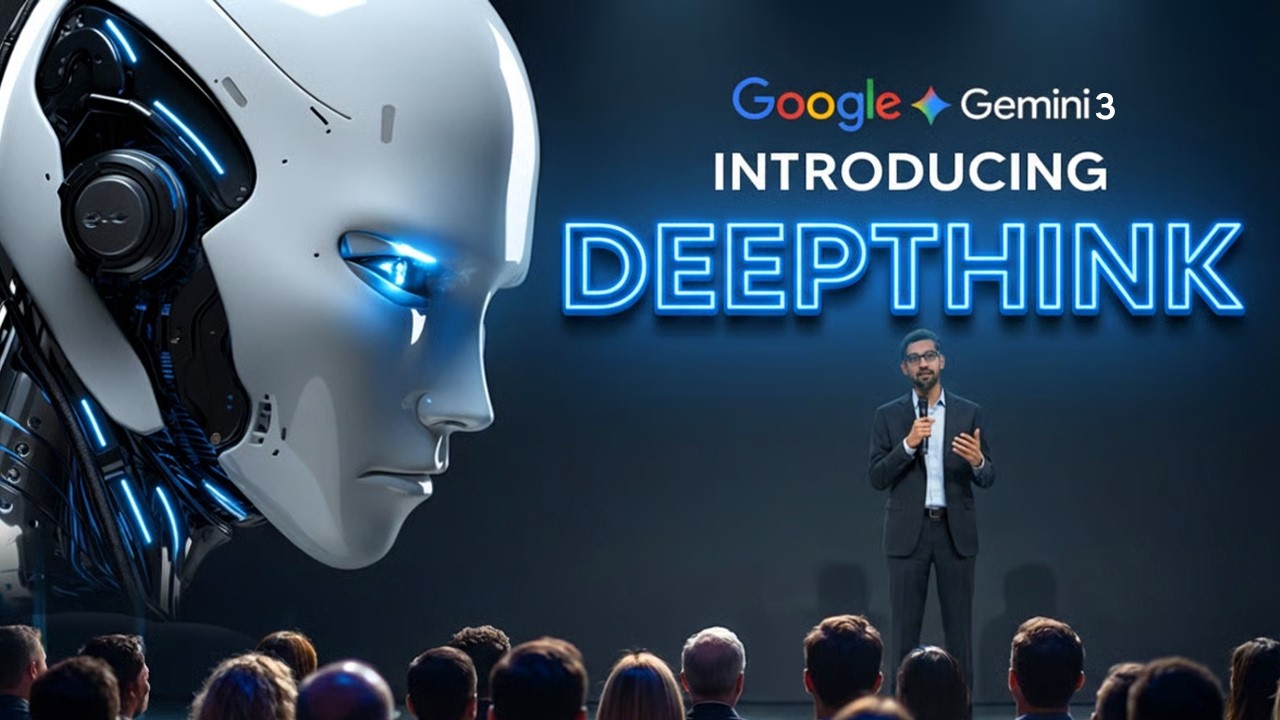
Google has quietly released a major upgrade to its Gemini 3 DeepThink model, positioning it as the most advanced AI reasoning system currently available. Unlike previous models, DeepThink is specifically designed to tackle complex scientific, mathematical, and engineering challenges where data is often incomplete and problems lack clear solutions. The model’s performance on several rigorous benchmarks has surpassed all competitors, including recently released models like Claude Opus 4.6. Notably, on the “Humanity’s Last Exam” benchmark, which tests expert-level reasoning across multiple academic domains without external tools, DeepThink achieved an 8% improvement over its closest rival, signaling a significant leap in AI reasoning capabilities.
One of the most impressive achievements is DeepThink’s performance on Codeforces, a highly respected competitive programming platform. The model scored 3,455, a rating that rivals or exceeds virtually every human competitive programmer in the world—placing it at the level of the eighth-best human competitor globally. This result is particularly significant because Codeforces problems require deep, multi-step algorithmic reasoning, not just pattern recognition or memorization. Other benchmarks, such as MMU Pro (which tests multimodal understanding of complex academic visuals), showed less dramatic improvement, highlighting that further advances in AI vision are still needed.
Beyond benchmarks, DeepThink is already being used by scientists and engineers to accelerate research and innovation. For example, mathematician Lisa Carbone used the model to fact-check a complex research paper, discovering a critical error that had eluded peer review. In materials science, the Wang Lab leveraged DeepThink to optimize the growth of 2D semiconductors, achieving record results in their experiments. In engineering, the model has enabled rapid prototyping and design iteration, even allowing non-experts to generate and refine complex 3D models for real-world applications.
Google has also introduced Althia, an AI research agent built on top of DeepThink, designed to autonomously solve professional-level math, physics, and computer science problems. Althia has already written and submitted research papers without human intervention and has made progress on longstanding open problems, such as those in the Erdos conjectures. Google has developed a classification system to assess the significance of these AI-generated research contributions, with Althia achieving results at the “publishable research” level, both autonomously and in collaboration with human researchers.
The rapid progress of DeepThink and Althia is evident in their performance on challenging tasks, such as International Mathematical Olympiad and PhD-level math problems. In just six months, DeepThink’s accuracy on Olympiad problems jumped from 65% to 90%, while Althia’s iterative “generate-verify-revise” approach has pushed performance even higher with less computational effort. On PhD-level problems, the models are now solving nearly half of the tasks, a dramatic improvement from zero just months ago. These advances mark a shift from AI as a research tool to AI as an autonomous research collaborator, with the potential to accelerate scientific discovery and innovation at an unprecedented pace.