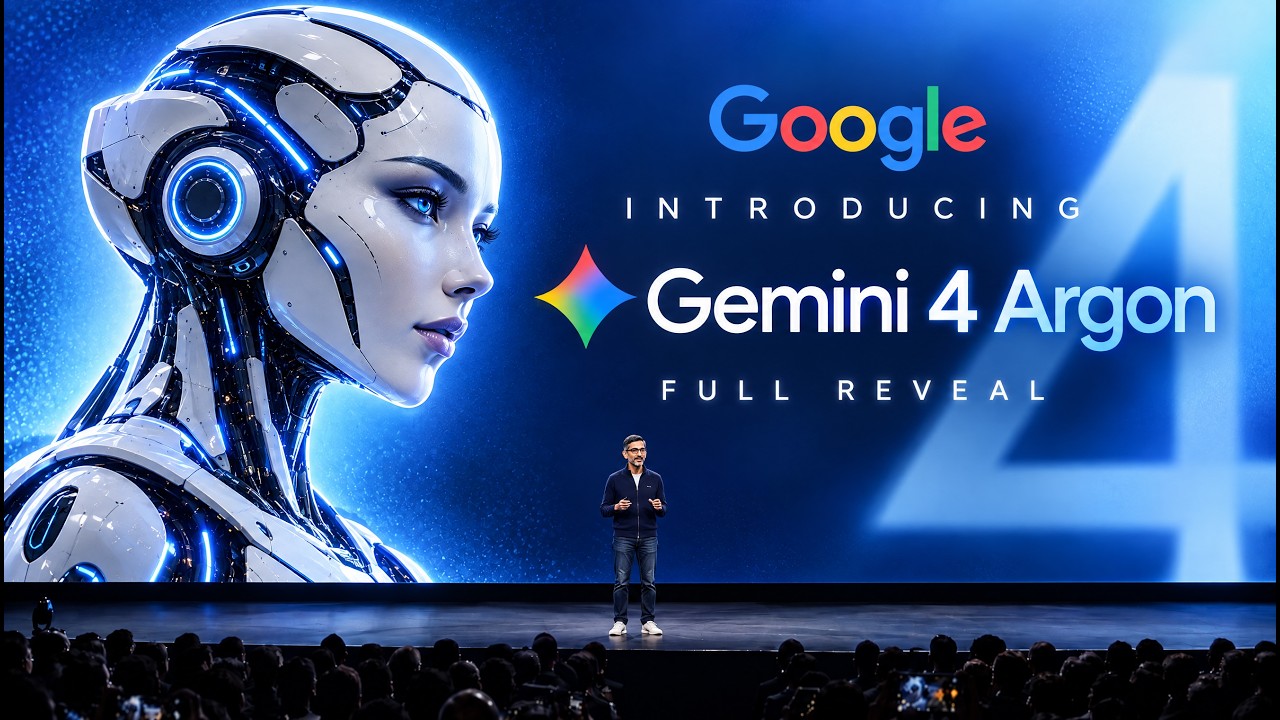
Google has just launched Gemini 4 Argon, its most powerful AI model to date, designed for deep, complex tasks across multiple domains including software engineering, finance, law, cybersecurity, and science. Argon supports a massive one million token context window that can process text, images, audio, and video simultaneously, enabling it to handle entire codebases, lengthy legal contracts, or hours of video content in one go. It excels at long-form reasoning and multi-step workflows, running teams of AI agents in parallel for hours within Google’s Anti-gravity platform. Argon is also integrated into various Google services like the Gemini app, AI mode in search, and Google Cloud, targeting both professional and everyday users.
Performance-wise, Argon marks a significant leap for Google, placing it among the top three AI labs globally. It leads on Google’s Val index for economically valuable professional work and outperforms competitors on benchmarks in finance, legal tasks, automation, and coding. Independent evaluations confirm its strengths, particularly its low hallucination rate and superior prompt injection resistance, making it highly reliable for sensitive fields like legal and financial work. Pricing is competitive during an introductory discount but will double after November, and while Argon is powerful, it is not yet the absolute best in every category, especially coding where competitors like Claude Opus 5.5 still hold an edge.
One of Argon’s standout features is its ability to orchestrate teams of specialized AI agents within Anti-gravity, enabling complex projects like website localization across multiple languages in days instead of weeks. It also demonstrates impressive multimodal capabilities, such as converting raw 3D scans and historical data into interactive web visualizations and building physics simulations from simple sketches. These examples highlight Google’s push towards AI that can manage large-scale, multi-agent workflows and assist users beyond traditional chatbot interactions, including everyday professionals like caterers or researchers.
Cybersecurity is a major focus for Argon, with the model trained to give defenders an advantage by identifying and fixing vulnerabilities faster than attackers can exploit them. It significantly outperforms previous Google models and competitors in real-world vulnerability discovery, penetration testing, and autonomous code auditing. Google has partnered with security firms to deploy Argon in scanning critical infrastructure, uncovering serious security flaws that were quickly remediated. However, due to the dual-use nature of these capabilities, Google tightly controls access and implements extensive safeguards to prevent misuse, including advanced monitoring and alignment training.
Finally, Argon represents a breakthrough in robotics and embodied AI, capable of teaching robots new skills by watching videos, building simulations, and iteratively improving performance without human intervention. Demonstrations include teaching a humanoid robot to play cornhole, controlling a robot dog to open a trash bin, and generating detailed physics simulations from sketches. Google’s extensive safety report acknowledges the model’s advanced capabilities and risks, emphasizing transparency, evaluation awareness, and robust safeguards. While Argon is a major step forward for Google, independent reviews suggest it still trails some competitors in coding and cost-efficiency, but it excels in long-context, low-hallucination tasks, signaling a promising future for trusted, multi-agent AI systems.
Useful Links