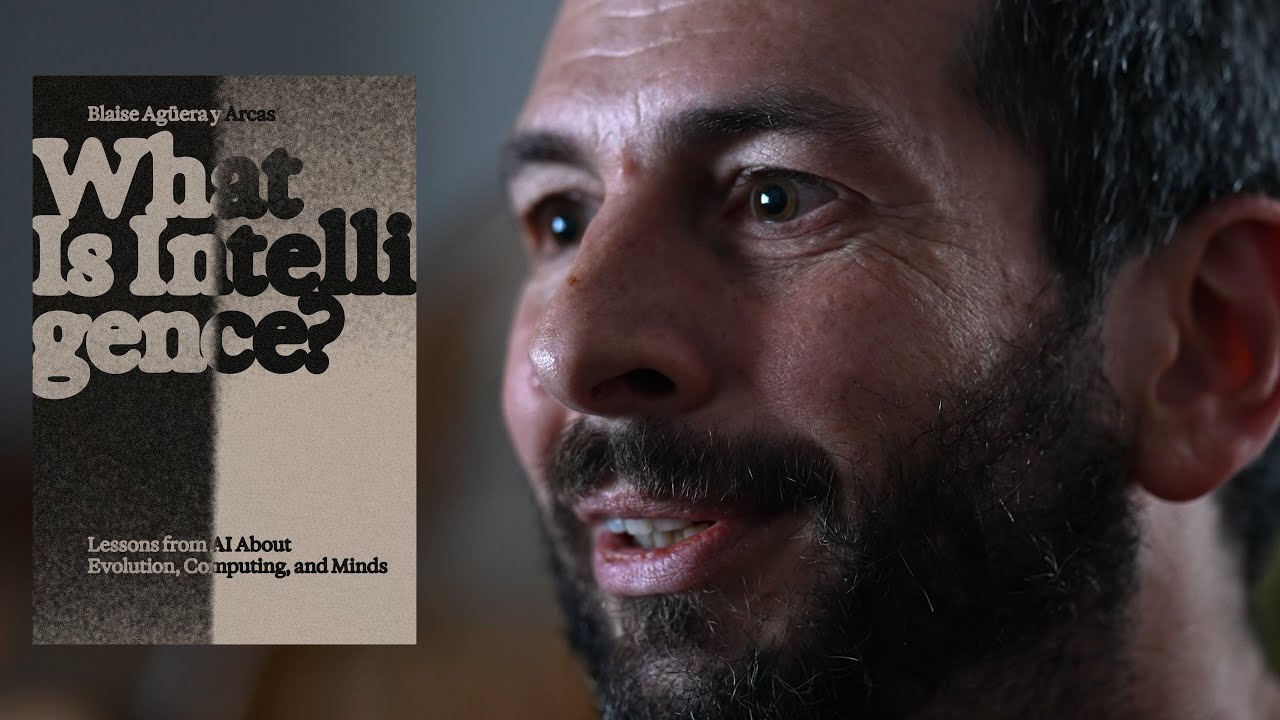
The video features a discussion with a Google researcher and AI expert who recently published a book titled “What is Intelligence?” through MIT Press. The book explores the relationship between life and intelligence, proposing that life itself is a form of computation. Drawing on foundational work by John von Neumann, the researcher explains that living organisms function as universal Turing machines, with DNA acting as a computer program or tape that encodes instructions for self-replication. This computational perspective extends to the cellular level, where ribosomes serve as universal constructors, enabling life to reproduce and evolve through encoded instructions.
The conversation delves into the nature of computation in life, comparing it to cellular automata like Conway’s Game of Life, but emphasizing that biological systems are far more complex due to factors like three-dimensional structure and thermal randomness. The researcher highlights the importance of recursion, parallelism, and nested systems in biological intelligence, where multiple layers of computation—from molecules to cells to societies—interact to produce adaptive behavior. This nested and parallel computational architecture underpins the emergence of complex life and intelligence, allowing for rapid cultural evolution that operates much faster than genetic evolution.
A significant portion of the discussion focuses on the emergence of purpose and life from computational processes. The researcher describes experiments using minimal Turing-complete languages, such as a variant of Brainfuck, where random sequences of instructions evolve into self-replicating programs, demonstrating a phase transition from randomness to order. This emergence of self-replication and purpose is framed as a thermodynamic phenomenon aligned with an extended interpretation of the second law of thermodynamics, where dynamic kinetic stability favors systems that reproduce and maintain themselves. The role of symbiogenesis—merging and cooperation between entities—is emphasized as a key driver of increasing complexity in evolution, challenging traditional Darwinian views that focus solely on mutation and selection.
The discussion also touches on the philosophical and functional aspects of intelligence and consciousness. The researcher advocates a functionalist view, arguing that consciousness is not an epiphenomenon but a necessary feature for cooperation and theory of mind among intelligent agents. Through multi-agent reinforcement learning research, they explore how recursive self-modeling and modeling of others enable cooperation and collective intelligence. Examples such as conjoined twins and split-brain patients illustrate the fluid and relational nature of consciousness and agency, suggesting that boundaries of self and intelligence are context-dependent and can merge or separate depending on the system’s organization.
Finally, the conversation addresses the implications of AI and collective intelligence for society. The researcher expresses cautious optimism, viewing AI as an extension of human collective intelligence rather than a separate or threatening entity. They highlight the convergence of AI model representations with human brain activity and acknowledge current limitations, such as the lack of long-term narrative memory in AI systems. The discussion concludes with reflections on the importance of compositionality, path dependence, and the ecological context of intelligence, emphasizing that intelligence—biological or artificial—is deeply embedded in its environment and history, shaped by both physical and informational substrates.