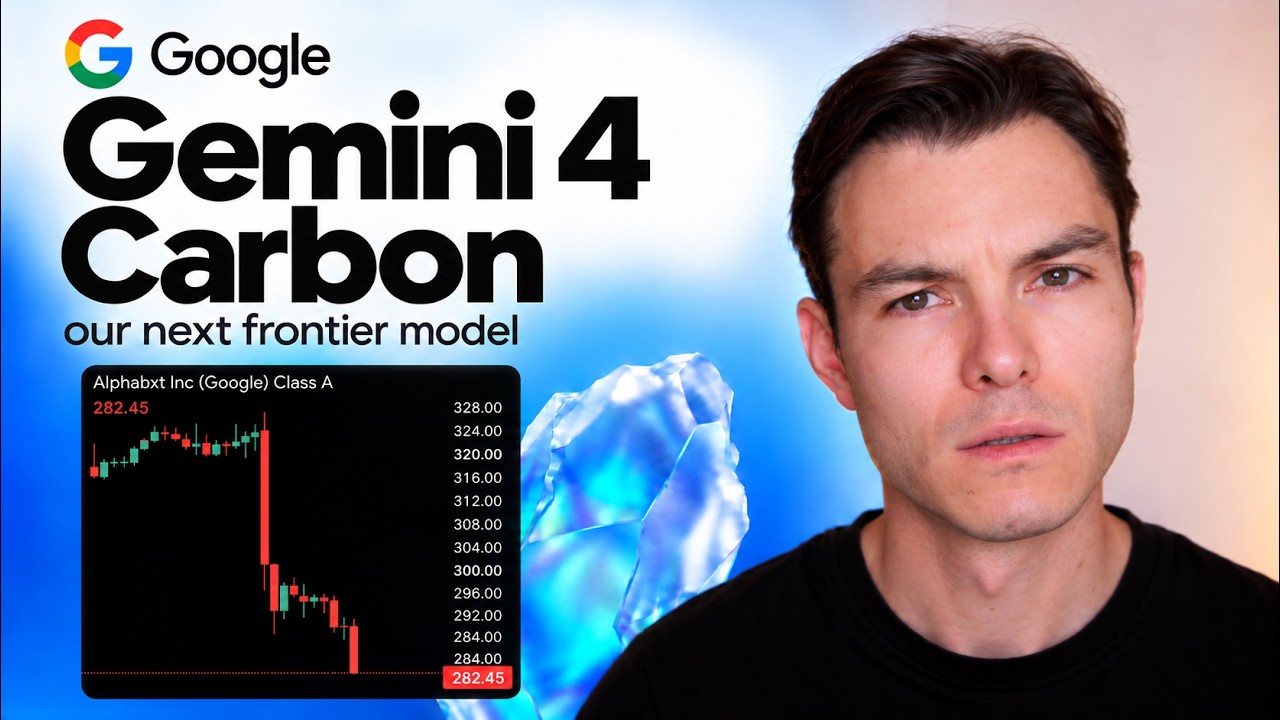
Google recently launched Gemini 4 Carbon, their most advanced AI model, which tops many benchmarks and was announced by their CEO during an earnings call. Despite this achievement, Google’s stock price dropped 10% on the same day, signaling underlying concerns. The release was rushed, likely to showcase leadership in AI amid pressure from competitors like OpenAI and Entropic. Gemini 4 Carbon is a large, powerful model, with a distilled smaller version called Gemini 4 Argon released just two weeks prior, indicating a strategic rollout.
The model excels in long-horizon tasks, coding, and cybersecurity, with Google emphasizing its state-of-the-art cybersecurity capabilities. However, Google is cautious about public release, initially limiting access to trusted cyber defenders to ensure alignment and safety. This cautious approach contrasts with the rushed announcement, suggesting internal pressure to demonstrate progress. Pricing is another concern, as Google offers an initially low price but plans to double it later, a move that contrasts with competitors who are actively reducing costs.
Benchmark results show Gemini 4 Carbon narrowly surpassing competitors like Cloud Opus 5.5 and GPT6 Astra on the latest Artificial Analysis Index V5, which uses private datasets to prevent training bias. However, on coding benchmarks, Gemini 4 Carbon ranks third, behind GPT6 Astra and Cloud Opus 5.5, indicating it is not dominant across all areas. The model’s large size likely contributes to its high token consumption, making it expensive per task despite the low token pricing, which raises concerns about efficiency.
In cybersecurity, Gemini 4 Carbon outperforms even OpenAI’s models, which are known for their strength in this domain. It achieves top scores in vulnerability detection, validation, and remediation benchmarks, reinforcing Google’s focus on security as a core business proposition. Despite this strength, the model’s design and 3D generation capabilities appear underwhelming compared to competitors, with Google ranking fourth in design benchmarks behind Opus Astra and Sonet 5.5, suggesting room for improvement in creative AI tasks.
Overall, while Gemini 4 Carbon is a technical milestone for Google, the rushed release, high operational costs, and mixed benchmark performance highlight challenges. Competitors like Entropic and OpenAI are likely holding back their best models for upcoming IPOs, potentially leaving Google behind in the AI race. Coupled with disappointing search business results, Google faces significant pressure to innovate and maintain competitiveness. The AI landscape benefits from strong competition, so it remains crucial for Google to address these issues and continue advancing.
Useful Links