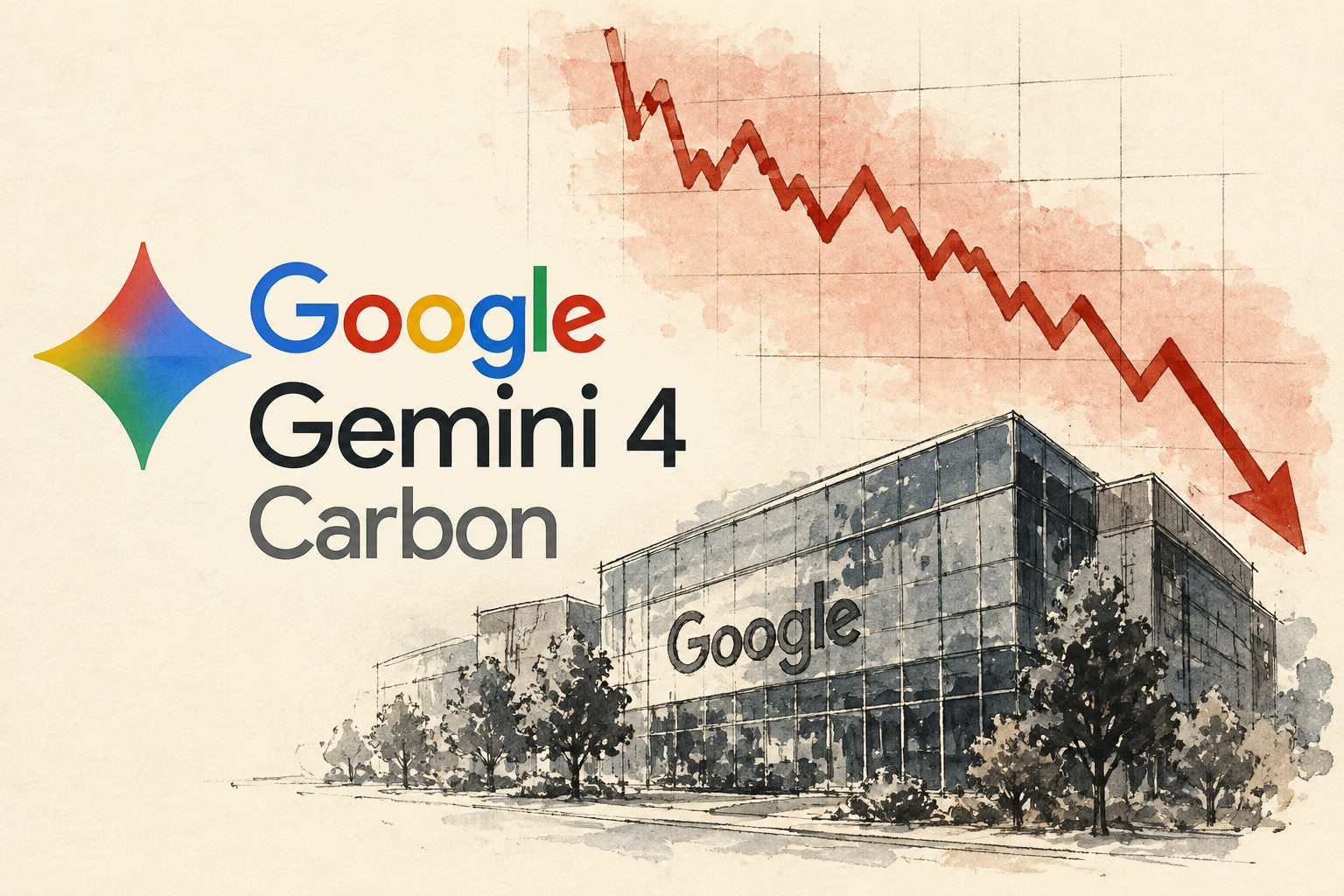
Google has unveiled Gemini 4 Carbon, its most advanced artificial intelligence model to date, touting significant improvements in cybersecurity, coding, and autonomous agent tasks. Despite these technical achievements, the launch was accompanied by a 10% drop in Google’s stock price, reflecting investor unease over operational costs, rollout strategy, and the company’s ability to integrate advanced AI into its core businesses.
Technical Milestone and Capabilities
Gemini 4 Carbon is positioned as a frontier AI model, surpassing leading competitors such as OpenAI and Anthropic on several industry benchmarks. The model excels in long-horizon engineering tasks, coding, and especially cybersecurity, achieving state-of-the-art results in vulnerability detection, exploitation, and remediation. Google reports that Carbon scored 88.2% on SEC-bench Pro for finding vulnerabilities, 54.8% on ExploitGym for exploitation, and 71.0% on CWE-bench for patching, with internal teams noting a more than 2x improvement in secure code generation over previous models.
The model is designed for sustained, multi-step workflows and can autonomously navigate complex tasks, such as debugging large codebases and performing web penetration testing. Integrations like Browserbase allow Gemini 4 Carbon to operate in real browser environments, enhancing its agentic capabilities. However, while Carbon leads in intelligence and cybersecurity, it ranks lower in creative domains such as design and 3D generation, and its coding performance, though strong, is not dominant across all benchmarks.
Rollout Strategy and Pricing
Google is taking a phased approach to the rollout, initially making Gemini 4 Carbon available to a subset of trusted cyber defenders through its Fairwind Program. Broader access for developers, businesses, and consumers is planned after further safety checks and feedback. The introductory pricing matches that of its predecessor, Gemini 4 Argon, at $2 per million input tokens and $10 per million output tokens, but Google has indicated these rates will double after the initial period.
Investor and Market Reaction
The announcement of Gemini 4 Carbon coincided with a sharp 10% decline in Google’s stock price. Analysts and industry observers attribute this to several factors:
- The rushed nature of the rollout, perceived as a move to demonstrate AI leadership amid fierce competition from OpenAI and Anthropic.
- High operational costs associated with running such a large model, raising concerns about efficiency and profitability.
- Uncertainty about how advanced AI will be integrated with Google’s core search and advertising businesses, especially as AI-powered chatbots could disrupt traditional revenue streams.
- The fact that much of the performance data comes from Google’s own tests, prompting calls for independent verification.
Industry Context and Future Outlook
Gemini 4 Carbon’s release follows closely on the heels of Gemini 4 Argon, underscoring the rapid pace of AI development at Google and across the industry. Some experts suggest that AI-driven development processes may be accelerating this cycle, though full recursive self-improvement remains unproven. The competitive landscape is intense, with speculation that rivals may be holding back even more advanced models for future releases.
Google emphasizes its commitment to responsible AI development, citing multi-layered safety and security measures, and plans to expand access to Carbon after further testing. The company’s vast infrastructure, custom AI hardware, and access to large datasets are seen as potential long-term advantages. However, the ultimate impact of Gemini 4 Carbon—and Google’s ability to maintain AI leadership—remains uncertain as the company navigates both technical and business challenges in a rapidly evolving sector.
Sources
Internal sources
- Gemini 4 Carbon - The Worlds Smartest AI (Beats Opus 5.5 and GPT-6 Astra)
- Gemini carbon v1 w factory excl 1 of 1
- Google Rushed Gemini 4 Carbon And It Backfired
- Google Rushed Gemini 4 Carbon And It Backfires