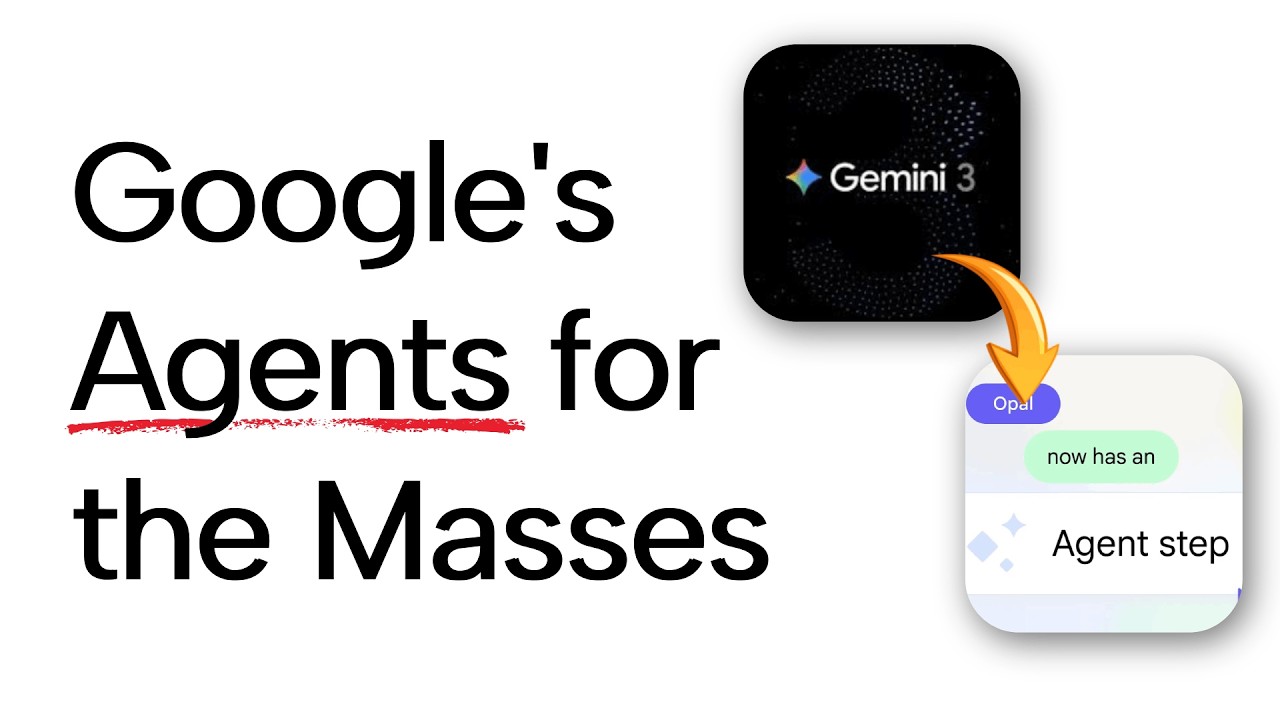
The video discusses the latest updates to Google Labs’ Opal, a no-code visual agent builder that has evolved from a simple drag-and-drop tool into a more sophisticated platform for creating AI agents. The presenter highlights how Google Labs is rapidly releasing new generative AI products, leveraging their Gemini models. Notable recent launches include updates to Flow, Pomelli, and Stitch, all aimed at empowering everyday users to create high-quality outputs with generative AI. Opal, in particular, is positioned as a tool for non-experts to build their own agents, allowing Google to observe which agent types gain popularity and inform future product and model development.
A major feature in the new Opal release is the introduction of the “agent step,” which transforms static workflows into interactive experiences. This reflects a broader trend in AI agent design: as models like Gemini 3 and the latest versions of Claude improve, agents can operate with more autonomy, making decisions dynamically rather than following rigid, pre-defined paths. The presenter compares this to other frameworks such as OpenClaw and LangGraph, noting that the industry is moving away from strictly “agents on rails” toward more flexible, decision-making agents.
Another significant advancement is the addition of memory to Opal agents, allowing them to remember information across sessions and become more personalized over time. While Google hasn’t detailed the technical implementation, this feature aligns with trends in other agent frameworks, where memory is increasingly important for both single-user and multi-user systems. The update also introduces dynamic routing, enabling the model to determine the best path through a workflow, and “interactive chat,” which essentially adds a human-in-the-loop step for agents to ask follow-up questions and gather more user input when needed.
The presenter demonstrates building an Opal agent from scratch, designed to find events and activities in a specified city. The process is straightforward: users input a city name, and the agent uses web search and other tools to generate a comprehensive event list, which is then rendered as a web page. The workflow can be easily customized by adding new nodes or user inputs, and the system supports a variety of tools and models. The demonstration shows how even non-coders can quickly create useful, interactive applications, and how the platform’s flexibility allows for more complex agent behaviors.
Finally, the video encourages viewers to explore Opal and its pre-made templates, such as a Google Calendar integration or a YouTube quiz generator. The presenter emphasizes that Opal is free to try and accessible to anyone with a Google GenAI account, making it a valuable resource for both personal and educational use. The video concludes by inviting feedback from viewers and suggesting that similar agent-building tools are likely to emerge from other companies, especially for corporate applications.