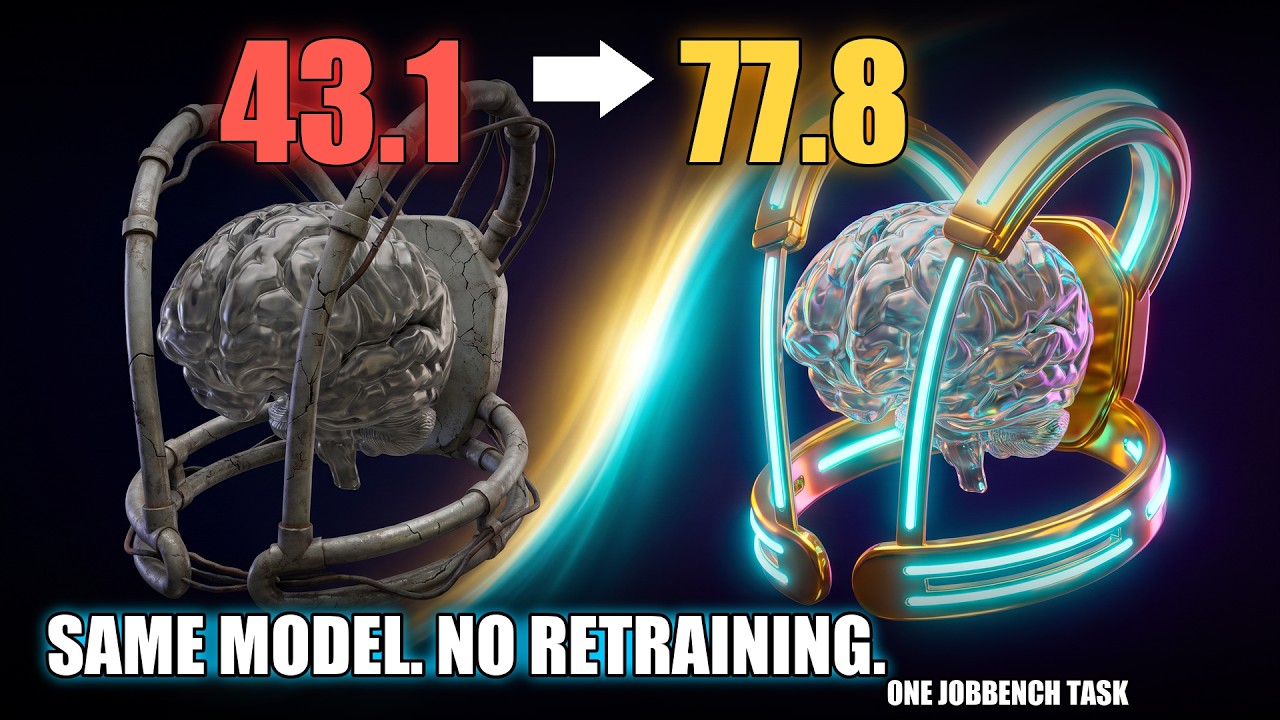
Google Research has developed an innovative AI system called Harness Squared, which enables an AI agent to improve its own operational framework, or “harness,” without any human intervention. The harness includes all the prompts, tools, memory, skills, and rules that surround the AI model, which itself remains unchanged and frozen. This approach addresses the significant variability in AI performance caused solely by differences in the harness, highlighting that the same model can perform drastically differently depending on how it is wrapped and guided.
The core challenge Harness Squared tackles is recursive self-improvement in an open-world setting where there is no ground truth or verifier to measure success. To overcome this, the system uses a two-loop recursive process: an inner loop focused on task-level improvements and an outer loop that manages harness-level learning across tasks. The harness is modularized into eight editable files, including system prompts, guardrails, memory, skills, and tool guidance, allowing the AI to read, edit, and improve its own instructions and operational rules systematically.
Within the inner loop, the agent first performs a task with the current harness to generate a reference run. Then, an editor proposes two new harness variants—one targeting general failures and another focusing on domain-specific knowledge. These variants are tested alongside the original, and their outputs are compared to identify improvements or regressions without needing the correct answer. A composer then merges or selects the best edits based on evidence, producing a refined harness that is tested again to deliver the final improved output.
The outer loop involves a reflector that reviews the entire improvement history after each task, storing successful harness versions and lessons learned in a library. This library allows the agent to borrow ideas for future tasks, enabling transfer learning and continuous improvement without inheriting potentially unsuitable changes. This method was demonstrated on real benchmarks, where Harness Squared significantly boosted performance across various tasks and models, sometimes enabling a weaker model with a better harness to outperform a stronger model with its original harness.
Despite its successes, Harness Squared has limitations, including increased computational costs and potential vulnerability to randomness and model biases due to the lack of ground truth. Future work aims to optimize the library by pruning less useful knowledge and dynamically adjusting exploration based on task difficulty. The system is open source, allowing users to experiment with it locally, marking a step forward in AI systems that can autonomously refine their own operational frameworks to achieve better results.
Useful Links