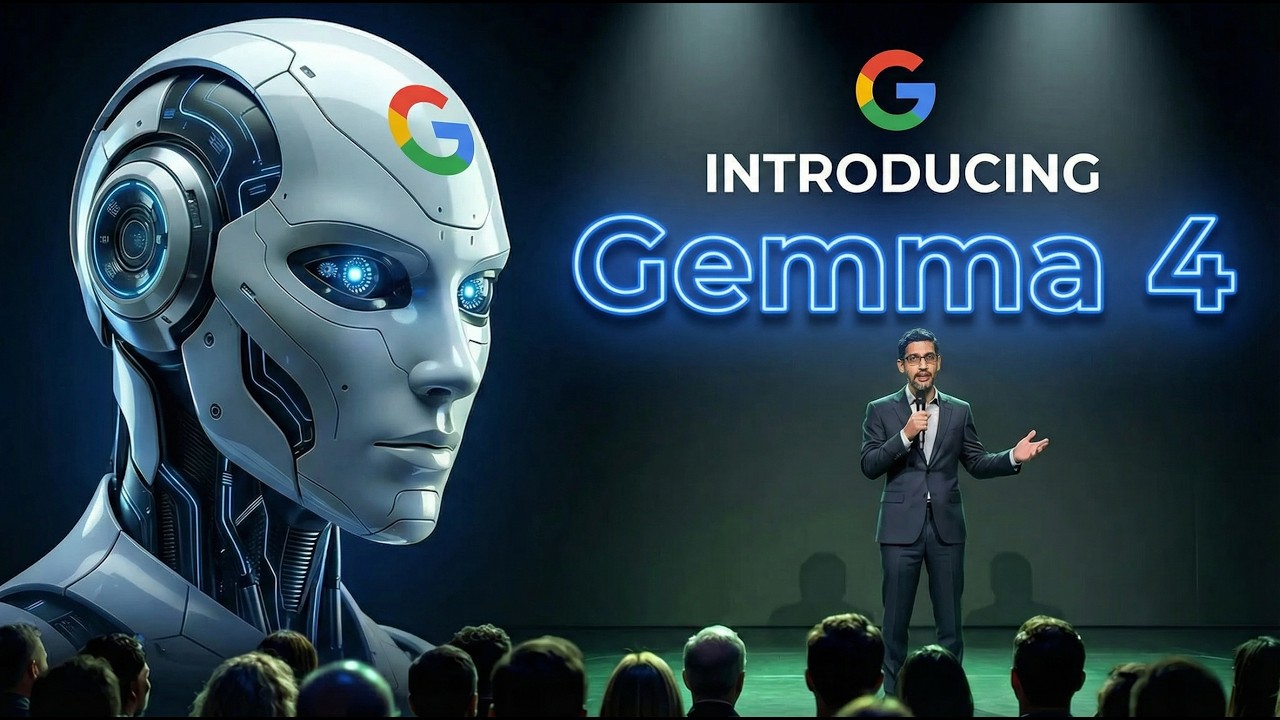
Google has just released Gemma 4, a groundbreaking open-source family of AI models designed to run directly on personal hardware such as phones, laptops, and desktops. Released under the Apache 2.0 license, Gemma 4 is built on advanced research from Gemini 3 and is tailored for the agentic era, capable of handling complex logic, multi-step planning, and agentic workflows. The models support large context windows of up to quadrillion tokens, enabling analysis of entire codebases and multi-turn interactions, with native tool use support for building intelligent agents.
The Gemma 4 family includes a 26 billion parameter mixture of experts model and a 31 billion parameter dense model, both optimized for local reasoning and coding without needing to upload data externally. The 26B model is exceptionally fast, while the 31B model prioritizes output quality. Additionally, there are smaller, memory-efficient 2B and 4B models designed for mobile and IoT devices, featuring combined audio and vision capabilities for real-time processing and support for over 140 languages, making them highly versatile for multilingual and multimodal tasks.
One of the most impressive aspects of Gemma 4 is its efficiency. Despite having fewer parameters compared to other large models like GLM5 or Kim K 2.5, Gemma 4 achieves comparable performance while being up to ten times more efficient. This efficiency allows users to run powerful AI models locally on their own hardware, ensuring data privacy, offline functionality, and significant cost savings. The 31B parameter model, for example, can be run on a personal GPU, eliminating the need for cloud-based inference and associated expenses.
The models are also remarkably lightweight and scalable, with the smaller versions running smoothly on devices like the iPhone 15 Pro using only a few gigabytes of RAM. This opens up new possibilities for on-device AI applications that are private, offline, and multimodal, supporting images, audio, and potentially video inputs. The ability to run such advanced models locally without sacrificing quality or speed is a major step forward for the open-source AI ecosystem and could shift the default towards on-device AI usage for many tasks.
Overall, Gemma 4 represents a significant leap in open-source AI, combining high performance, efficiency, and accessibility. Google’s release not only makes powerful AI models freely available but also enables users to run them securely and privately on their own devices. This development is poised to reshape the AI landscape by making advanced reasoning and multimodal AI capabilities widely accessible, affordable, and practical for everyday use. Tutorials and guides are already available to help users get started with Gemma 4 on various devices, signaling a new era of local AI empowerment.