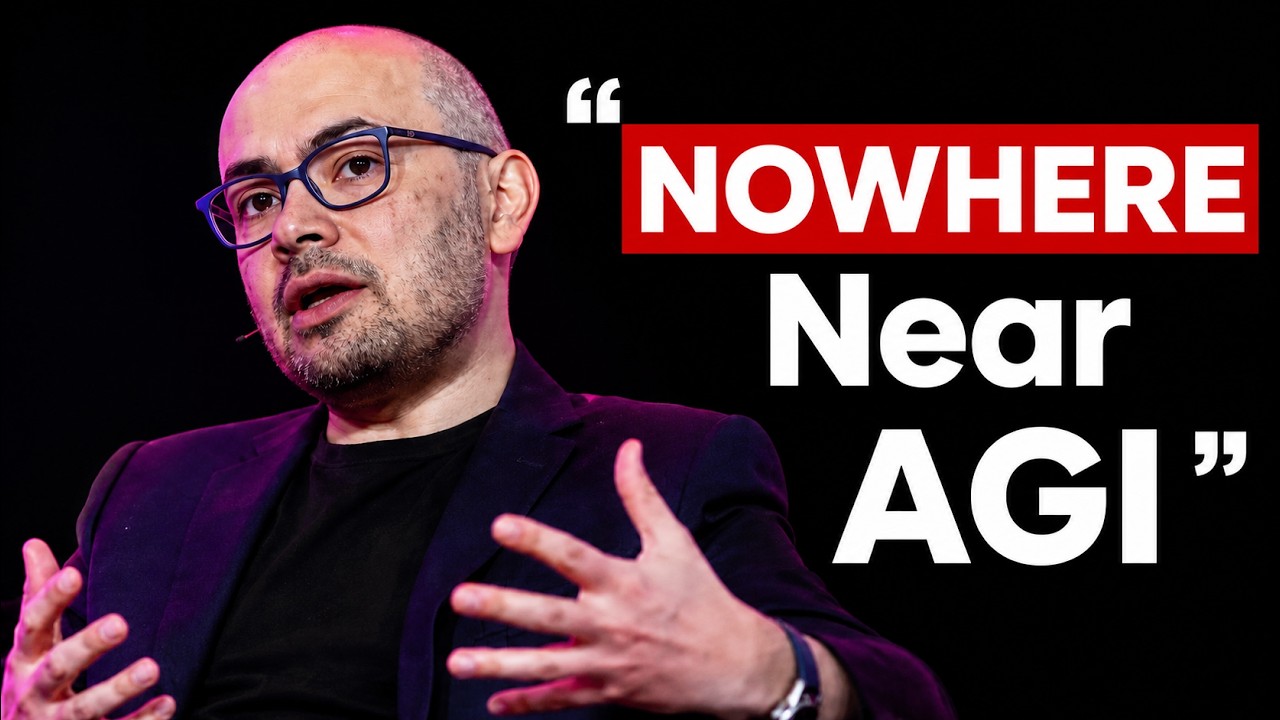
Demis Hassabis, CEO of Google DeepMind, recently stated that today’s AI systems are “nowhere near” achieving Artificial General Intelligence (AGI). Despite impressive advances, such as AI models solving complex mathematical problems like the Erdős conjecture, Hassabis emphasizes that these achievements do not equate to true AGI. He defines AGI as a system capable of exhibiting the full range of human cognitive abilities—creativity, planning, reasoning, and reliable performance across diverse tasks—not just excelling in narrow domains or producing impressive outputs in isolated instances.
The current state of AI is described as powerful yet inconsistent, often referred to as exhibiting “jagged intelligence.” While AI can outperform humans in specific tasks like coding, research, or language generation, it still struggles with reliability, hallucinations, lack of stable memory, and real-world understanding. Experts like Gary Marcus highlight these inconsistencies, pointing out bizarre behaviors such as AI models inserting nonsensical words like “goblins” into outputs, which underscores the technology’s unpredictability and the challenges in aligning AI systems safely and effectively.
On the other hand, proponents of the view that AGI is near or already here, such as Marc Andreessen, argue that AI’s ability to provide expert-level answers across multiple fields resembles general intelligence in practical terms. Nick Carter supports this by noting that if a human possessed the combined capabilities of current AI models, they would be considered a genius. However, the key distinction remains that AI’s strengths and weaknesses do not mirror human cognition, and current systems lack the stable, transferable intelligence that true AGI would require.
The debate is further complicated by differing definitions of AGI. Helen Toner points out that the term has become fuzzy, with some equating AGI to expert-level chatbots and others expecting fully autonomous, conscious machines capable of recursive self-improvement. This semantic confusion makes it difficult to have a clear consensus. Meanwhile, Yann LeCun and Demis Hassabis acknowledge that while AI is far from human-level intelligence, it is already transformative and rapidly evolving, with the potential to reach AGI within a few years.
In conclusion, the consensus among leading AI researchers is that while AI has made remarkable progress and is already reshaping industries, it has not yet achieved the comprehensive, reliable, and creative intelligence that defines AGI. The ongoing debate reflects both the excitement and caution surrounding AI’s capabilities. Recognizing the current limitations is crucial to responsibly deploying AI technologies and preparing for the profound changes that true AGI could bring in the near future.