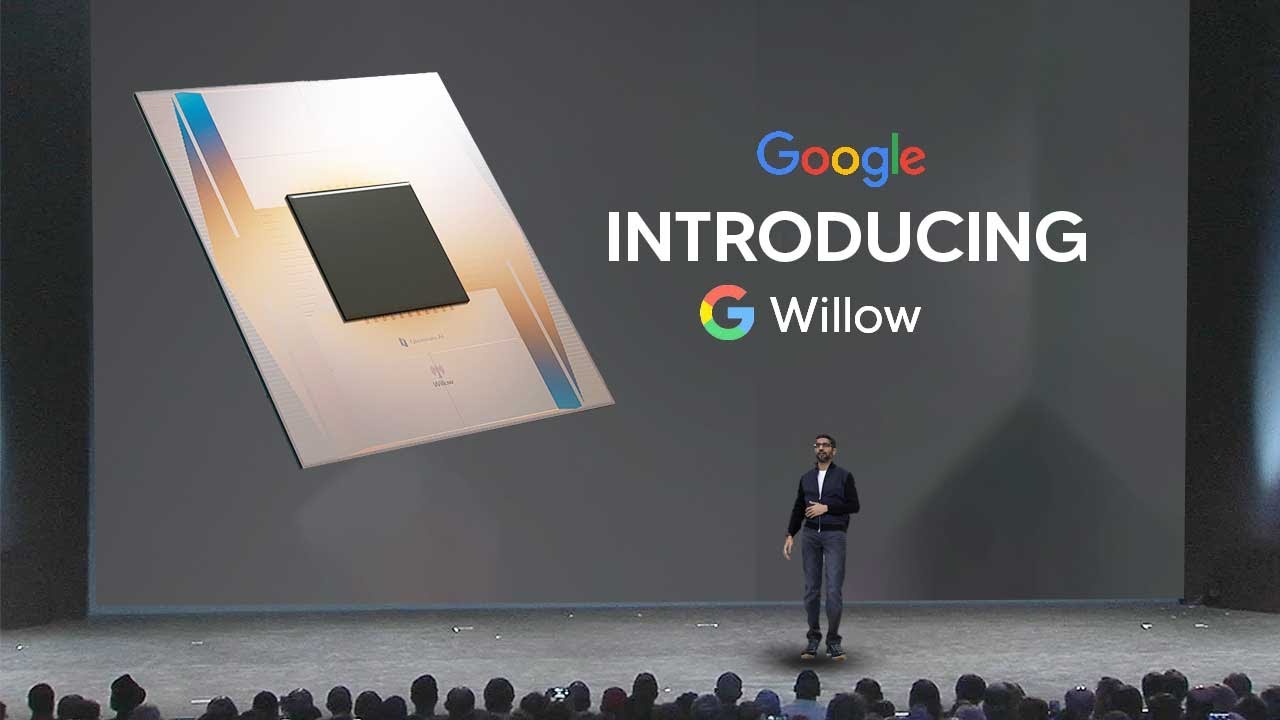
Google has unveiled its revolutionary quantum chip, Willow, which utilizes qubits to perform complex calculations exponentially faster than traditional supercomputers while improving error correction as it scales. With the potential to transform computing and advance technologies like artificial intelligence, Willow’s capabilities raise intriguing questions about the nature of computation and the future of quantum technology.
In a groundbreaking announcement, Google introduced its new quantum chip named Willow, which is set to revolutionize computing by leveraging the principles of quantum physics. Unlike traditional computers that operate on binary code (ones and zeros), Willow utilizes quantum bits, or qubits, which can exist in multiple states simultaneously. This unique property allows Willow to perform complex calculations much faster than conventional supercomputers. The chip’s design challenges the conventional wisdom that larger systems tend to be more error-prone, as Willow actually improves its error-correcting capabilities as it scales up.
One of the most significant breakthroughs of Willow is its ability to handle errors more effectively as the number of qubits increases. In a visual analogy, the chip can be likened to a team of workers who collaborate to catch and correct mistakes. As the team grows, so does its efficiency in managing errors, which is contrary to the traditional understanding that larger systems are more chaotic. This innovative approach allows Willow to maintain its quantum properties even as it expands, making it more stable and reliable.
The performance of Willow is astonishing, with the ability to complete calculations in under five minutes that would take the fastest supercomputer an unfathomable 10^25 years. This staggering difference highlights the vast potential of quantum computing and raises questions about the nature of computation itself. Some theorists suggest that quantum computers might be tapping into parallel universes to perform calculations, allowing them to explore multiple solutions simultaneously, akin to having infinite versions of oneself working on a problem at once.
Despite concerns that Willow could pose a threat to Bitcoin security, experts clarify that the chip’s capabilities are not suited for breaking Bitcoin encryption. Willow excels in specific types of calculations but lacks the versatility and precision required to crack complex cryptographic systems. This distinction emphasizes that while quantum computing is advancing rapidly, it does not render existing security measures obsolete.
Looking ahead, Google has outlined a roadmap for quantum computing milestones, including improving error correction, developing long-lived qubits, and creating reliable logical gates. Each milestone builds upon the last, ultimately leading to a fully functional quantum computer capable of solving real-world problems. As the field of quantum computing evolves, it promises to unlock new possibilities in artificial intelligence and other advanced technologies, marking an exciting era of innovation on the horizon.