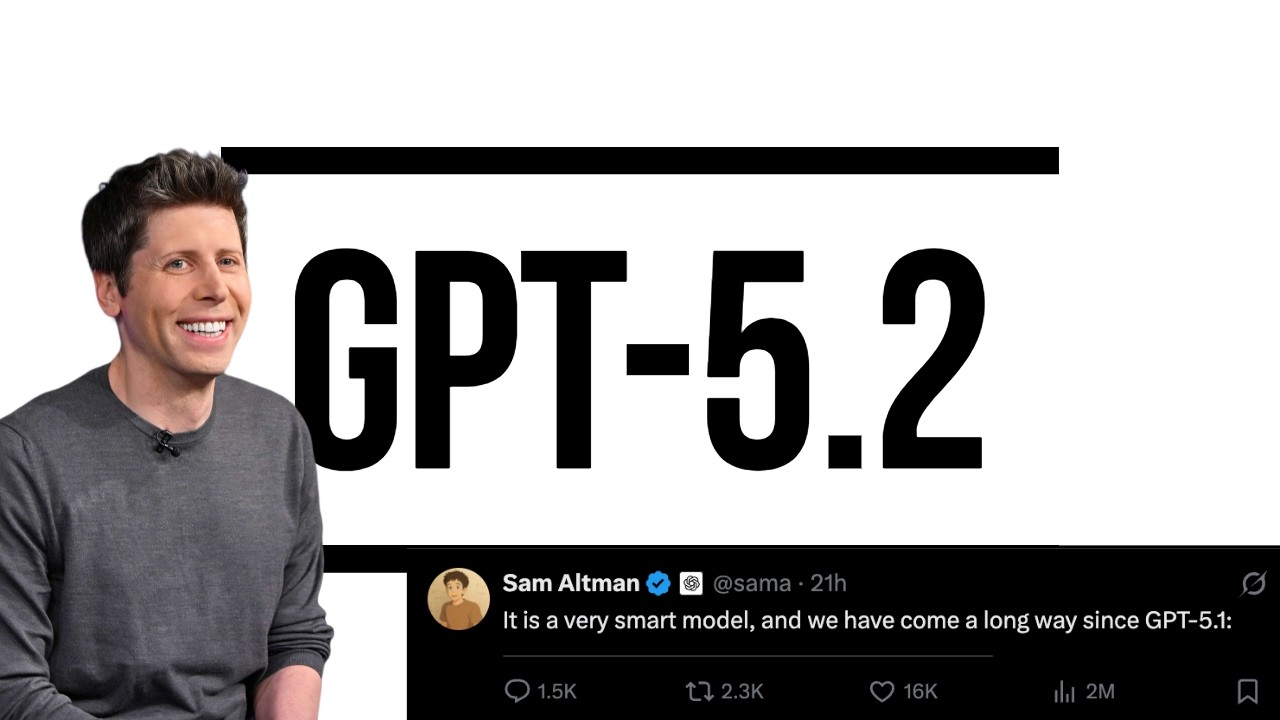
In the last 24 hours, OpenAI released GPT 5.2, a new language model that has achieved record-breaking results on several benchmarks. While it may not be a Christmas miracle, GPT 5.2 performs at or above human expert level on many professional tasks, particularly those involving well-specified digital jobs. However, the model often requires more tokens—essentially more “thinking time”—to reach frontier performance. This means that while GPT 5.2 is among the best language models available, its impressive results come with the caveat that increased computational effort is often necessary.
One important nuance highlighted is the complexity of comparing AI models based on benchmarks. OpenAI’s claims about GPT 5.2’s superiority are based on specific, carefully selected tasks and benchmarks, which may not fully capture real-world complexity or the impact of catastrophic errors. Additionally, comparisons with other models like Claude Opus 4.5 and Gemini 3 Pro are sometimes missing or incomplete, leading to debates about which model truly leads in various areas such as visual understanding, coding, and chart analysis. The performance of these models often depends heavily on the computational budget allocated during testing, making direct comparisons challenging.
The video also discusses the importance of benchmark selection and the difficulty in trusting any single benchmark as definitive. Different benchmarks test different skills, and even those designed to measure the same abilities can yield varying results. For example, GPT 5.2 outperforms Gemini 3 Pro on some reasoning benchmarks but falls behind on others, such as a custom benchmark called SimpleBench, which tests common sense and spatio-temporal reasoning. This highlights that no single model is best at everything, and the choice of model should depend on the specific use case.
Another notable advancement of GPT 5.2 is its ability to recall details across extremely long contexts, with near-perfect accuracy on tasks involving up to 400,000 tokens. This is a significant improvement and positions GPT 5.2 as a strong competitor to Gemini 3 Pro in applications requiring long-term memory and context understanding. However, for even longer contexts—up to a million tokens—Gemini 3 Pro still holds an advantage. The video also touches on incremental improvements in AI capabilities, such as coding and machine learning engineering tasks, where GPT 5.2 shows progress but is not yet dominant.
Finally, the video reflects on the broader implications of GPT 5.2 and the future of AI development. OpenAI’s CEO Sam Altman predicts superintelligence within the next decade, and the company is already working on models beyond GPT 5.2. Despite the hype, progress remains largely incremental, with AI gradually mastering one task after another rather than achieving a sudden leap to superintelligence. The analogy of counting sheep is used to illustrate this steady, task-by-task approach to automating human endeavors. Overall, GPT 5.2 represents a meaningful step forward, but the journey toward true artificial general intelligence continues.