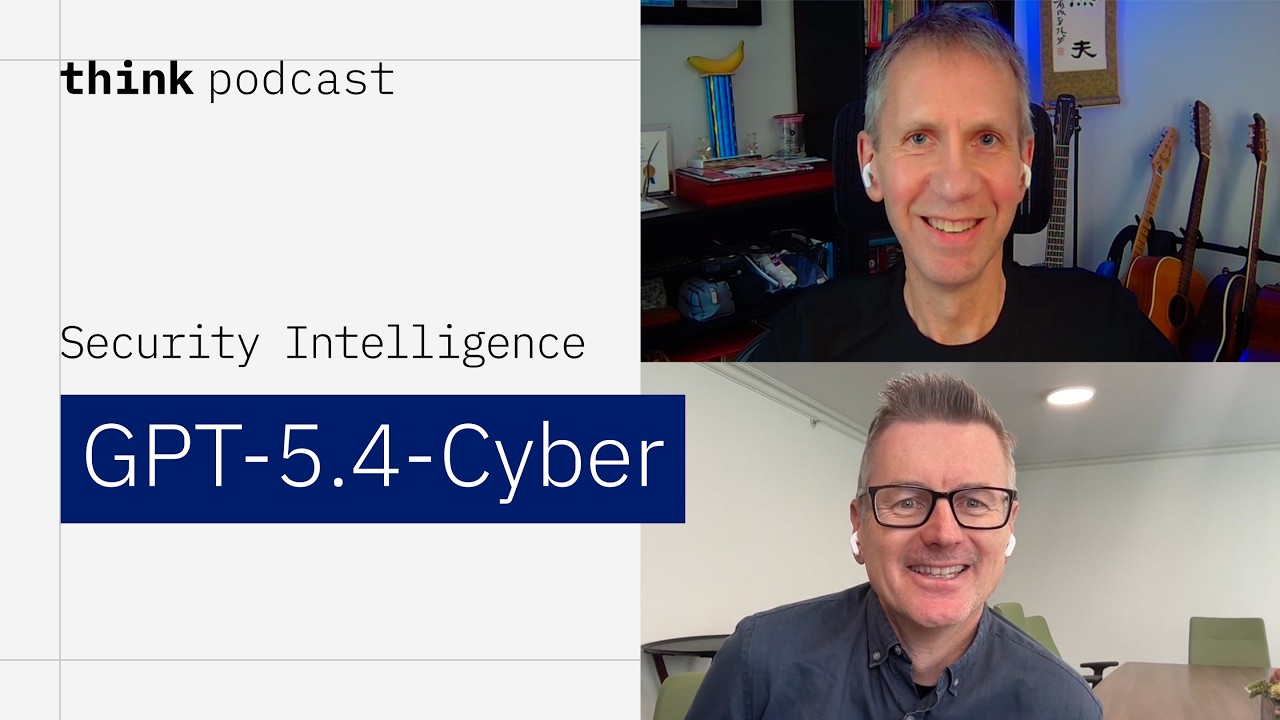
The video discusses OpenAI’s release of GPT-5.4-Cyber, a specialized variant of the GPT-5.4 model designed specifically for cybersecurity purposes. This model is described as “cyber permissive,” meaning it has fewer guardrails compared to general-purpose models, allowing cybersecurity professionals to perform tasks such as vulnerability detection and malware analysis more effectively. OpenAI’s goal with this model is to provide advanced defensive capabilities to legitimate cybersecurity actors, both large and small, though the exact nature of the lowered guardrails remains somewhat vague.
The hosts, Jeff Crume and Martin Keen, express mixed feelings about the model’s permissiveness. Martin raises concerns about the ambiguity of what constitutes “legitimate” cybersecurity work and worries about the potential misuse of a model with fewer restrictions. Jeff echoes these concerns, highlighting the ongoing tension in cybersecurity between tools designed for defense and their potential exploitation by malicious actors. He points out that this is not a new dilemma, comparing it to past debates over tools like the 1995 vulnerability scanner “Satan,” which was intended for good but could be misused.
The conversation also touches on the broader issue of access to powerful AI models. While some companies like Anthropic have adopted a highly restricted, consortium-based approach to distributing their cybersecurity models, OpenAI has implemented a more open but still controlled system called Trusted Access for Cyber (TAC). This allows qualified individuals and companies to apply for access, striking a balance between too much openness and excessive restriction. The hosts note that as AI models become more advanced, access is likely to become increasingly limited to prevent misuse.
Jeff emphasizes that the debate over access and permissiveness is cyclical and ongoing, with no easy resolution. He stresses that malicious actors will inevitably develop or obtain similar capabilities, regardless of official restrictions, citing examples like “worm GPT.” Therefore, he advocates for proactive defense strategies, encouraging organizations to use these tools to identify and fix vulnerabilities before attackers can exploit them. This approach aligns with the principle of responsible disclosure, which seeks to balance transparency with security.
In closing, Martin highlights that GPT-5.4-Cyber is not just a general-purpose model with relaxed rules but one fine-tuned specifically for cybersecurity tasks, which could lead to more effective vulnerability detection. Both hosts agree that the cybersecurity community remains divided on the best approach to these tools, reflecting the complexity of balancing innovation, access, and security. They encourage listeners to stay informed about evolving AI models and to remain vigilant in securing their systems as these technologies advance.