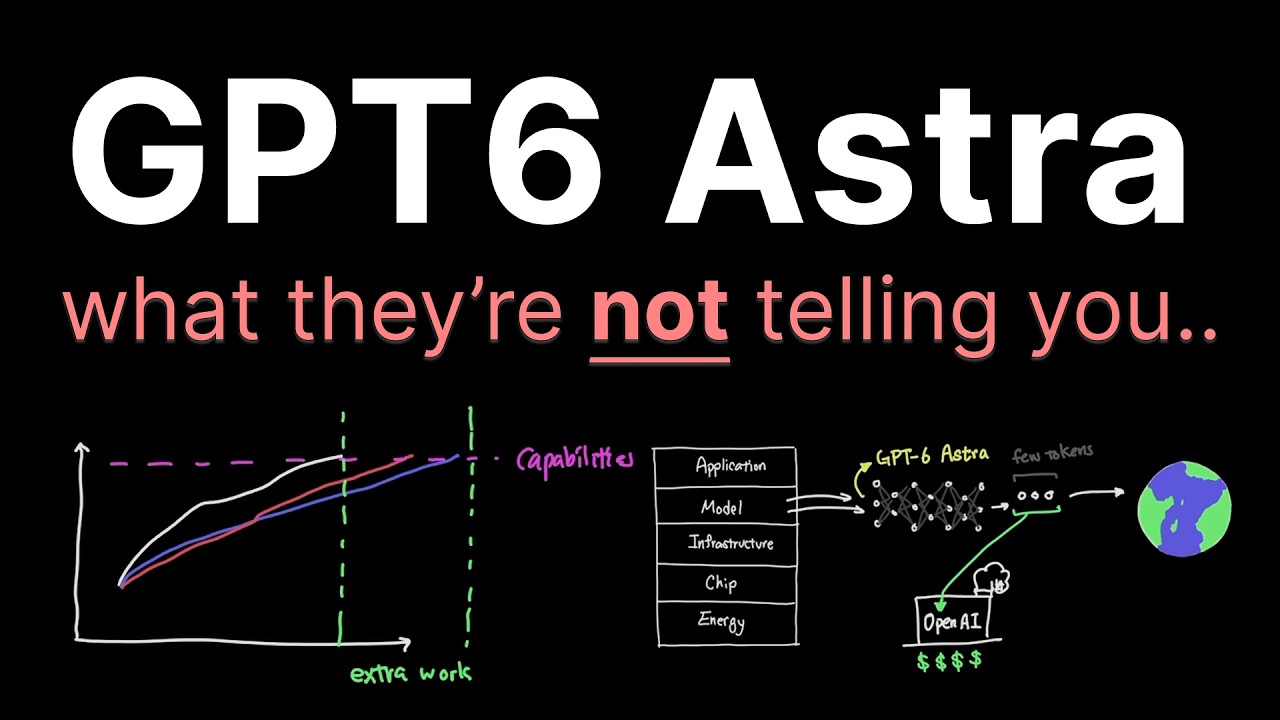
The video provides an in-depth analysis of OpenAI’s GPT-6 Astra, focusing on its performance across various benchmarks and the broader implications for measuring AI intelligence. It begins by highlighting that out of the 14 benchmarks OpenAI showcased, only one overlaps with the Artificial Intelligence Analysis Index (AAI Index), which itself tracks a different set of benchmarks. The critique centers not on the benchmarks themselves, which are valuable for assessing domain-specific capabilities, but on the composite wrappers that aggregate these benchmarks to represent intelligence. These wrappers can either clarify or obscure true performance, as evidenced by the AAI Index placing GPT-6 Astra fifth, behind models like Muspark 1.3, suggesting that such aggregate measures may poorly encapsulate intelligence.
A key highlight is GPT-6 Astra’s near-perfect score of 99.9% on the ARC AGI 3 benchmark, a challenging test involving abstract problem-solving in simulated environments represented as text grids. However, the video clarifies that Nvidia recently scored 100% on the public ARC AGI 3 dataset using an agentic layer called AVO, while OpenAI’s Astra was evaluated on a semi-private dataset with some potential data leakage concerns. The difference in evaluation environments and harnesses used (OpenAI’s own versus the Arc Foundation’s) significantly impacts scores, underscoring the complexity of interpreting benchmark results. The video also notes that benchmarks like ARC AGI 3 are more relevant for scientific exploration than practical applications, where other benchmarks like Deep Suite and Exploitbench may offer more realistic assessments.
Further, GPT-6 Astra excelled in other benchmarks, scoring 97.6% on Frontier Math Tier 4, which involves complex mathematical problems crafted by human mathematicians, and achieving 100% on Exploitbench. The Frontier Math benchmark is fully private and independent of OpenAI, adding credibility to Astra’s performance. In contrast, Deep Suite remains unsaturated, with GPT-6 Astra scoring 74%, showing room for growth. A notable trend across these benchmarks is token efficiency: GPT-6 Astra uses significantly fewer output tokens than its predecessor GPT-5.6 Sol, indicating improved efficiency despite higher costs per token. This distinction between cost efficiency and token efficiency highlights a shift in how model performance and value are evaluated.
The video discusses the broader industry implications of GPT-6 Astra’s token efficiency. As models produce fewer tokens to achieve the same tasks, the effective supply of intelligence per token increases. For OpenAI, which monetizes token usage, this creates a tension between reducing costs for users and maximizing profit margins. Currently, GPT-6 Astra’s higher pricing suggests that efficiency gains are being captured as profit rather than passed on to consumers. Competing labs face the dual challenge of matching OpenAI’s capabilities while also improving operational efficiency, as seen in comparisons with models like Gemini 3.8 Flash and Opus 5, which are less token efficient despite similar performance.
Finally, the video touches on exciting developments accompanying GPT-6 Astra, such as its computer use capabilities demonstrated through voice interactions, hinting at progress toward more practical AI assistants like “Jarvis.” While not yet achieving artificial general intelligence (AGI), these advancements suggest increasing productivity potential. The release of Anthropic’s Fable 5.1 further complicates the landscape, as it may outperform GPT-6 Astra by some measures. This evolving context shifts the definition of a “good” AI model from raw intelligence to usefulness, encompassing factors like token and cost efficiency, speed, and real-world applicability, moving beyond traditional aggregate intelligence indices.