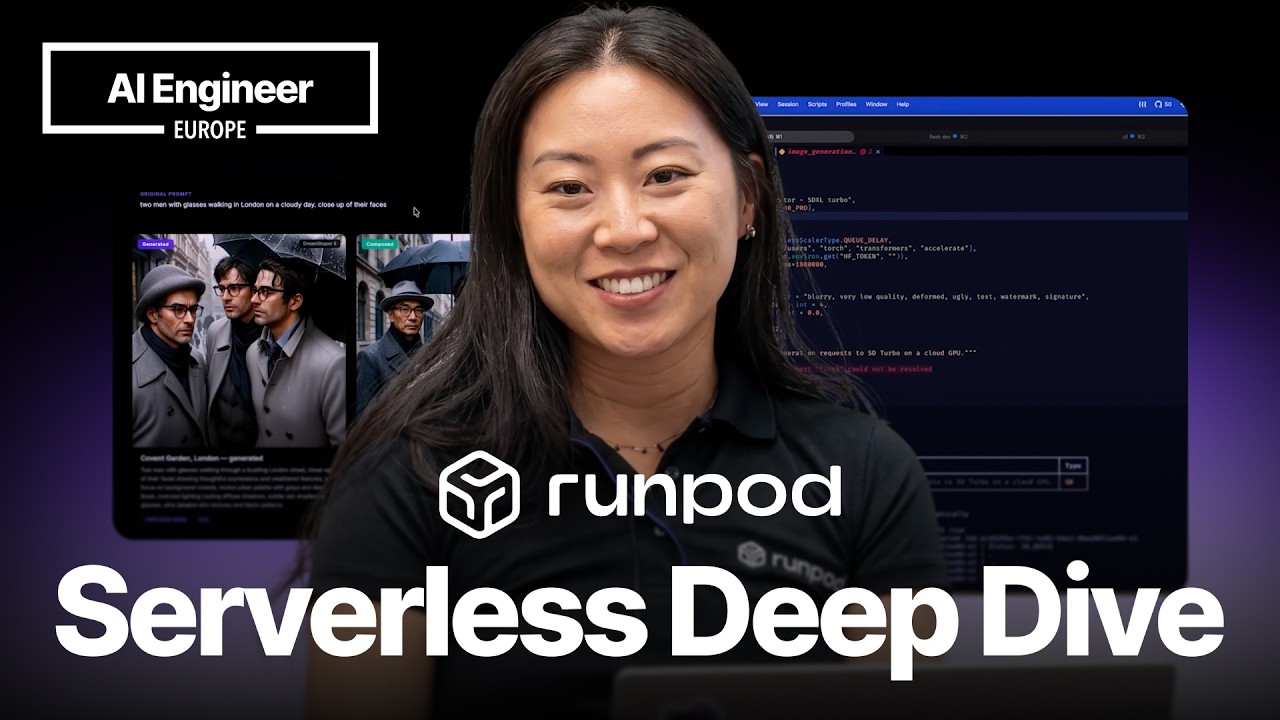
Audry Hsu from RunPod introduces the company as an AI cloud infrastructure provider focused on simplifying GPU cloud deployment for developers. RunPod aims to eliminate the complexities of managing infrastructure, such as CUDA version compatibility and GPU configuration, allowing developers to focus on building and training AI models. The company was founded in 2022 by Zenin and Pradeep, who initially started by offering spare GPUs from a failed crypto mining venture. Since then, RunPod has grown to serve around 500 developers across 30+ data centers in 10 countries, generating significant annual recurring revenue.
RunPod offers various deployment options tailored to different needs, including persistent VMs called pods, serverless auto-scaling workloads, multi-node clusters for training, and a hub for deploying popular open-source AI models. Audry focuses on demonstrating the serverless product, which allows developers to deploy GPU-powered functions directly from their local IDE using RunPod’s Python SDK called Flash. This tool streamlines the development cycle by eliminating the need to commit code, build Docker images, and manually manage GPU servers, enabling rapid iteration and testing.
The Flash SDK works by decorating an asynchronous Python function to deploy it on a GPU cloud seamlessly. Audry showcases a demo using a stable diffusion model to generate images based on user prompts, highlighting how changes in code are instantly repackaged and deployed without leaving the local development environment. This approach significantly speeds up the development process, allowing developers to test different models and configurations quickly and efficiently.
Audry further demonstrates a more complex pipeline that orchestrates multiple AI models, including prompt generation by a hosted model and image composition by a premium Google model. This example illustrates how Flash can manage multi-step workflows involving several AI services, all running on scalable GPU infrastructure. Pricing is usage-based, charging only for the time the GPU workers are active, with serverless options offering auto-scaling at a premium compared to fixed pods, which are better suited for experimentation with limited GPU needs.
In conclusion, RunPod’s Flash SDK empowers developers to deploy and scale GPU workloads directly from their IDEs, simplifying AI development and iteration. The platform supports both open-source and private models, providing flexible infrastructure options to meet varying demands. Audry’s presentation highlights the ease of use, speed, and scalability of RunPod’s solutions, making GPU cloud deployment accessible and efficient for AI developers.