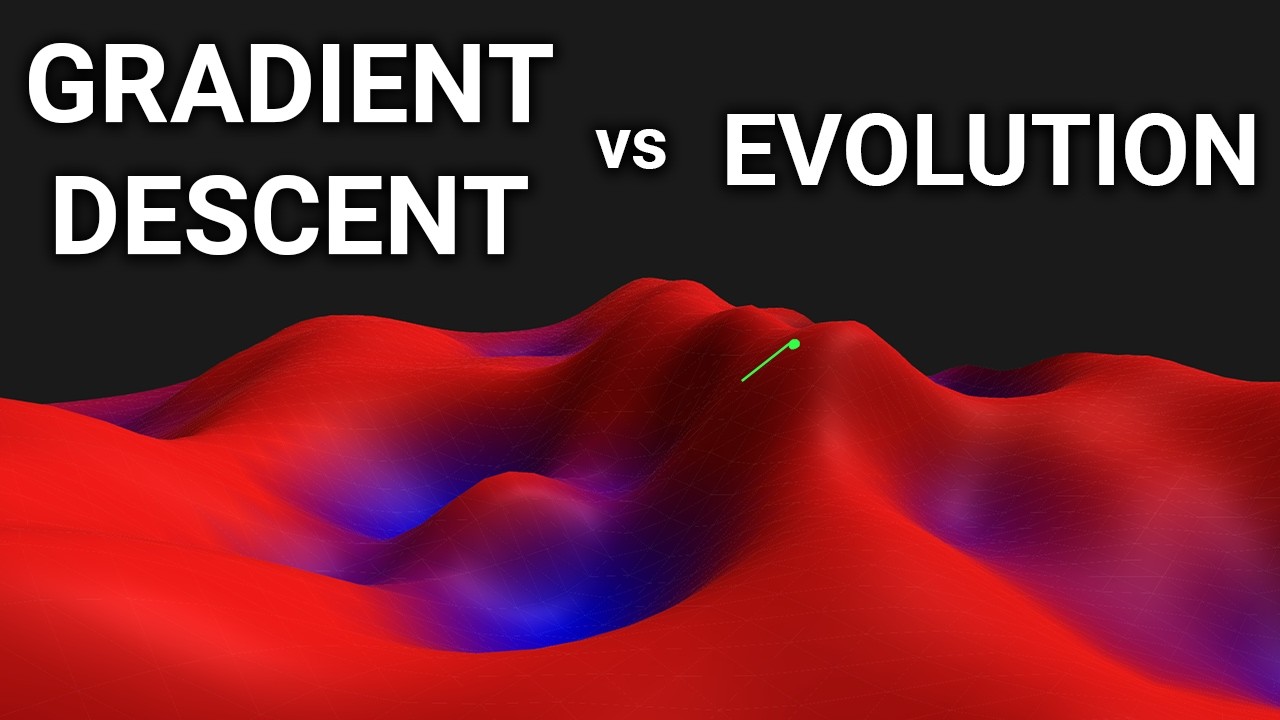
In the video, the creator explores how neural networks learn through optimization algorithms, specifically comparing stochastic gradient descent (SGD) and evolutionary algorithms. The discussion begins with a brief overview of neural networks as universal function approximators, capable of reconstructing any function given enough data points. The creator emphasizes that the learning process involves optimizing the network’s parameters—weights and biases—to minimize the difference between predicted outputs and true outputs, measured by a loss function, typically mean squared error.
To visualize the learning process, the creator introduces a web tool that allows viewers to manipulate a simple neural network with two parameters. This interactive demonstration illustrates the concept of parameter space, where each point represents a different network configuration. The goal is to find the set of parameters that produces the best approximation of a target function, represented as a loss landscape. The creator explains that optimization is fundamentally a search problem, where the algorithm must navigate this landscape to minimize loss.
The video contrasts two optimization strategies: evolutionary algorithms and gradient descent. The evolutionary approach involves random mutations of parameters and selecting the best-performing networks over successive generations. This method, while effective, can be slow and may get stuck in local minima—points where the algorithm cannot find a better solution. In contrast, gradient descent uses the gradient of the loss function to determine the steepest descent direction, allowing for more efficient and direct optimization of parameters.
As the video progresses, the creator demonstrates the application of both algorithms on more complex tasks, such as image generation. While the evolutionary algorithm shows promise, it struggles with higher-dimensional problems, leading to slower convergence. On the other hand, gradient descent, particularly its variant Adam, proves to be more efficient and capable of refining details in the learned function. The creator notes that while both methods have their strengths and weaknesses, gradient descent is generally more effective for training large neural networks.
In conclusion, the video highlights the advantages of gradient descent, particularly its scalability and efficiency in high-dimensional parameter spaces. The creator acknowledges that evolutionary algorithms have unique benefits, especially in scenarios where the loss landscape is not smooth or differentiable. However, for most practical applications, gradient descent remains the preferred optimization method due to its ability to handle complex neural networks effectively. The creator hints at future explorations of advanced evolutionary methods, suggesting that there may still be untapped potential in these algorithms.