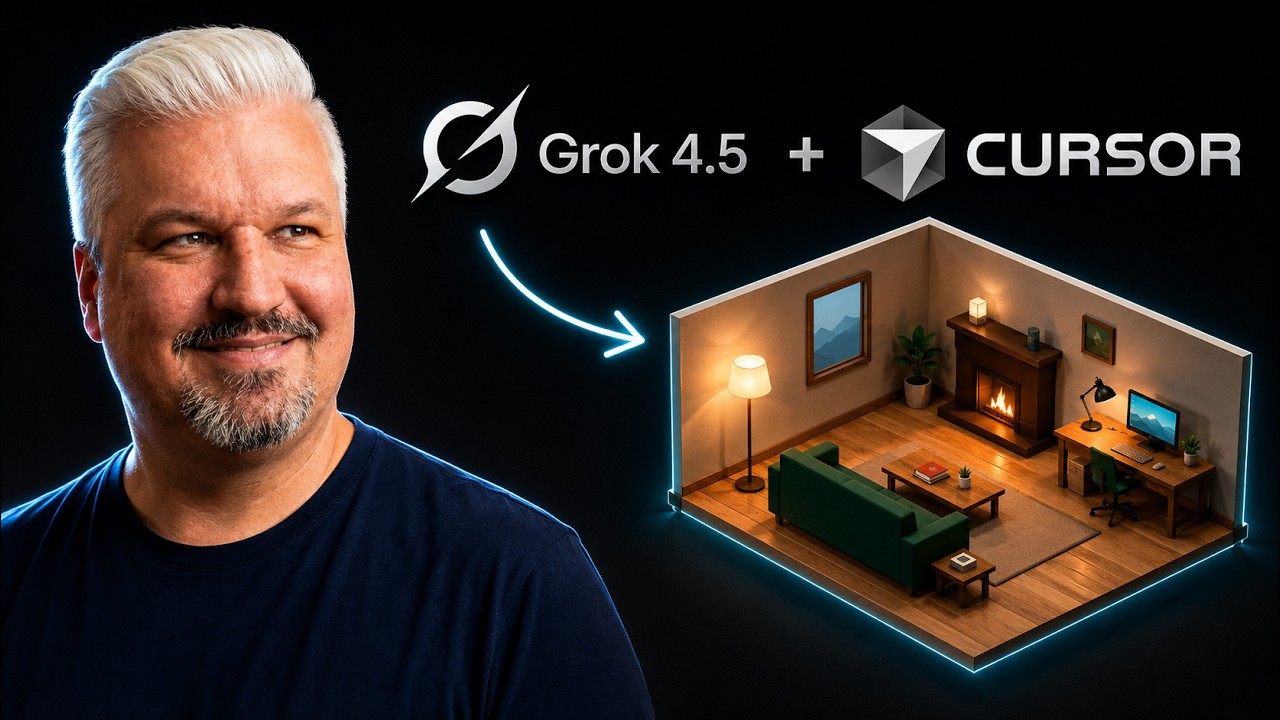
The video showcases the capabilities of Grok 4.5 integrated within Cursor, emphasizing its ability to create complex web projects, including 3D rooms with animations and lighting effects, as well as generating images directly within Cursor. Unlike many videos that focus on benchmarks, this tutorial highlights the practical use of Grok 4.5, starting from a blank project to building and deploying a website. A key advantage of Grok 4.5 is its cost efficiency, being significantly cheaper than competitors like Opus and GPT models, while also requiring fewer tokens to achieve similar results. The model was developed through a collaboration between XAI and Cursor, trained on powerful infrastructure owned by SpaceX and Tesla, resulting in a fast and efficient coding agent.
Users can run Grok 4.5 either through the CLI tool Grok Bolt or via Cursor’s user-friendly interface, which supports conversational interactions with the agent and includes an embedded browser for testing apps. Cursor offers workspace management, multiple agents running in parallel, and an IDE-like view for developers familiar with tools like VS Code. The video focuses on using Cursor, guiding viewers through downloading, installing, and signing in, while noting that Grok 4.5 requires a paid subscription beyond the free tier. The interface allows users to select the model, adjust reasoning effort, and toggle modes such as Planning Mode, which helps manage long-running tasks by creating implementation plans to avoid agent crashes.
The tutorial demonstrates building a website with Grok 4.5, starting with a detailed prompt describing the desired interior design page and 3D elements. The agent quickly generates a plan and begins coding, including generating images for the site, which can be used as avatars, icons, or mock-ups to guide the design system. The video highlights Grok 4.5’s iterative approach, encouraging users to build projects feature-by-feature rather than all at once, due to its smaller context window compared to other models. The agent’s speed allows for rapid iteration and refinement of the website, such as adjusting the 3D scene’s zoom and removing unwanted elements, making the development process smooth and efficient.
Once the website is ready, the video explains how to deploy it using Hostinger, a cost-effective hosting service that offers API integration compatible with Cursor. The setup involves creating a Hostinger account, configuring API access, and linking it with Cursor through a JSON configuration. After authentication, the agent can deploy projects directly to Hostinger, handling commits and pushing changes automatically. This seamless deployment process eliminates the need to manually manage hosting dashboards, enabling users to focus on development while the agent manages production deployment and provides live URLs for the websites.
In conclusion, the video presents Grok 4.5 in Cursor as a powerful, affordable, and user-friendly tool for agentic coding, suitable for both technical and non-technical users. It covers the entire workflow from project setup, iterative development, image generation, to deployment, showcasing the model’s speed and cost advantages. The presenter also mentions additional resources like an agentic coding masterclass and encourages viewers to subscribe for more tutorials, positioning Grok 4.5 and Cursor as a compelling solution for modern web development with AI assistance.