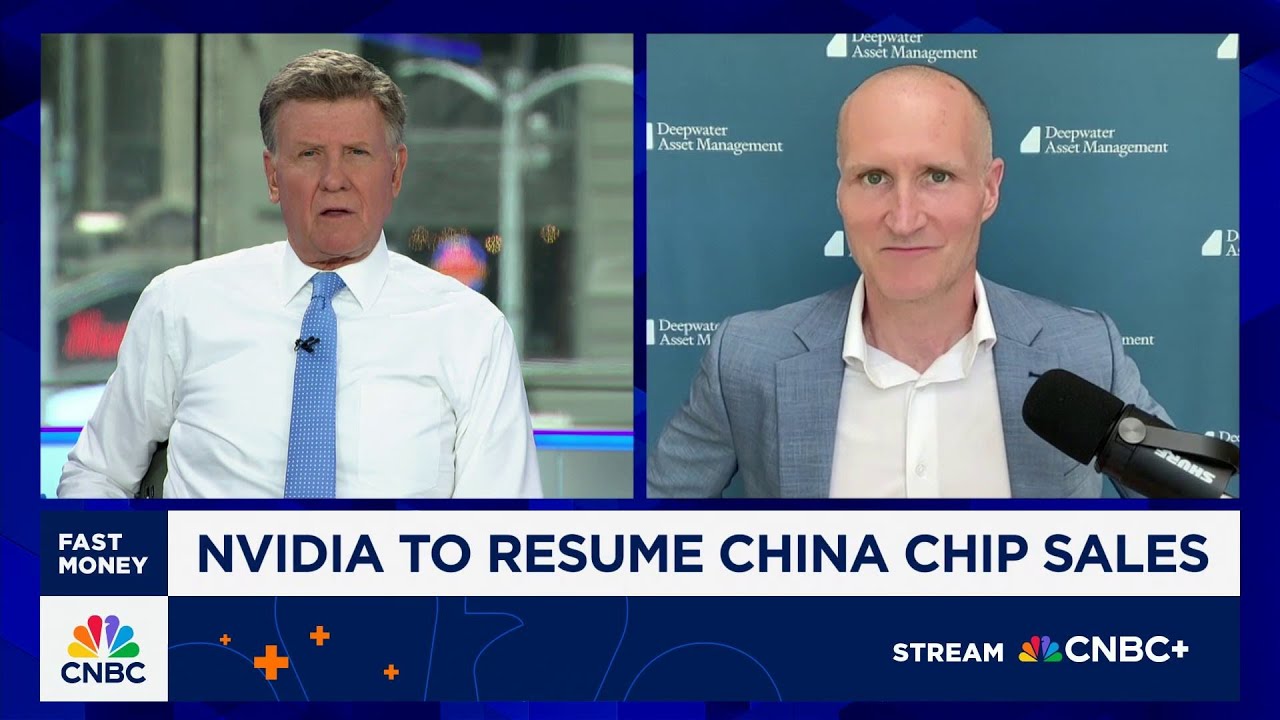
Gene Munster of Deepwater Asset Management highlights Nvidia’s strong growth potential in the AI market, suggesting its business could be 35% larger than current estimates and emphasizing the strategic importance of its chips amid US-China trade dynamics. He also notes the broader AI hardware ecosystem’s role, favoring TSMC over AMD, and underscores that while alternative technologies like DeepSeek exist, cutting-edge Nvidia chips remain essential for advancing AI development.
In the discussion, Gene Munster of Deepwater Asset Management provides insights into Nvidia’s recent performance and its implications for the AI industry. He explains that about 15% of Nvidia’s business involves lower-level chips, particularly those sold indirectly to China, which accounts for roughly a quarter of their business. The recent news about potential recovery of this segment led to only a modest 4% stock increase, partly because the information was anticipated and investors remain cautious about the sustainability of this recovery given geopolitical uncertainties.
Munster highlights the significant growth prospects for Nvidia, noting that analysts expect around 30% revenue growth in 2026 and about 60% in 2025. He suggests that Nvidia’s business could ultimately be 35% larger than current estimates, potentially reaching a market value of $5 trillion or more in the coming years. This growth is tied not only to Nvidia’s core business but also to the broader AI market, which is still in its early stages and has substantial room to expand.
A key point Munster makes is the strategic importance of Nvidia’s chips in the context of US-China relations. China’s willingness to accept lower-tier Nvidia chips as part of trade negotiations underscores the US’s hardware lead in AI technology and the critical role AI will play in future economic and geopolitical landscapes. This dynamic suggests that Nvidia’s influence and market opportunity are far from fully realized, with the AI build-up likely only about 20% complete.
When discussing other companies involved in the AI hardware ecosystem, Munster expresses a preference for Taiwan Semiconductor Manufacturing Company (TSMC) over AMD, citing market share and technological capabilities. He also mentions companies like Vertiv, which provide supporting infrastructure such as cooling solutions, as important players in the AI supply chain. Overall, he emphasizes that while Nvidia is a central figure, the AI revolution involves a broader cast of companies contributing to the infrastructure.
Finally, Munster touches on DeepSeek, a technology aimed at training advanced AI models on less sophisticated hardware. While useful for lagging models, DeepSeek does not yet replace the need for cutting-edge chips that power frontier AI developments. The reliance on these “junior varsity” chips by China further illustrates the ongoing demand for high-performance hardware, reinforcing the idea that Nvidia’s role in AI remains critical and that the market is still in the early phases of growth.