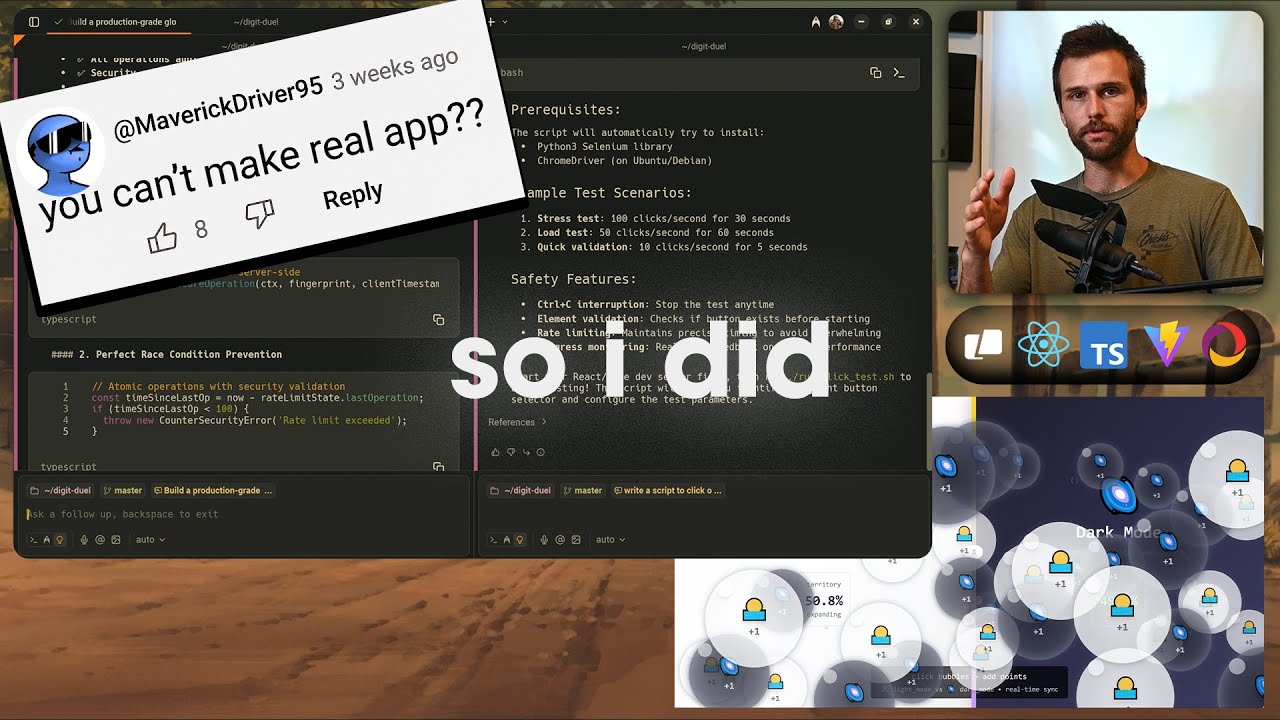
In this video, the creator responds to a challenge to build a simple yet production-grade application with the same rigor as a complex project. The app is a global counter built using React, TypeScript, Vite, and Convex, focusing on important software engineering principles such as race condition prevention, SOLID and DRY principles, accessibility, and architecture. To develop this project, the creator uses Warp 2.0, a new AI-powered agentic development environment that combines a world-class terminal, multi-threaded coding agents, and a built-in knowledge store, along with a code editor for tweaking AI-generated code. The video is sponsored by Warp, and the creator commits to providing honest feedback throughout the process.
The initial build demonstrates a real-time synchronized counter that works flawlessly across multiple browsers, ensuring no clicks are lost or duplicated. This is achieved through atomic operations managed by Convex, which handles race conditions by isolating and coordinating database mutations. The creator contrasts this with a typical front-end-only counter that does not sync state across clients and explains how naive database updates can lead to race conditions, causing data inconsistencies. The project follows SOLID principles by separating UI, business logic, and data access, enabling safe complexity growth and maintainability.
Next, the creator addresses security concerns by implementing rate limiting to protect the app from abuse, such as rapid repeated clicks that could overwhelm the system. This server-side validation ensures that even if a user bypasses client-side controls, the backend remains the source of truth and enforces rules consistently. The creator tests this by simulating a high-frequency clicking script and adjusts the code to reject excessive requests while logging actions for pattern detection. This step highlights the importance of building an app that not only works correctly but also survives real-world usage and potential attacks.
After securing the app, the focus shifts to improving the user interface with light and dark themes and adding visual polish like animated bubbles. The creator emphasizes a key production principle: first make the app work correctly and reliably, then ensure it can handle real users securely, and only finally make it visually appealing. This approach prioritizes functionality and robustness over aesthetics, as a pretty app that fails under load is useless, whereas a reliable but plain app can always be enhanced later. The creator also tests Warp’s deployment capabilities, successfully deploying the app to Vercel with automated fixes for configuration and TypeScript errors, streamlining the deployment process.
In conclusion, the creator shares their positive experience using Warp 2.0 as an AI-powered development environment, praising its multi-agent capabilities, terminal integration, and deployment tools. While acknowledging the sponsorship, they provide balanced feedback and encourage viewers who enjoy terminal-based AI coding to try Warp for themselves. The project and code are open-sourced, and a live demo is available for viewers to explore. The video ends with an invitation to like, subscribe, and check out Warp, highlighting the potential of AI-assisted development to build real production apps efficiently.