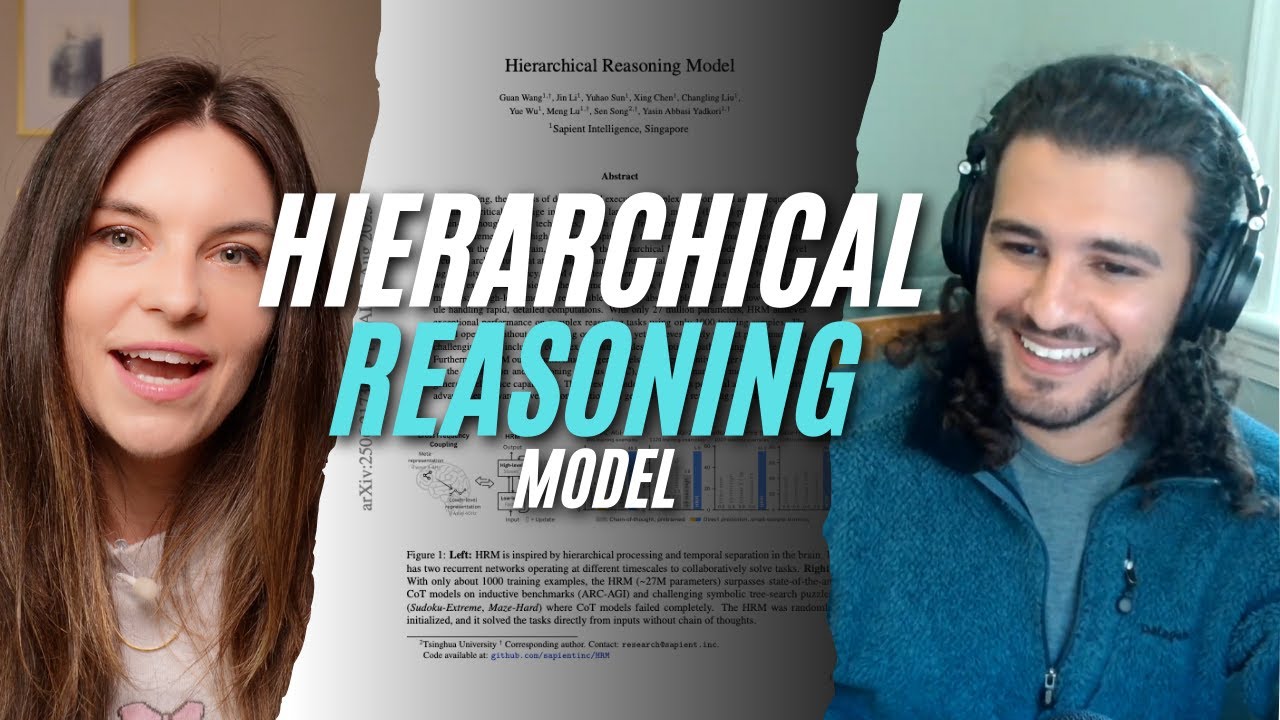
The video discusses the Hierarchical Reasoning Model (HRM), a novel AI architecture developed by Sapient Intelligence, which challenges the prevailing trend of scaling up large language models (LLMs) with massive data and parameters. Unlike typical transformers that rely on large-scale pretraining, HRM is surprisingly small, with only 27 million parameters, trained on just 10,000 data points without pretraining. Despite its modest size, HRM performs competitively on challenging benchmarks like the ARC AGI, sparking both excitement and skepticism within the AI community. The video also explores broader questions about the future of AI research and the standards for trustworthy scientific contributions.
The core limitation of standard transformer models highlighted is their inability to perform certain types of sequential reasoning tasks, such as solving Sudoku puzzles, which require backtracking and deep computational trees. Transformers process data in parallel layers with fixed depth, which restricts their capacity to handle computations that unfold over many sequential steps. While current LLMs use chain-of-thought prompting as a workaround by externalizing intermediate reasoning steps in generated tokens, this approach is inefficient. HRM addresses this by embedding recurrence directly within the model’s latent space, enabling iterative reasoning internally without relying on output tokens as a scratchpad.
Yasine, a neuroscience researcher, explains HRM’s architecture in detail, emphasizing its encoder-only transformer design with latent recurrence that allows repeated processing of inputs without increasing parameter count. The model incorporates a hierarchical structure inspired by neuroscientific findings on theta-gamma coupling in the rat brain, splitting processing into high-frequency and low-frequency modules that interact recurrently. Training uses a one-step gradient approximation to avoid the complexity of backpropagation through time, and an outer loop mechanism enables multiple inference cycles with adaptive computation time, allowing the model to decide dynamically when to stop reasoning.
Data augmentation and puzzle embedding are critical to HRM’s success, compensating for the lack of large-scale pretraining. The model generates numerous transformed versions of training examples through rotations, flips, and color permutations, each tagged with a puzzle embedding that informs the model about the specific task context. This scaffolding enables HRM to perform well on specialized tasks like ARC, although the approach has drawn criticism for potentially violating the spirit of the benchmark by incorporating augmented test samples into training and using task embeddings that reveal the expected output.
In terms of performance, HRM achieves near-perfect accuracy on Sudoku and scores competitively on the ARC AGI leaderboard despite its small size, placing it between larger models from OpenAI and Anthropic. However, concerns remain about the robustness of the evaluation dataset and the fairness of comparisons with general-purpose LLMs. The video concludes that while HRM is not a general language model and its results should be interpreted cautiously, it represents a promising direction for integrating recurrence and hierarchical reasoning into AI architectures, potentially replacing chain-of-thought methods and inspiring future research grounded in neuroscience principles.