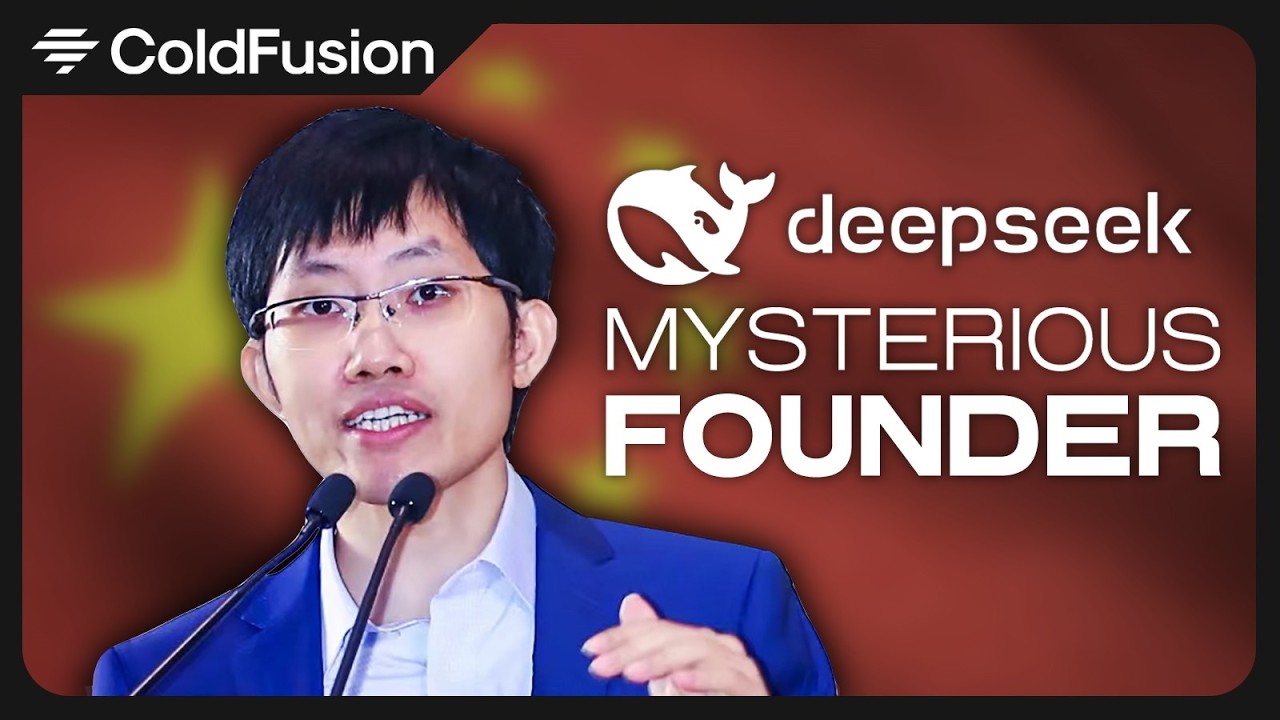
The video tells the story of Liang Fen Wang, a Chinese entrepreneur whose AI system, Deep Seek, disrupted the U.S. stock market and challenged major tech companies by offering competitive AI solutions for free. His journey from a humble background to becoming China’s AI leader highlights a shift in the global tech landscape, emphasizing innovation and originality in China’s technological advancements amidst rising tensions with the U.S.
The video discusses the remarkable story of Liang Fen Wang, a 40-year-old Chinese entrepreneur from M Ling Village in Guangdong Province, who has recently gained global attention for his AI system, Deep Seek. This system reportedly caused a $1 trillion stock market meltdown in the U.S., challenging major American tech giants by offering competitive AI solutions for free. Liang’s unexpected rise has shifted the perceived balance of power in the global AI race, leading to a hero’s welcome upon his return to his hometown during the Chinese New Year.
Liang’s journey began in a modest environment where his parents were primary school teachers. He excelled academically, particularly in mathematics, and attended Xiang University, where he majored in electronic information engineering. His interest in machine learning was sparked during the 2007 financial crisis when he and his classmates explored whether AI could predict market trends better than human traders. This early experimentation led to significant financial success and laid the groundwork for his future endeavors in AI and finance.
After earning his master’s degree, Liang founded a hedge fund called High Flyer, which utilized deep learning models for automated stock trading. His innovative approach positioned High Flyer among China’s leading quantitative analysis firms. However, in 2023, he made a surprising decision to pivot the focus of his hedge fund towards developing artificial general intelligence (AGI), a move that many considered ambitious given the dominance of American tech companies in this field.
Despite facing challenges, including restrictions on access to American GPUs, Liang adapted by reworking his training processes and establishing Deep Seek as a research-focused entity. He embraced an open-source model, contrasting with the closed-source approaches of many American firms, and aimed to foster innovation within China. Liang’s philosophy emphasized the importance of originality over imitation, seeking to elevate China’s role in technological advancements rather than merely benefiting from Western innovations.
As Liang’s influence grew, he was appointed as China’s AI leader, tasked with spearheading the country’s technological breakthroughs. His vision is to transition China from a beneficiary of technology to a contributor, emphasizing the need for core tech innovation. The video concludes by highlighting the potential implications of Liang’s leadership, including the possibility of military applications for AI, and leaves viewers pondering the future of AI development amid rising tensions between the U.S. and China.