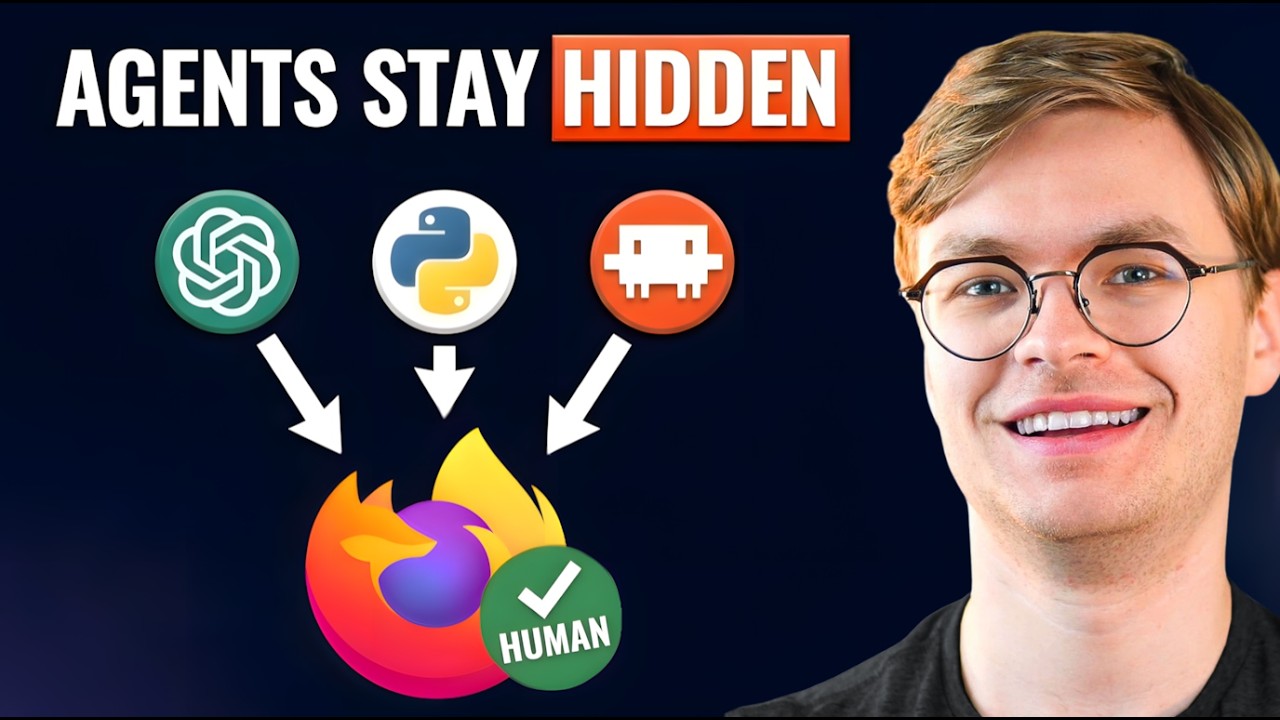
The video explains that AI agents are quickly detected as bots because bot detection relies on multiple subtle browser signals that are difficult to fake consistently, especially at the client-side JavaScript level. It introduces Camoufox, a custom stealth browser based on Firefox that patches these signals at a low level to evade detection, while also noting that advanced real-world systems add further complex layers making bot evasion increasingly challenging.
The video explains why AI agents using automated browsers are quickly detected as bots when loading web pages, unlike everyday human browsers. The key reason is that bot detection relies on a combination of multiple small signals rather than a single clever check. Real human users naturally emit thousands of consistent signals through their browsers, while bots must fake all these signals perfectly. Any inconsistency or contradiction in these signals can immediately flag the visitor as a bot, leading to silent detection without obvious challenges like CAPTCHAs.
Bot detection operates on two main layers: the server layer and the client layer. The server layer inspects HTTP headers such as the user agent string, accept language, and other fetch headers to identify lazy or poorly configured bots. These headers are relatively easy to fake, but missing or malformed headers raise suspicion. The client layer, however, runs JavaScript inside the browser to measure actual behavior and environment details, making it much harder to deceive. This layer checks for various browser and system attributes that bots often fail to replicate accurately.
The video outlines eight specific signals used in client-side detection: the navigator.webdriver flag, framework-specific global variables, WebGL vendor and renderer information, font fingerprints, screen and window geometry, and canvas and audio fingerprints. Each of these checks contributes to a comprehensive fingerprint of the visitor’s device and browser environment. Real devices have unique hardware and software characteristics that bots struggle to mimic consistently, and any mismatch between claimed and actual attributes can reveal automation.
To overcome these detection methods, the video introduces Camoufox, a custom-built stealth browser based on Firefox. Camoufox patches the browser engine at a low level in C++, eliminating contradictions in the eight key signals. Demonstrations show that while a standard Playwright-controlled Firefox browser is quickly flagged as a bot, Camoufox passes the same tests and appears as a genuine human visitor. It achieves this by hiding automation flags, providing realistic GPU and font data, and maintaining consistent fingerprints across all checks.
Finally, the video notes that real-world anti-bot systems like Cloudflare and Akamai add even more complex layers of detection beyond what the browser can see, such as TLS handshake fingerprinting and HTTP/2 frame analysis. These advanced techniques make bot evasion increasingly difficult. The presenter encourages viewers interested in AI engineering to learn these techniques responsibly and offers further resources through a program link, emphasizing that understanding these detection mechanisms is crucial for building effective AI agents that interact with real websites.