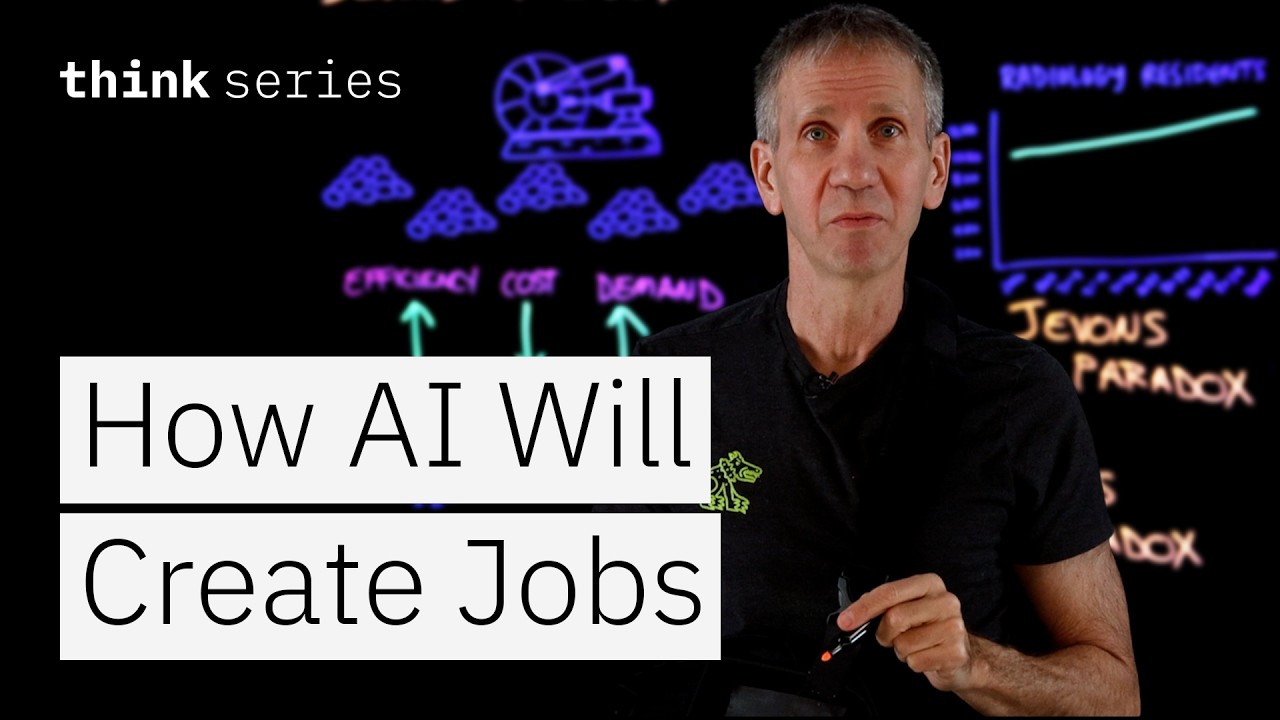
The video begins by debunking the notion that companies can achieve top market positions by simply cutting costs and shrinking their workforce. While operational efficiency and cost reduction are important, true success comes from investing, innovating, and growing. Leading organizations view technology, especially AI, as a tool to enhance employee capabilities and creativity, embracing AI as augmented intelligence rather than a replacement for human workers.
The video references Jeffrey Hinton’s 2016 prediction that AI would soon replace radiologists, noting that a decade later, radiologists are not only still in demand but are being trained in greater numbers. This paradox is explained through Jevons Paradox, an economic principle observed in the 19th century, which states that increased efficiency and lower costs often lead to higher overall demand rather than a reduction in usage. This principle applies to AI, where efficiency gains lead to expanded opportunities and increased demand for skilled workers.
Using the example of spreadsheet software, the video illustrates how automation reduced routine tasks but simultaneously increased the demand for higher-level financial analysis. Similarly, AI is creating entirely new job categories such as AI product managers and prompt engineers, expanding access to personalized services like tutoring and healthcare, and raising expectations for quality and speed. This shift results in fewer routine jobs but more roles requiring critical thinking, oversight, and emotional intelligence.
The video emphasizes that AI will augment human work by reducing labor per task while expanding what is economically feasible, ultimately increasing the total amount of work and demand for skilled employees. Organizations that understand this dynamic will seek more adaptable, lifelong learners who can think critically, creatively, and maintain human control over AI systems. These employees will excel in roles involving problem framing, decision-making, and cross-functional coordination.
In conclusion, the video warns that companies focused solely on cutting costs risk missing the transformative opportunities AI offers. Instead, smart organizations will invest in innovation and new business models enabled by AI, while employees who continuously upskill and embrace AI as a collaborative tool will thrive. The future belongs to those who leverage AI to augment human intelligence and creativity rather than replace it.