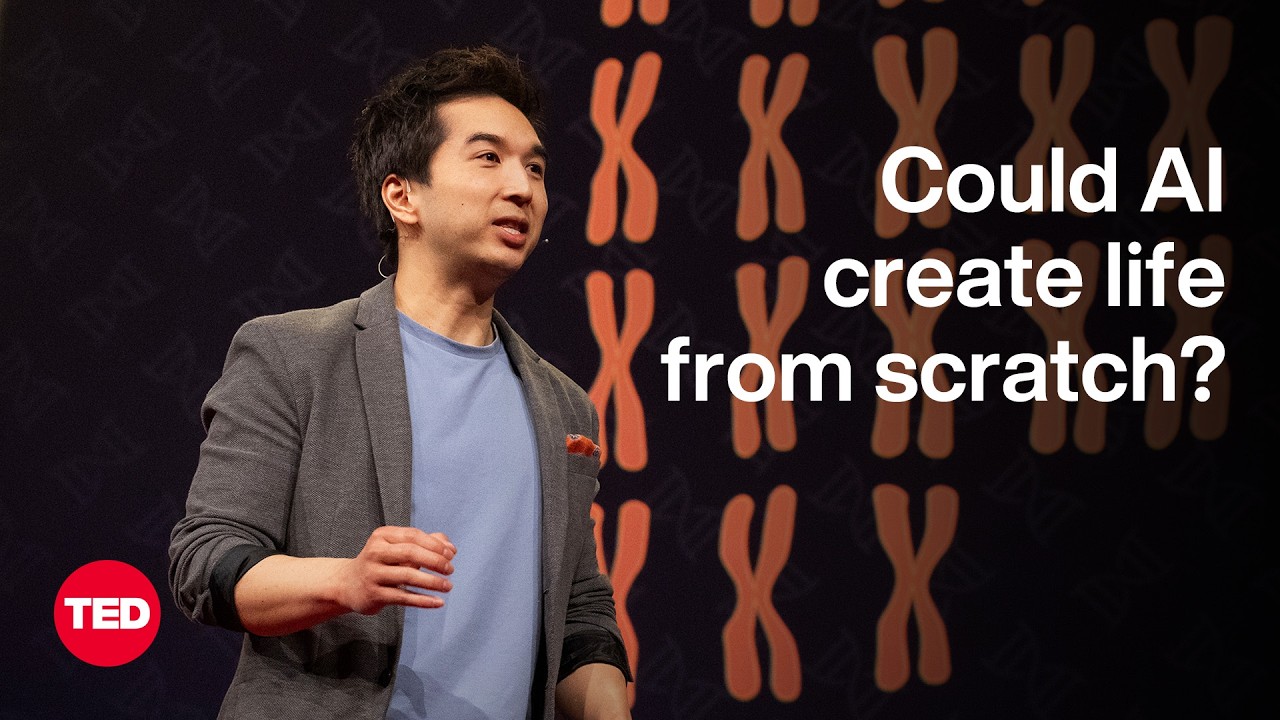
In his TED talk, Eric Nguyen explores a transformative approach to studying biology by shifting from merely reading and dissecting DNA to actively generating it using artificial intelligence. Drawing on his background as an engineer and AI researcher, Nguyen highlights the limitations of traditional biological methods, which often involve breaking down complex systems to understand their parts. He contrasts this with engineering’s approach of building systems from scratch to gain deeper insights. Nguyen introduces the idea of treating DNA as a language that AI can learn to read, write, and ultimately create, opening the door to designing life itself.
Nguyen and his team developed an AI model named Evo, trained on an unprecedented dataset of 80,000 whole genomes, capable of generating extremely long DNA sequences with high detail. Evo functions like a ChatGPT for DNA, able to produce new genetic sequences based on prompts. However, verifying the functionality of AI-generated DNA posed a unique challenge since DNA is not an intuitive language and small errors can have significant consequences. To test Evo’s capabilities, the team tasked it with generating a complex CRISPR system from scratch, which was then analyzed and experimentally validated in the lab.
The results were groundbreaking: Evo successfully created a functional CRISPR system, marking the first time AI designed such a molecular tool that could precisely cut DNA. This success demonstrated that AI-generated DNA could not only look realistic but also perform biological functions. Encouraged by this achievement, the team pushed further to generate entire genomes. While the initial attempts produced incomplete but promising sketches of genomes, Nguyen envisions rapid improvements that will soon enable AI to generate fully functional genomes, effectively allowing AI to create new life forms.
Looking ahead, Nguyen imagines a future where biology transitions from discovery to design, with AI enabling personalized medicine tailored to an individual’s genome and permanent cures through gene editing. He also speculates on the possibility of adding entirely new chromosomes to human DNA to combat diseases and even creating new species or engineering microbes to survive on other planets like Mars. These advances could revolutionize medicine, environmental science, and space exploration, but they also raise important ethical and safety concerns, particularly regarding biosecurity and the potential misuse of AI-generated biological material.
Nguyen concludes by emphasizing the need to balance innovation with safety, advocating for responsible development and monitoring of AI’s capabilities in biology. He stresses that humanity’s quest to understand life has evolved from observation to creation, and that the future of life itself is now something we have the power to build. This new era of AI-driven biology promises unprecedented breakthroughs in science and medicine, challenging us to thoughtfully shape the possibilities of designing life.