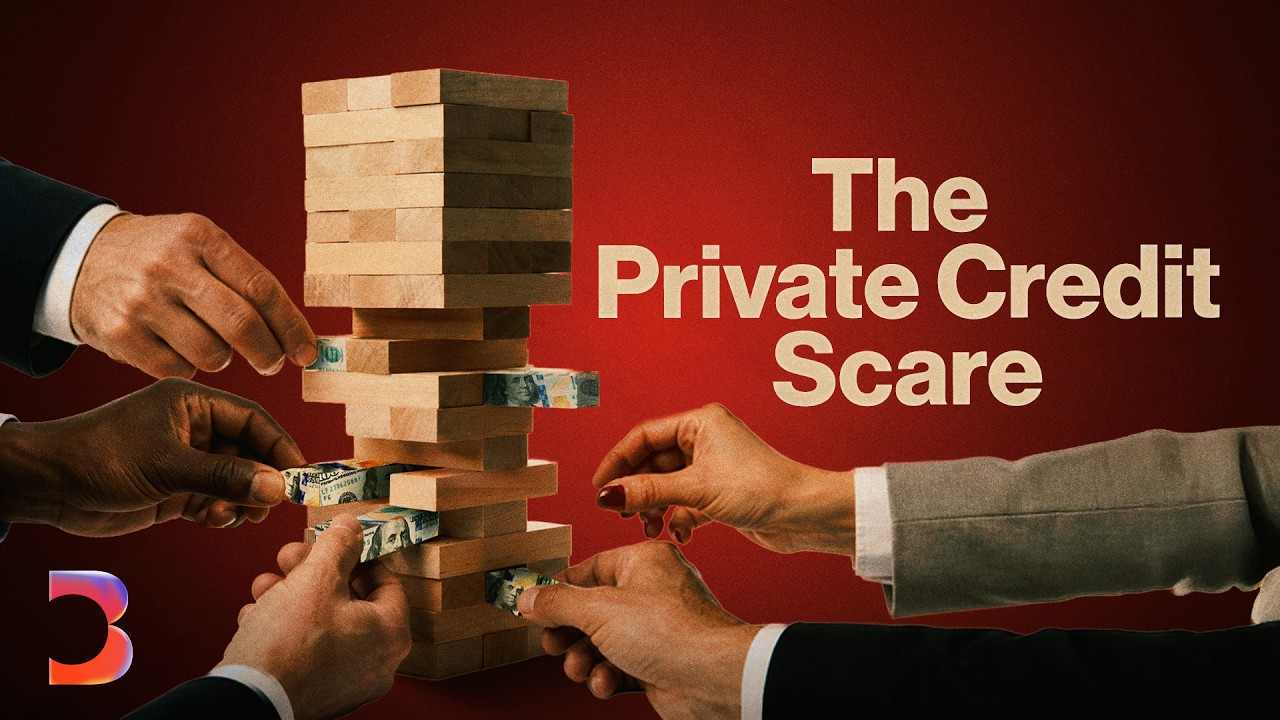
The $1.8 trillion private credit market, which involves non-bank lending directly to companies, is currently facing its biggest crisis of confidence. Private credit firms, such as Blue Owl, Blackstone, and Apollo, have become major lenders to software companies, often backed by private equity. However, the rise of AI has introduced existential risks that threaten the growth trajectories of these companies, causing retail investors to pull their money out and prompting firms to limit withdrawals and sell assets to meet redemption requests. This crisis has led to sharp declines in share prices and widespread concern across the industry.
Private credit refers to lending that bypasses traditional banks, involving direct loans from institutional investors or private credit funds to companies. This market has grown significantly since 2015, expanding from around $500 billion to $1.8 trillion today, with potential opportunities estimated as high as $40 trillion across various sectors like supply chain finance, consumer loans, and even music royalties. The market’s growth was partly fueled by regulatory changes after the 2008 financial crisis, which pushed banks to reduce risky lending, allowing private credit to fill the gap and become a central part of the global financial system.
The private credit market has been particularly attractive to software companies that exhibit strong revenue growth but lack profitability, a segment traditional banks often avoid. Firms like Blue Owl saw their assets under management triple between 2019 and 2023, coinciding with the rapid rise of AI technologies valued in the hundreds of billions. However, the AI revolution has cast doubt on the sustainability of these investments, leading to increased scrutiny of loan underwriting practices and concerns about overly optimistic growth assumptions.
A major challenge for private credit is its opacity and lack of transparency. Loans are bespoke, private agreements that do not trade on public markets, making it difficult to assess their true value. Recent collapses of companies like Tricolor and First Brands have raised alarms about hidden leverage and underwriting quality within the broader credit markets. Critics, including JPMorgan CEO Jamie Dimon, have warned that these failures might be just the beginning, drawing parallels to the lead-up to the 2008 financial crisis and highlighting the potential for more widespread problems.
Despite these concerns, some experts argue that the private credit market is fundamentally different from the pre-2008 banking system because the risk is borne by investors rather than banks holding deposits. While losses are possible, investors are generally better positioned to absorb them. Nonetheless, the market is expected to face significant challenges in the coming years, with the best days likely behind it as it navigates the uncertainties brought on by AI disruption and increased investor skepticism.