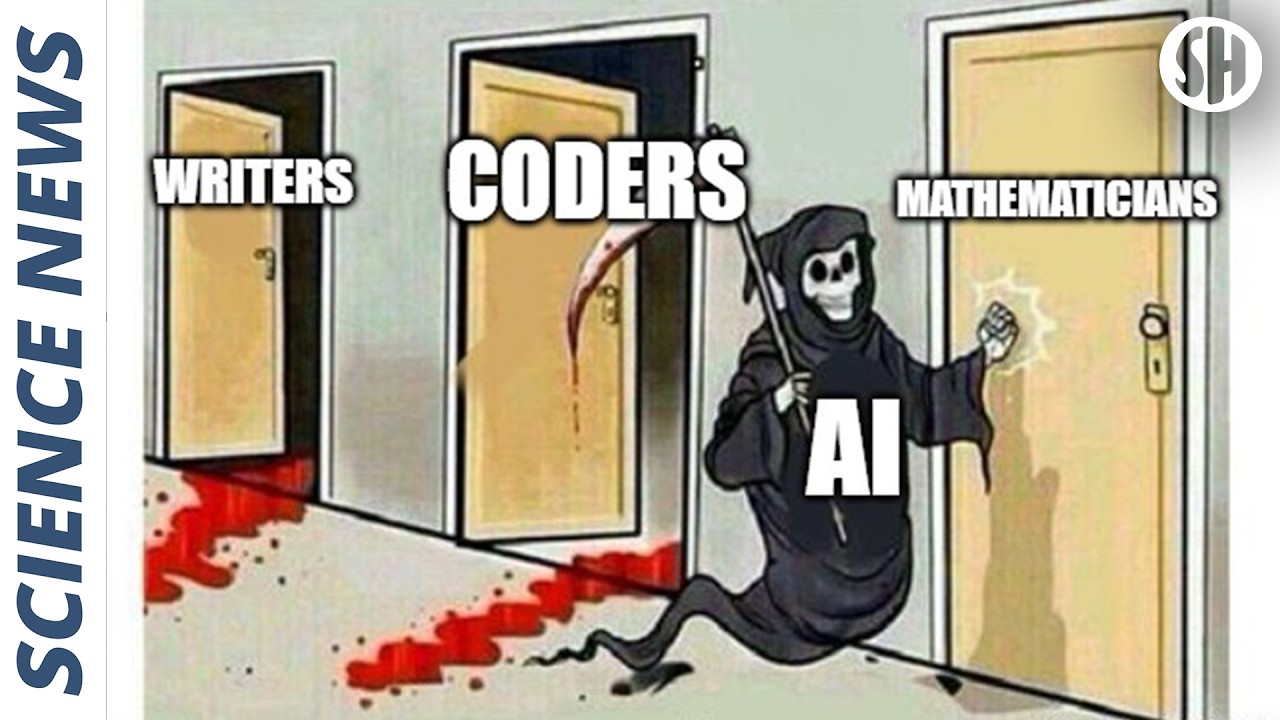
The video discusses the significant impact artificial intelligence (AI) is having on the field of mathematics, particularly in research and theorem proving. It draws a parallel between how calculators replaced human calculators and how AI theorem-proving machines are poised to replace much of the mathematicians’ work. Although not all mathematical work will be replaced, a substantial portion is likely to be automated. Despite this, many mathematicians remain in denial about the extent to which AI will transform their profession.
Earlier in the year, both Google DeepMind and OpenAI demonstrated AI systems that achieved gold medal-level performance on mathematics Olympiad problems. What surprised many was that these AI models were general-purpose reasoning systems rather than specialized ones. However, some mathematicians remain unimpressed, arguing that these problems are not comparable to the complex questions professional mathematicians tackle. Others, like Fields Medalist Terrence Tao, acknowledge the AI’s speed and collaborative-like proof generation but maintain that human mathematicians still hold unique value.
DeepMind’s recent announcement of a method to find singularities in classic fluid equations, related to the famous Millennium Prize problem concerning the Navier-Stokes equations, has stirred excitement and concern. Although their work focused on two-dimensional fluid equations rather than the Navier-Stokes equations themselves, it signals AI’s growing capability in tackling deep mathematical problems. Some mathematicians are embracing this shift by working on automatic theorem proving, supported by grants from organizations like the NSF and private foundations, while others worry about the quality and reliability of AI-generated mathematics papers.
A key criticism of current AI models, particularly large language models (LLMs), is that they do not truly understand logical correctness and may produce answers even to ill-posed questions without flagging issues. Moreover, AI-generated proofs might lack explanations that humans can comprehend, which is crucial since understanding is central to the mathematical endeavor. While some argue that a proof is a proof regardless of comprehension, mathematics is often seen as both an art and a sport, where the process and insight matter as much as the result.
Looking ahead, the video suggests that mathematics as a discipline will not disappear but will evolve, with mathematicians increasingly outsourcing routine work to AI and focusing on interpreting and validating AI-generated results. This shift may make mathematics more empirical, akin to physics, which some find difficult to accept. Ultimately, AI represents a new phase in human civilization, and adapting to this change will be essential. The video concludes by recommending Brilliant.org as a resource for learning more about mathematics, science, and computer science through interactive courses.