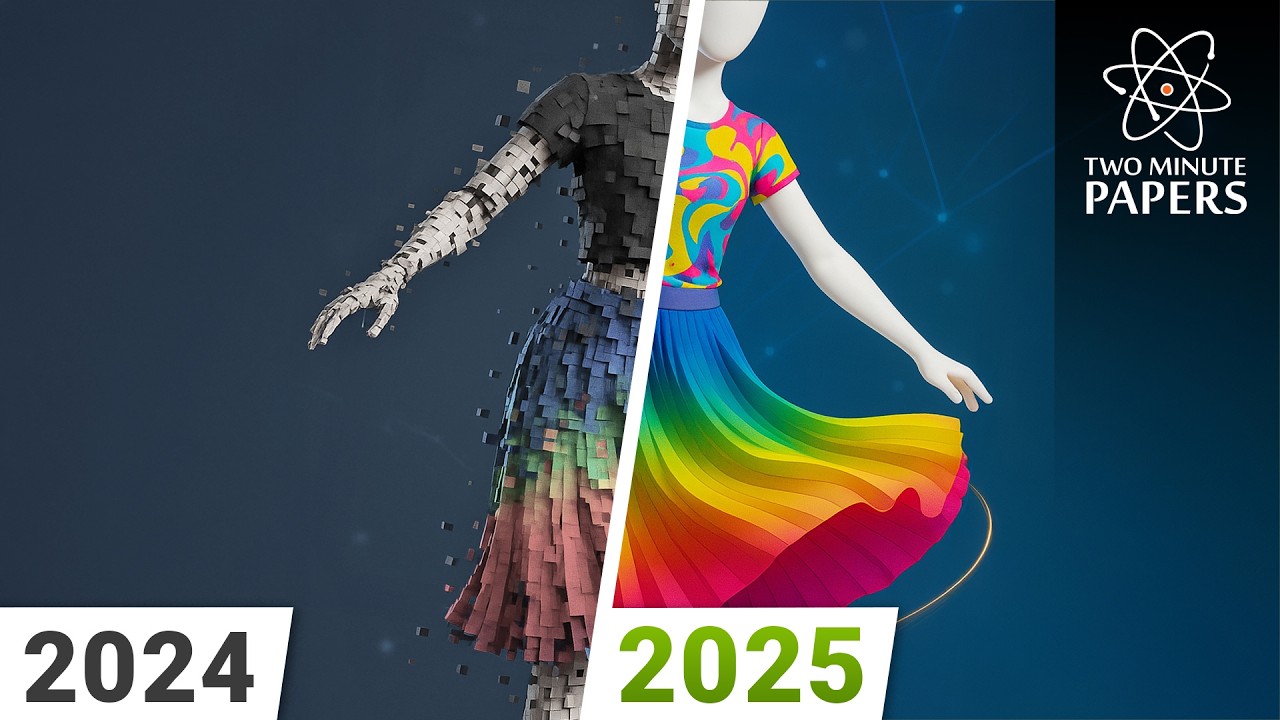
The video explores a groundbreaking advancement in digital fashion for games, where AI and human ingenuity combine to create realistic, simulation-ready 3D clothing from just a single photo. Traditional “image-to-3D” models could generate 3D humans but often merged clothes and bodies into one rigid piece, preventing realistic simulation like fluttering or wrinkling during movement. This limitation made digital fashion less convincing and unusable for dynamic animations, leaving the dream of physics-ready, wearable, and separable garments out of reach—until now.
The new method, developed by researchers from UCLA and the University of Utah, uses a novel approach to reconstruct not only a 3D human but also physically accurate, simulation-ready clothes that are separated from the body and ready to move naturally. The process begins by guessing an initial sewing pattern from the input image, akin to a digital tailor cutting fabric pieces. Although the initial fit can be rough and inaccurate, the system refines the garment shapes using differentiable physics and multi-view diffusion guidance, adjusting seams and curves to better match the character’s pose and clothing style.
Multi-view diffusion guidance allows the AI to imagine the subject from multiple angles, effectively creating a 3D understanding of the garment’s shape and appearance. Meanwhile, the physics-based cloth simulator, called Codimensional Incremental Potential Contact (CIPC), optimizes the garment’s resting position by minimizing system energy, ensuring the fabric behaves realistically by preventing penetration of the body and maintaining elasticity and bending. This combination of AI vision and physics simulation enables the creation of digital outfits that look and move convincingly in virtual environments.
Despite its impressive capabilities, the system is not perfect. It struggles with out-of-distribution fashion items like feather jackets or jellyfish costumes, where the AI’s predictions become less reliable. Additionally, some details, such as sleeve length, may still be inaccurate. However, the researchers behind this work are pioneers in physics-based animation, building on previous models that prevent fabric clipping and chaos in simulations. Their work represents a crucial but often overlooked area of computer graphics research that is essential for advancing realistic virtual fashion.
An intriguing feature of this system is its ability to “self-heal” clothing during the simulation process. If the cloth mesh tangles or the simulation encounters problems, the AI tailor can automatically re-sew and adjust the garment mid-process, preventing crashes and wardrobe failures. This robustness allows the entire process to run on a single RTX 3090 GPU within about two hours, making it practical for real-world applications. Overall, this breakthrough marks a significant step forward in creating lifelike, physics-ready digital fashion for games and virtual environments.