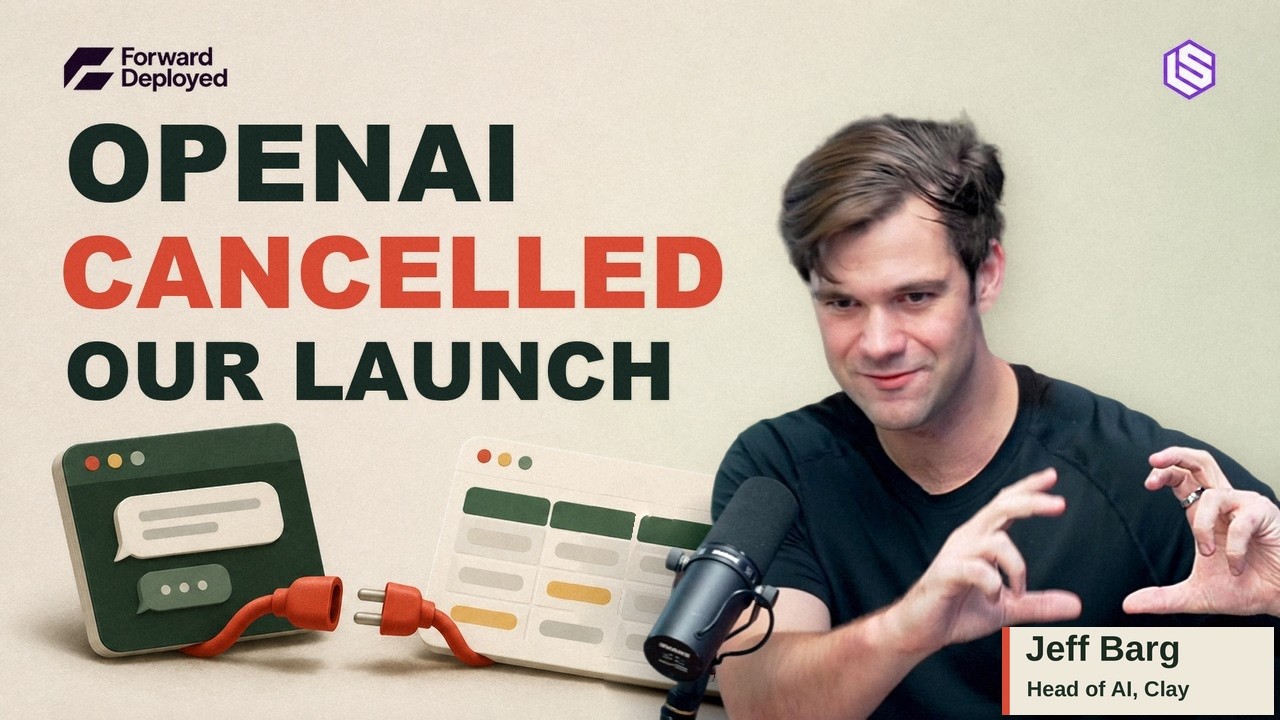
Jeff Barg, Head of AI at Clay, discusses how Clay leverages AI and agents to empower go-to-market (GTM) engineers in building scalable revenue systems. Clay, originally a low-code spreadsheet tool for prospecting and qualifying companies, has evolved into a flexible platform integrating numerous data providers to enrich company and contact lists. The company focuses on serving the GTM engineer persona—professionals who combine software engineering, data engineering, and agent prompt engineering to automate and optimize customer acquisition processes. Jeff highlights Clay’s unique position in the market by enabling users to build complex workflows and plays that go beyond traditional sales and marketing tools.
Jeff shares his journey from co-founding Avenue, a company focused on operational observability, to joining Clay through acquisition. At Clay, his team helped build the Signals product, which monitors market events like new hires or promotions to trigger sales plays. This product laid the groundwork for more advanced agent-driven workflows. Over time, Clay rebuilt its agent architecture, moving from simpler tool-loop models to sophisticated coding agents capable of orchestrating complex GTM workflows. This evolution was driven by the need for greater expressivity, scalability, and integration with diverse data sources such as CRM and Gong.
A significant part of Clay’s AI strategy involves balancing model capabilities and cost efficiency. Jeff explains their exploration of open-weight models and post-training techniques to reduce inference costs while maintaining performance. They also emphasize the importance of model routing—selecting the best model for specific tasks—to optimize results. Despite offering a model selector, most users prefer an “auto mode” where Clay chooses the appropriate model, reflecting a broader trend of simplifying AI usage for end customers. Jeff notes that while frontier intelligence is crucial for high-level orchestration and creative GTM plays, many qualification tasks can be handled effectively by less complex models.
Clay’s agent infrastructure is designed to be flexible and extensible, supporting both internal and external agents without aiming to outperform users building their own workflows with Clay’s CLI or Cloud Code. This openness fosters a diverse ecosystem where users can customize their GTM automation. Jeff also discusses operational challenges such as handling spiky inference workloads, ensuring fairness among customers, and maintaining robust observability with tools like Langsmith. The team builds much of their infrastructure in-house, including data pipelines and orchestration, favoring custom solutions over off-the-shelf products to meet their specific needs.
Finally, Jeff emphasizes the importance of institutional courage and continuous iteration in AI product development. He recounts experiences like the abrupt postponement and quick reinstatement of a ChatGPT app launch, illustrating the dynamic and uncertain nature of AI partnerships. Looking ahead, Clay plans to launch a re-architected Sculptor product featuring a powerful coding agent to enhance GTM workflows further. Jeff envisions a future where GTM engineers leverage increasingly sophisticated AI tools to automate complex sales plays, supported by rigorous evaluation frameworks and community collaboration to drive ongoing improvement.
Useful Links